
OpenAI’s latest leap in artificial intelligence is not just about creating images — it is about rewriting the rules of visual communication.
With the rollout of ChatGPT Images 2.0, the company has introduced a model that does something AI systems have historically struggled to achieve: generate clean, readable, and contextually accurate text inside images. For years, distorted lettering and nonsensical typography were telltale signs of AI-generated visuals. That limitation may now be disappearing.
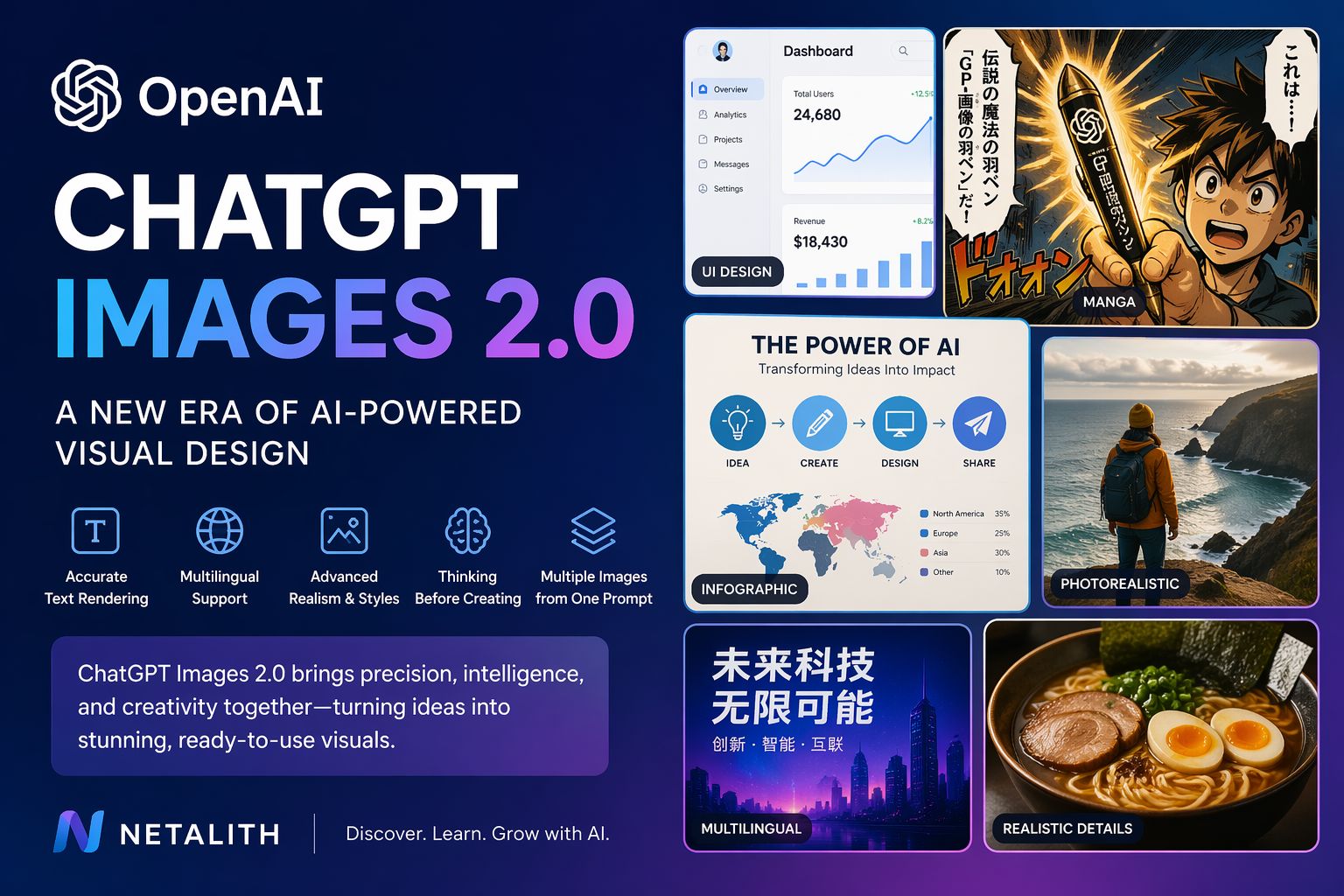
The new model, unveiled this week, combines image generation with reasoning capabilities, allowing it to interpret complex prompts and produce structured visuals — from posters and advertisements to comic panels and interface mockups — with striking precision. Within the broader ChatGPT ecosystem, this marks one of the most significant upgrades to visual intelligence so far.
In demonstrations and early testing, the system has shown a remarkable ability to render small text, user interface elements, and dense compositions — areas where earlier models routinely failed. The improvement is not incremental. It signals a shift in how AI-generated visuals can be used across industries.
A Breakthrough in AI’s Longstanding Weak Spot
The defining feature of ChatGPT Images 2.0 is its typography. OpenAI says the image generation model can now produce precise, immediately usable visuals, including accurately rendered text, icons, and layouts.
The system also introduces what many are calling advanced thinking capabilities — a reasoning layer that allows the model to plan outputs before generating them. This added step can slow generation slightly, but it significantly improves accuracy and coherence in complex visual tasks.
In practical terms, the model behaves less like a random image generator and more like a design assistant that understands structure.
From Viral Art to Professional Tool
Earlier waves of AI image tools were largely defined by novelty — surreal art, fantasy portraits, and social media experiments. ChatGPT Images 2.0 appears aimed at something more practical.
The model can generate multiple consistent images from a single prompt, making it suitable for projects like comic strips, branding kits, or multi-page layouts. It also supports multilingual text rendering, enabling outputs in languages such as Hindi, Chinese, and Japanese — a feature that expands its global usability.
According to early hands-on reports, the system can create everything from faux newspapers to detailed infographics, though it occasionally pulls outdated information when referencing external data.
Still, the broader implication is clear: AI-generated visuals are moving beyond experimentation into real-world workflows.
The Rise of “Thinking” Images
At the core of the upgrade is a deeper integration of reasoning into image generation. Instead of producing visuals in a single pass, the model can analyze prompts, plan compositions, and refine outputs.
This shift reflects a broader trend in artificial intelligence — merging generative capabilities with structured reasoning. OpenAI has indicated that the model can even verify aspects of its output by referencing available data.
The result is a system capable of producing visuals that feel intentional rather than approximate.
A Double-Edged Sword
Yet the same realism that makes the model powerful also raises concerns.
OpenAI has demonstrated the tool’s ability to generate hyper-realistic images, including fake screenshots and fabricated magazine-style visuals that closely mimic real-world media. The implications for misinformation are immediate.
If earlier AI images could be spotted by their flawed text, the new generation removes one of the most reliable detection signals. That could make it significantly harder to distinguish authentic visuals from synthetic ones.
Legal and ethical questions are also emerging. While OpenAI maintains that the model does not replicate specific copyrighted works, experts warn that stylistic similarities and realistic outputs may still challenge existing intellectual property frameworks.
The Competitive Landscape Heats Up
The release comes amid intensifying competition in the AI image space. Rivals are rapidly advancing their own models, and the lead for any one system is often short-lived.
Still, ChatGPT Images 2.0 positions OpenAI at the forefront of a new phase in generative AI — one where the goal is not just creativity, but usability.
The model is now available across ChatGPT and its API, with advanced features reserved for paid tiers.
A Shift in Who Gets to Create
Perhaps the most profound impact of ChatGPT Images 2.0 is not technical, but cultural.
By lowering the barrier to producing polished, text-rich visuals, the tool expands who can participate in design and content creation. Tasks that once required specialized skills — from building marketing assets to drafting product mockups — can now be accomplished with a well-written prompt.
That does not eliminate the need for designers or editors. But it changes the starting point.
In the emerging landscape shaped by AI, the first draft is no longer a blank canvas. It is already generated — complete with images, layout, and now, finally, readable text.