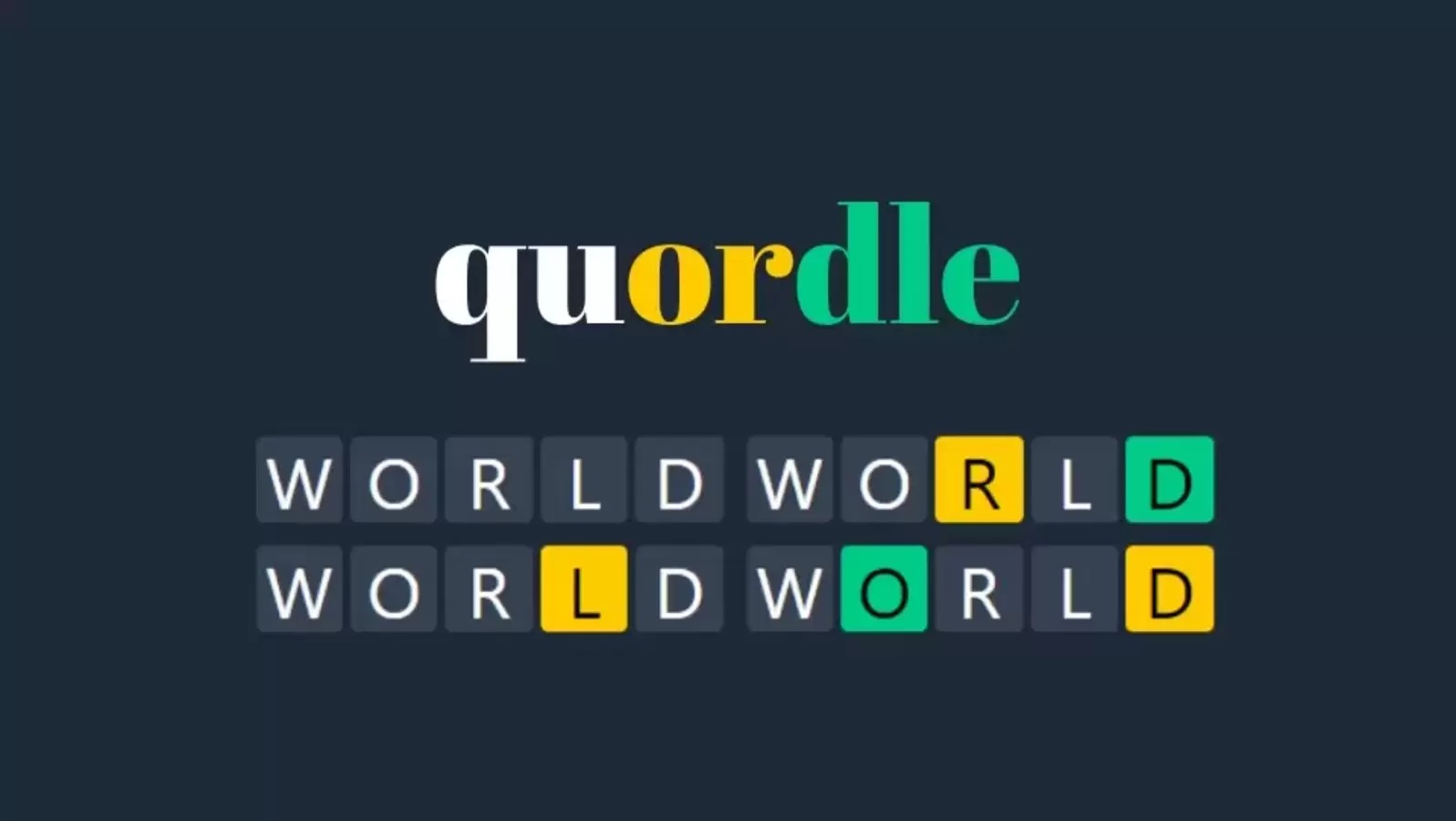
The Quordle puzzle for 16 May 2026 has reinforced a familiar truth about modern word-game design. What appears structurally simple on the surface quickly evolves into a layered test of memory, pattern recognition, and constraint management. Today’s solution set, consisting of DEMUR, THREE, SLEEP, and CRUDE, exposes how repetition and vowel clustering can distort even experienced solving strategies.
The game continues to sit within the broader ecosystem of the Wordle-style daily word puzzle format, where each iteration is designed to test cognitive flexibility under limited attempts. While Quordle expands the challenge by multiplying grids, its underlying logic remains rooted in elimination efficiency rather than vocabulary difficulty.
Today’s set confirms a medium to high difficulty rating based on structural interference rather than lexical obscurity. Players were forced to navigate repeated-letter traps, overlapping vowel placements, and deceptive semantic familiarity that disrupted early-stage solving confidence.
Solution set overview and structural breakdown
The confirmed answers for today’s Quordle are DEMUR, THREE, SLEEP, and CRUDE. Each word plays a distinct functional role within the puzzle architecture, balancing familiarity with deliberate misdirection.
The solution set pattern continues a recent trend in which Quordle puzzles rely less on obscure vocabulary and more on controlled structural interference. This approach shifts difficulty from knowledge recall to pattern verification under uncertainty.
At the center of today’s difficulty is a phenomenon best described as structural complexity. Rather than presenting rare or technical words, the puzzle introduces familiar terms arranged in ways that force repeated re-evaluation of letter placement.
Repetition pressure and cognitive disruption
Two of today’s answers, THREE and SLEEP, rely heavily on repeated letters. This creates what experienced solvers often describe as repetition pressure, where early correct letters mislead players into overconfidence about grid structure.
In THREE, the repetition of E distorts positional certainty. In SLEEP, the dual E structure creates a bottleneck effect, forcing solvers to test multiple permutations before convergence becomes possible. These designs are not accidental. They function as controlled friction points that slow linear solving approaches.
This is where Quordle diverges from simpler word puzzles. It does not simply test recognition; it tests correction under iterative feedback loops.
DEMUR as the semantic pivot
DEMUR introduces a tonal shift within the puzzle. Unlike the other solutions, it operates in a more abstract lexical category. Its meaning, associated with hesitation or refusal, subtly reflects the solver’s own experience when faced with conflicting grid signals.
Within today’s configuration, DEMUR functions as an anchor of semantic neutrality. It does not align with numerical patterns like THREE, nor does it exhibit repetition density like SLEEP. Instead, it occupies a stabilizing role that resists clustering logic.
CRUDE and the illusion of simplicity
CRUDE appears straightforward but plays a strategic role in the puzzle’s difficulty curve. Its balanced consonant structure encourages premature classification as an “easy” word, which often leads to misallocated guesses in early rounds.
This deceptive simplicity is central to modern puzzle design. It aligns with broader Quordle puzzle game mechanics, where difficulty is not derived from obscurity but from psychological misdirection embedded in familiar language structures.
Strategic takeaway from today’s puzzle
The most effective solving approach today required strict prioritization of positional elimination over semantic intuition. Players who relied on vocabulary familiarity were consistently outperformed by those who systematically tested letter positions under constraint conditions.
As reflected in broader difficulty analysis, Quordle increasingly rewards structural discipline over linguistic instinct. The presence of repeated-letter clusters reinforces the need to treat each grid independently rather than infer cross-grid symmetry too early.
This shift aligns with broader trends in digital word puzzles, where designers increasingly emphasize cognitive load distribution rather than vocabulary expansion. The result is a game that feels accessible at entry but progressively restrictive under sustained play.
Puzzle design evolution and broader context
Today’s configuration also reflects an ongoing evolution in puzzle construction philosophy. Rather than relying on rare or technical vocabulary, designers are leaning into predictable words arranged in structurally disruptive patterns.
This approach creates what can be described as controlled unpredictability. Players recognize the words but cannot easily resolve their placement without iterative correction cycles. It is a design model that prioritizes engagement through friction rather than challenge through obscurity.
The broader ecosystem of daily word games continues to evolve in parallel with this approach, reinforcing a shared logic of constraint-based reasoning rather than pure lexical recall.
Conclusion
The 16 May 2026 Quordle puzzle demonstrates a clear design trajectory: simplicity of vocabulary paired with increasing structural complexity. With DEMUR, THREE, SLEEP, and CRUDE, the game constructs a compact but cognitively demanding challenge that rewards disciplined elimination strategies over intuition.
As the Quordle format continues to mature, its difficulty increasingly resides not in what words are used, but in how those words are arranged to disrupt expectation. Today’s puzzle is a precise example of that shift in action.