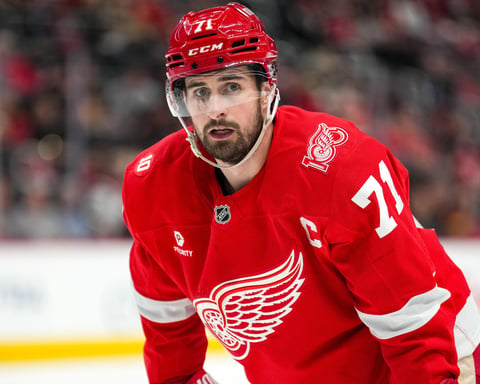

DETROIT — Before the phone calls started in earnest, before the agent meetings and the competing term sheets, the Detroit Red Wings discovered something inconvenient about trading their franchise captain. The teams most likely to want Dylan Larkin are not always the teams he is willing to go to. And the teams willing to offer the best return may not be on his list at all.
That is the central tension now shaping what could be the most consequential trade of Steve Yzerman’s tenure as general manager. With the 2026 NHL Draft in Montreal less than three weeks away, Detroit is running a compressed auction with a buyer pool Larkin himself has already filtered. Sportsnet’s Elliotte Friedman, who first broke the trade request earlier this month, reported this week that Larkin has narrowed his preferred destinations to a short list of roughly three teams. That detail, quiet as it sounds, carries significant weight in a negotiation where Detroit was already working from a position of diminishing time.
Larkin’s no-movement clause is the structural fact that governs everything else. He gets to decide where he goes, and that right doesn’t expire until his contract does. Yzerman cannot simply put the best offer on the table and call Larkin with the result. He has to find a team that can both satisfy Detroit’s asking price and pass Larkin’s test simultaneously. That is a much smaller intersection than it might appear from the outside.
The draft deadline matters because first-round picks are not equivalent commodities. A top-10 selection from a rebuilding team like the Florida Panthers or Seattle Kraken — both of whom hold high-value picks in the 2026 class — is a fundamentally different asset than a first-round pick from an established contender that will likely land near pick 28. Detroit needs young talent that can contribute to the Moritz Seider and Lucas Raymond era, not a decade of late first-rounders from playoff teams. The draft is where that calculus crystallizes. After it passes, the premium picks disappear from the table.
Larkin himself understood this arithmetic. He spent 11 seasons with Detroit — 808 regular-season games, 643 points, the captaincy — and watched a succession of rebuilding cycles fail to produce a single playoff round after his rookie year. The Red Wings made the postseason in 2015-16, lost to Tampa Bay in five games, and that was it. Every year since has been a version of the same story: a promising offseason, a credible training camp, and a March collapse that leaves the franchise further behind its Atlantic Division rivals.
The Montreal Canadiens finished last in the league two years after their 2021 Stanley Cup Final run. They have made the playoffs in each of the past two seasons. The Ottawa Senators, the San Jose Sharks, the Utah Mammoth — teams that bottomed out more recently than Detroit are already ahead of it. That acceleration is what Larkin’s trade request was really about. Not a feud with Yzerman. Not a salary dispute. A calculation about time that the organization had been making incorrectly for a decade.

For Yzerman, the professional obligation runs the other direction. His job is not to smooth Larkin’s exit. It is to extract maximum value from one of the league’s most attractive trade chips — a captain-caliber center in his early 30s, still productive, still durable — and deploy that value in service of the next chapter. The players already in Detroit’s pipeline, Marco Kasper, Nate Danielson and Michael Brandsegg-Nygard among them, project as eventual contributors. But projection is not certainty, and the Seider-Raymond core cannot survive on potential alone.
The ideal return, according to multiple reports, would include a young center under team control, an NHL-ready forward with proven offensive upside, and at minimum one premium first-round pick from the right team. Detroit’s leverage in demanding that package is real but not unlimited. Larkin’s restricted trade list reduces the field of available partners, and every week the draft approaches is a week in which the perceived cost of non-action rises. Teams know that too. They will not overpay just because Detroit needs the deal done before Montreal.
The Edmonton Oilers provide a useful parallel. Sportsnet’s Mark Spector reported this week that Edmonton is effectively prepared to move veteran defenseman Darnell Nurse, whose $9.25 million cap hit has become difficult to justify on a roster trying to build around Connor McDavid. The Oilers’ situation and Detroit’s are different in their particulars — Nurse is not making a trade request and does not hold a full no-movement clause for another season — but the underlying dynamic is familiar. A franchise is trying to reshape itself around its core, and the asset it needs to move carries conditions that limit what the market can absorb.
What Yzerman has going for him is a track record of not flinching. He has let negotiations stall rather than accept terms that did not meet his standard. If the right offer does not materialize before the draft opens, he will wait. That patience is credible, which is itself a negotiating asset. The teams that want Larkin know that a failed pre-draft deal does not mean a desperate post-draft discount. It means they have to come back with a better number.
What remains genuinely uncertain is whether Larkin’s list includes the teams offering the richest returns. That is the piece of this story that has not yet been reported, and it may not be until the deal is done or falls apart. A trade that sends Larkin to a rebuilding team with a coveted pick could accelerate Detroit’s timeline significantly. A trade that satisfies his preference for a contender might deliver a lesser haul from a team whose first-round pick lands at 26.
The Red Wings have been here before — at the inflection point between eras, holding an asset they know they need to move, hoping the market catches up with the ask. The difference this time is that the clock is not metaphorical. The 2026 draft begins June 27 in Montreal. The window is closing on both sides.