LAS VEGAS — The number that defined Carolina’s power play for most of this postseason was 12.1 percent. Seven goals on 58 opportunities across three rounds against Ottawa, Philadelphia, and Montreal — opponents the Hurricanes were so thoroughly dominant over at five-on-five that the man-advantage barely registered as a variable. Rod Brind’Amour’s team didn’t need it. They buried everyone without it.
Vegas is different. The Golden Knights are the first team in these playoffs capable of matching the Hurricanes at even strength, which means the margin of error has narrowed to a single unit that, until five days ago, had essentially stopped functioning. Two power-play goals in Game 2 — Jordan Staal’s third-period deflection and Seth Jarvis’s overtime one-timer — did not just save the Hurricanes’ season. They announced, somewhat urgently, that the power play has woken up. Whether it stays awake on the road, in a hostile T-Mobile Arena crowd, with Carolina’s season on the line in Game 4 on Tuesday night, is the central question of this Final.
“That’s a step in the right direction,” Jarvis said after his Game 2 winner. “Our power play found our groove tonight.” The phrasing was careful. He said “tonight,” not “finally.” Brind’Amour, for his part, described the team as having simply been “holding the rope,” trusting its game even as the man-advantage sputtered. The patience was strategic, or at least that is the version everyone is sticking to.
What the numbers actually show is less comfortable. According to NHL Carolina entered Game 2 operating at 12.1 percent on the power play — seventh-worst among the eight playoff teams that had reached that stage. The Hurricanes ranked fourth in the NHL during the regular season at 24.9 percent, which means the playoffs did not just suppress their man-advantage; they erased nearly half its effectiveness. No dominant shot volume, no sustained zone entries, no secondary threats from the half-wall. For three rounds, it almost did not matter.
The Golden Knights made it matter. Vegas came into the Final with a power play converting at 21.8 percent — fifth-best in the playoffs — while Carolina’s penalty kill, extraordinary as it has been at 91.9 percent, cannot hold down a team this dangerous indefinitely. Game 3 offered a preview of what happens when those imbalances compound: Mitch Marner’s second-period hat trick, a four-goal burst that turned a close game into a rout before Carolina’s own breathtaking comeback, and a 5-4 double-overtime loss that left the Hurricanes trailing 2-1 in the series. That implosion — and Carolina’s nearly miraculous answer to it — exposed something that no amount of five-on-five brilliance can fully conceal: at this level, against this opponent, goals with the extra skater will determine who lifts the Cup.
Shayne Gostisbehere is the pivot on which the power play turns. The 33-year-old defenseman orchestrated both Game 2 goals from the top of the formation — the pass to Staal, disguised as a shot, and then the no-look feed to Jarvis that the young forward converted into the series-tying winner. “If he wouldn’t have faked like he did then Jarvy wouldn’t score on that,” Andrei Svechnikov told reporters afterward, singling out the deception rather than the eventual finish.
Gostisbehere played only 55 regular-season games this year because of injury but still set a career high in points per game, with 18 of his 50 points coming on the man-advantage. He now has six power-play points in 15 playoff games. As NHL.com reported, Brind’Amour described his defenseman as “very gifted” at generating offense throughout his career, which is a polished way of acknowledging that the entire unit runs through one player. That is both the power play’s strength and its fragility.
The fragility shows up at the edges of the series so far. In Game 1, Carolina went zero-for-two on the power play with no shots. Zero shots in two opportunities, against a team that had surrendered chances to everyone else. The unit did not simply miss; it failed to generate anything. Brind’Amour offered no public explanation. The players offered variations of the same answer: patience, trust, the belief that something would eventually click. The coach’s challenge by Vegas in Game 2 — a failed review of the Barbashev interference play — handed Carolina a gift power play that Staal immediately converted. Tortorella later said he would make the same decision ten out of ten times. He may be right about that. He cannot, however, unchallenged his way out of the series.
What made Game 2’s power-play performance notable was not just the two goals but the location. Both came when the stakes were highest: the first erasing a two-goal deficit late in regulation, the second ending the game in overtime. High-leverage situations tend to expose the gap between a power play that converts on early-period opportunities and one that wins when the game is actually on the line. Carolina’s did the latter.
Game 3 added another data point. Down 4-0 entering the third period, the Hurricanes mounted one of the most remarkable comebacks in Final history, scoring three goals in 39 seconds — the fastest trio in the championship’s history — before Svechnikov’s tying goal with the goalie pulled set up a second overtime. A late power play in regulation contributed to that comeback. The pattern is consistent: Carolina’s man-advantage has become a crisis unit, most effective when the situation is most desperate. That is not a power play built for winning from ahead.
Jordan Staal’s production gives the unit something else. The captain is 37 years old and has now scored in each of the first three games of this Final, making him only the second player in NHL history at that age to score in the first three games of a championship series. He is not a power-play specialist. He is a captain playing with the kind of deliberate, earned authority that arrives only once or twice a career. His deflection in Game 2 was clinical — redirect, short side, no celebration until Gostisbehere was already pointing at him. The captain knew what the team needed before the goal went in.
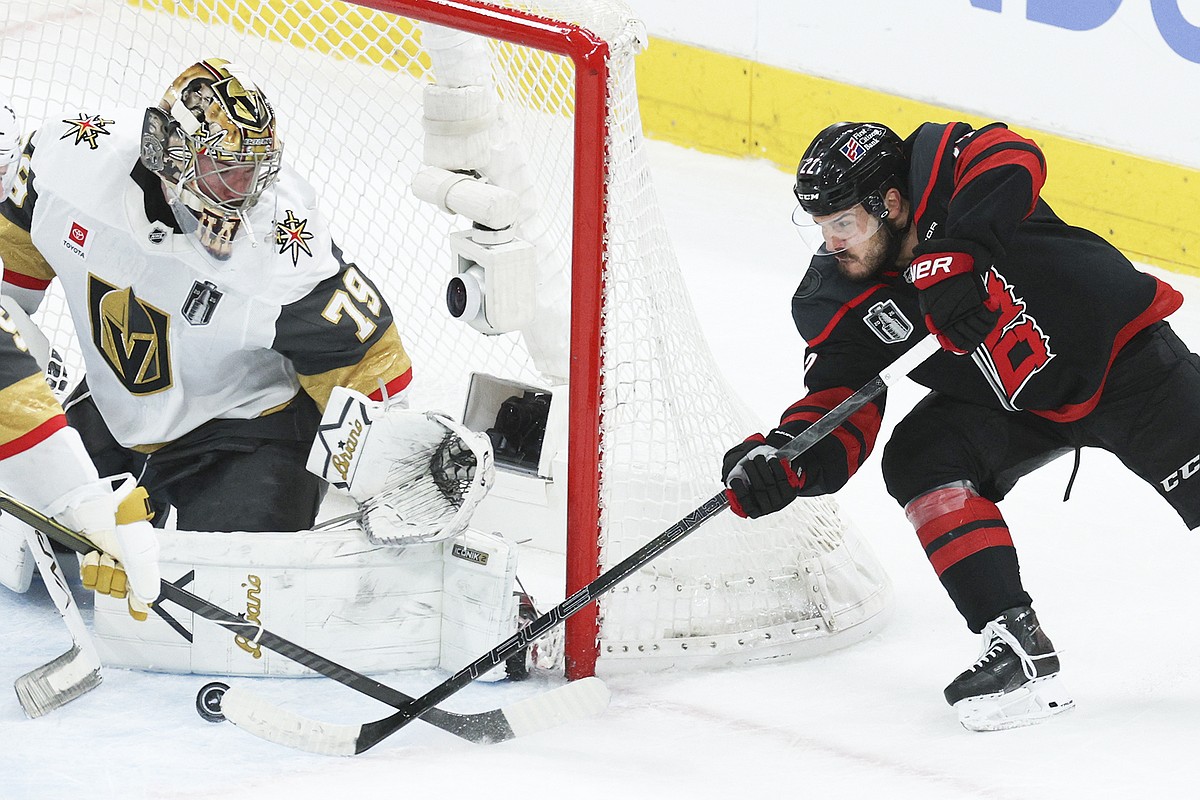
The question facing Brind’Amour on Tuesday is also the most uncomfortable question of the series: who starts in net. Brandon Bussi’s relief appearance in Game 3, when he replaced Frederik Andersen after a four-goal second period and stopped 18 of 19 shots in the game’s chaotic final stretch, created the kind of goaltending controversy teams generally avoid discussing at Cup Final time. Brind’Amour confirmed he had made a decision but declined to name his starter. “It’s the only suspenseful thing around here that I have to hold on to,” he said, with a lightness that did not entirely conceal the weight of the choice. The goaltending answer matters enormously. But it may matter less than whether the power play is the version that went zero-for-two with no shots in Game 1, or the version that changed Game 2 twice.
The Hurricanes entered this Final with a 12-1 playoff record — a start no team had managed since the 1976 Montreal Canadiens. They are built around relentless defensive structure and the kind of five-on-five production that exhausted every team they faced before Vegas. None of that disappears. But the series is 2-1, the next game is in enemy territory, and Carolina’s capacity to convert when given a man advantage is suddenly the most important thing about this team. The power play was asleep for three rounds. It woke up once. There is no margin left to hit the snooze again.