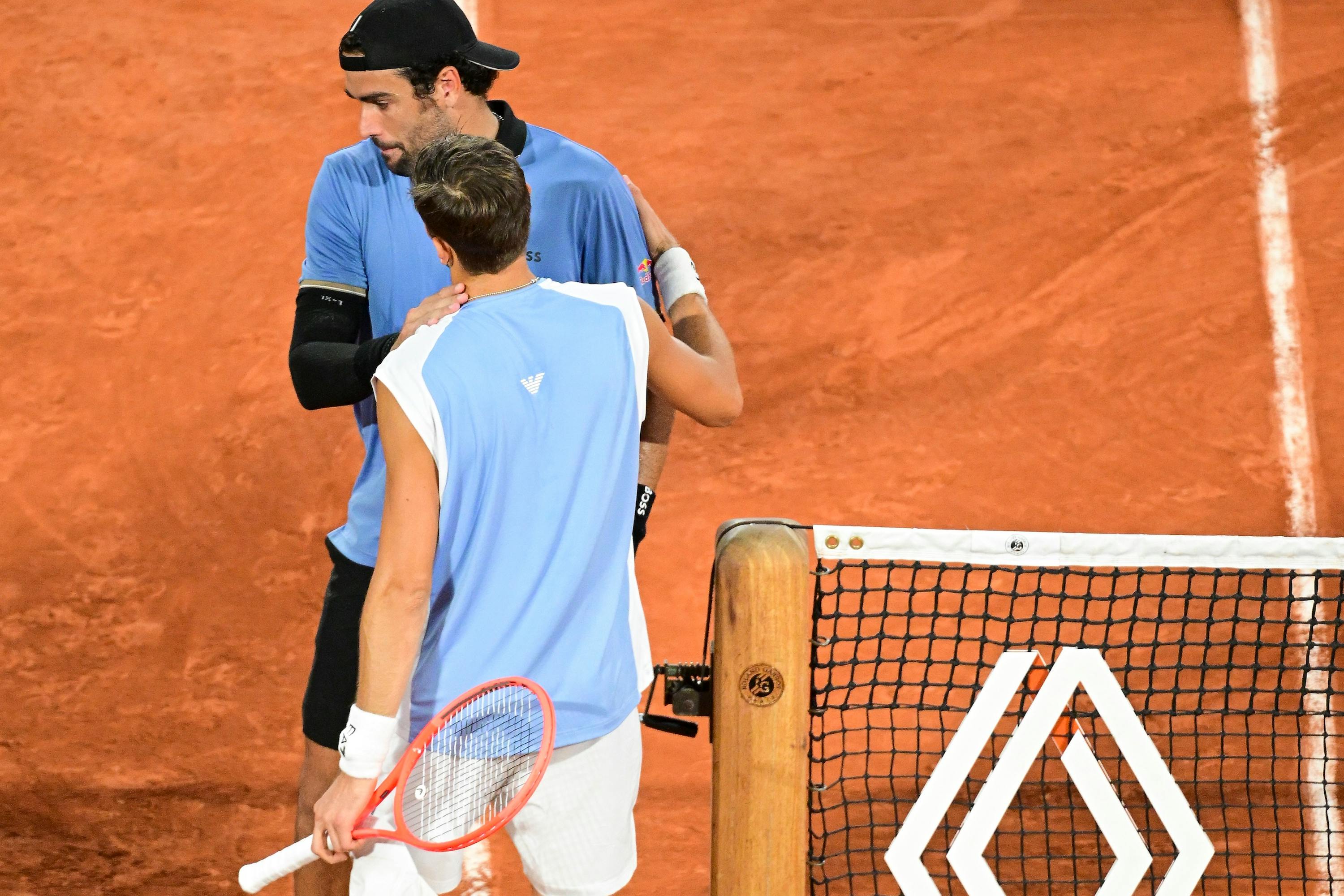
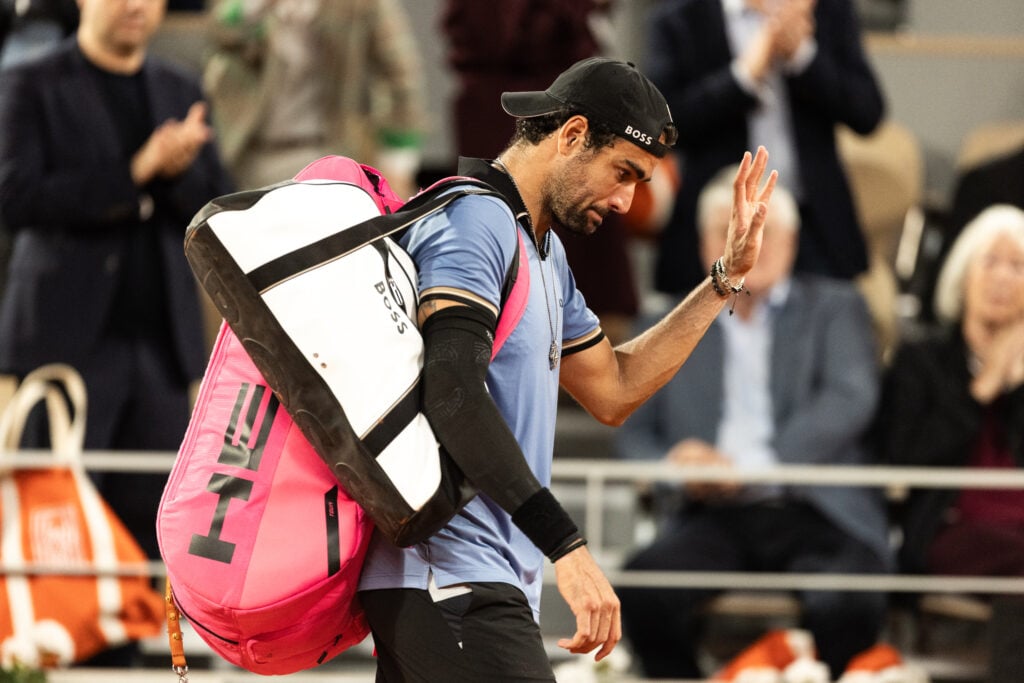
PARIS — He sat in his chair for a long time. He did not move to the net to concede immediately when Matteo Arnaldi led 5-2 in the second set. Instead, Berrettini looked at his coaching box, and the look his team sent back told the story before the official retirement did. Five years of injury, rehabilitation, and grinding back through the rankings had brought him to this quarterfinal at a French Open already stripped of its top seed — and now a left hip was ending it before he could find out how far he might have gone.
Berrettini, seeded outside the top 100 at the start of the fortnight, retired in the early stages of the second set against his compatriot on Wednesday night at Court Philippe-Chatrier. The official scoreline read 7-5, 5-2 in Arnaldi’s favour. What it could not capture was what the previous ten days had actually meant: a former world No. 6 and 2021 Wimbledon finalist beating his way back through a draw that had handed him nothing, climbing from a ranking of 105 to a projected 48 by tournament’s end.
The injury first announced itself early in the opening set. He left the court for an off-court medical timeout at 1-2 in the second and returned to hold to love, a brief flash of defiance. Then his movement tightened, his team began waving at him from the stands, and he sat down one final time. The match had lasted just under two hours.
Andy Roddick, the former world No. 1 and Hall of Famer, addressed the retirement almost immediately on his Served with Andy Roddick podcast. His read was not sentimental. It was clinical. Berrettini, he argued, made the only rational calculation available to him.
“When you are down a couple of sets and you have an injury — which we don’t know what it is yet. Obviously if you go off the court it is a hip or a groin,” Roddick said. “If you are his camp and you saw them saying ‘don’t do it’. We don’t know how bad it is at this point and he doesn’t know how bad it is. One hundred percent it has to be a responsible thought in the back of your mind that I don’t think I can get through three more sets with how I am feeling.”
That calculation sharpens considerably when the surface changes in three weeks. Berrettini is, by his own track record, a different animal on grass. He reached the Wimbledon final in 2021. He won back-to-back titles at Queen’s Club in 2021 and 2022. His best chance of a Grand Slam title has consistently been on the lawns of southwest London, not the red clay of Paris. With that in view, Roddick said the arithmetic of pushing through three sets against a fresh Arnaldi — one who had already spent 17 hours and 42 minutes on court just reaching the quarterfinals — did not add up.
“His best chance of winning a Slam or making a final of a Slam — I have to think he would tell you this — it’s at Wimbledon,” Roddick said. “I hope he is healthy for the grass court season. What he did at this tournament, grinding through, getting to the quarters, exercising a few demons and making a physical run at a Grand Slam — there will be a pay off for that, even if you are switching surfaces.”
The ranking arithmetic was the other dimension Roddick highlighted. Berrettini entered Roland Garros at No. 105 in the PIF ATP Rankings. The quarterfinal run vaults him to approximately No. 48 — close enough to re-enter the Masters 1000 draw threshold without needing qualifiers. After years in which injury had rendered that level of tour access theoretical, the number is now real again.
Arnaldi, for his part, was measured in victory. “It’s a tough one,” he said in his on-court interview. “We both played a lot, so it’s normal to not be at our best. But you never wish someone to end their tournament like this. He did an amazing tournament. We are all doing such a good job in Italy. I’m sorry for him and I hope he’s going to recover.” The 25-year-old had himself spent six months earlier this year navigating a foot injury that dragged his ranking toward 150 before a Challenger win in Cagliari in early May began this unlikely resurrection. He is now in his first Grand Slam semifinal.
Arnaldi’s semifinal opponent will be his fellow Italian Flavio Cobolli, who earlier defeated Felix Auger-Aliassime 4-6, 6-4, 6-4, 6-4. It is the first Grand Slam semifinal for each of them. Roland Garros will produce an Italian men’s finalist for the first time since Berrettini himself reached the final of the 2021 edition. A result that mirrors a similarly unexpected shift in the women’s draw, where the semifinals produced their own departures from expectation.
There is a complication to Roddick’s grass-court optimism, however. Berrettini had already missed the direct entry deadline for Wimbledon. Despite the ranking boost from this tournament, he was below the cutoff when Wimbledon’s entry list was locked. He will either require a wildcard — for which his status as a former finalist gives him a legitimate claim — or he will need two withdrawals from the main draw to advance as an alternate. He is currently listed as the third alternate.
The wildcard picture at Wimbledon this year is congested. Nick Kyrgios, another former finalist, is among those seeking consideration. The withdrawal of Carlos Alcaraz from Wimbledon earlier in the spring has already reshaped the draw’s competitive dynamics, and the All England Club will face genuine pressure to deploy its wildcards toward players whose health gives them a meaningful chance of reaching the second week.
Roddick acknowledged the visible moment that made it plain Berrettini had made his decision: “He sat down and he did not immediately go to the net at 5-2. He sat in his chair, looked at his team and there was this look of resignation that rocks up. I have to think in that moment he is thinking do I have a shot at Wimbledon? What is my best chance to make a Grand Slam semi or final? Is it here right now or is it somewhere else, with the form that I now have?”
What Roddick was describing was not defeat. It was, in his framing, a veteran athlete choosing the fight he could still win. Whether Berrettini is healthy enough to find out remains the question nobody in his camp can answer yet.