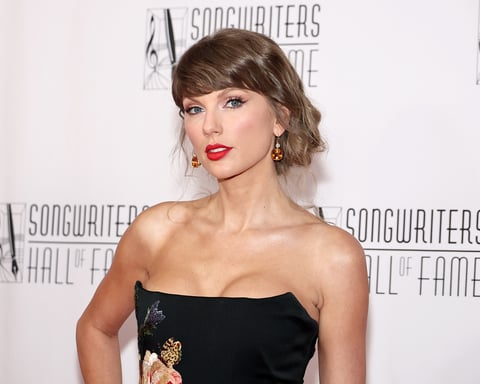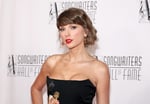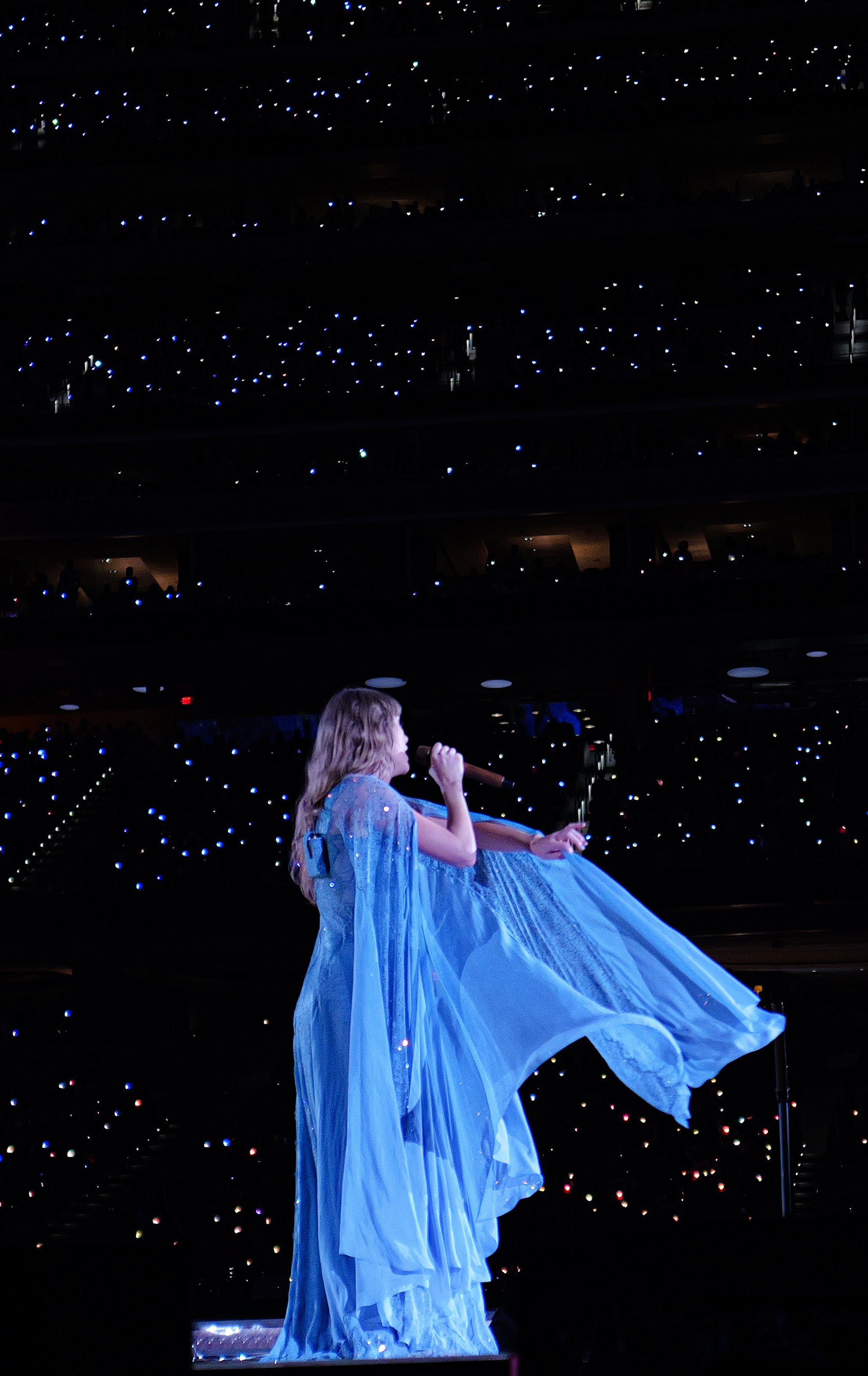

NEW YORK — Sixteen years ago, the Songwriters Hall of Fame handed Taylor Swift its Hal David Starlight Award, the trophy it reserves for young writers who show promise. On Thursday night at the Marriott Marquis, the institution formally ran out of higher compliments. It let her in.
Swift, 36, was inducted at the Hall’s 55th annual Induction and Awards Gala, a sold-out dinner in Times Square, becoming the youngest woman ever admitted in the organization’s history, NBC News reported. The previous mark had stood since 1987, when Carole Bayer Sager was inducted at 43. Only Stevie Wonder, admitted at 32 in 1983, got in younger than Swift among anyone at all.
The Starlight detail is the one with the shape of a story. Swift won the promising-newcomer award in 2010, when she was a 20-year-old who had already spent six years under a publishing deal she signed at 14. No Starlight recipient had ever gone on to full membership before. The award for potential and the award for proof now belong to the same person, with the gap between them covering roughly the entire modern history of pop.
Even her paperwork made an argument. Nominees submit songs in support of their candidacy, and Swift’s five selections read like a deliberate map of the catalog: “Love Story,” the teenage fairy tale that built the empire; “Blank Space” and “Anti-Hero,” the two great self-portraits; “The Last Great American Dynasty,” the folk-era short story; and “All Too Well (10 Minute Version),” the song her fans treat as scripture. Fifteen years of writing, five tracks, no collaborator-heavy hits among them.
The man at the podium handing her the honor was Steven Spielberg, a pairing Swift arranged herself. When the Hall asked which creative figure she wanted as her presenter, she named the director who shaped her sense of storytelling, and within about an hour his wife, Kate Capshaw, called back with a yes, even though Spielberg’s own film “Disclosure Day” was opening that same night. Capshaw’s explanation was five words: “Good and true things are easy.” From the stage, Spielberg told the room that Swift “continues to fulfill her destiny as the most successful female artist not just of her time, but of all time,” then delivered the night’s most repeated line: she may have written “You Belong With Me,” but in the most profound way, “we belong to her.”
Swift’s acceptance ran twenty-one minutes and turned first to the people who drove her there, literally. “You’re the reason I’m here tonight,” she told her family, crediting the decision to uproot from Pennsylvania to Nashville for a teenager’s long-shot career. “I will never be able to express my gratitude to you guys for doing that for me,” she said, Variety reported. Of the craft itself she offered the closest thing the night had to a thesis: “It felt easy to work incredibly hard at this.” She even reached for “Yellowstone” to describe two decades of fighting over her own catalog, quoting the show’s warning that if you build something worth having, somebody is going to try to take it.
She did not perform. That duty went to Sombr, the young New York artist who covered “Cardigan” and “Dear John” before her speech, an assignment that doubled as a generational handoff staged by an institution built on exactly that. The room was a family affair otherwise: her parents, Scott and Andrea Swift, walked the carpet with her future mother-in-law, Donna Kelce, while Travis Kelce slipped in as the program got underway. The gala’s wider lineup included Brandi Carlile, Billy Corgan and Nile Rodgers, the Songwriters Hall of Fame said in its program for the evening.
Swift headlined a class with unusual range. The 2026 inductees also included Alanis Morissette, Kenny Loggins, Kiss founders Paul Stanley and Gene Simmons, Mariah Carey’s longtime collaborator Walter Afanasieff, the British team of Terry Britten and Graham Lyle, and Christopher “Tricky” Stewart, the producer-writer behind “Umbrella.” It is a roster that runs from arena rock face paint to “Jagged Little Pill” to the song that made Rihanna a superstar, with Swift as the one act younger than some of the catalogs she joined.
The induction adds an institutional seal to the part of Swift’s identity she has guarded most carefully. The 14 Grammys and the record four Album of the Year wins reward records; this one rewards the writing itself, the thing she has insisted on since she was a teenager telling Nashville publishers she would not sing other people’s songs. The Hall’s membership is the closest thing the trade has to a writers’ room of record, and she is now in it at an age when most writers are still waiting for their first call.
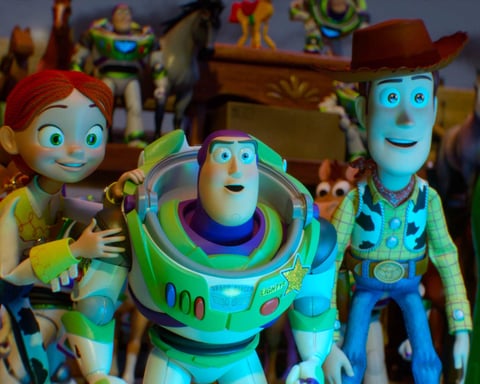
It caps a strange, busy season for her songwriting in particular. Her quiet country overture, the “Toy Story 5” ballad that doubled as a homecoming she was nervous to name, is a week old. The film carrying it opens June 19, twenty years to the day after “Tim McGraw” introduced her to country radio. She swept the iHeartRadio Awards in March. The Hall of Fame induction lands in the middle of all of it, less a capstone than a mile marker passed at speed.
The Hall does not disclose its voting, and nothing said on the record Thursday answered the question hanging over the season, which is whether the country overture is a one-off or the beginning of a project. Twenty-one minutes at a podium, and Swift, characteristically, volunteered nothing about what comes next.
The symmetry is the part worth keeping. In 2010 an institution looked at a 20-year-old and filed her under promise. The same institution has now closed the file the only way it could. The bet on the teenager turned out to be the safest one the Hall ever made.