

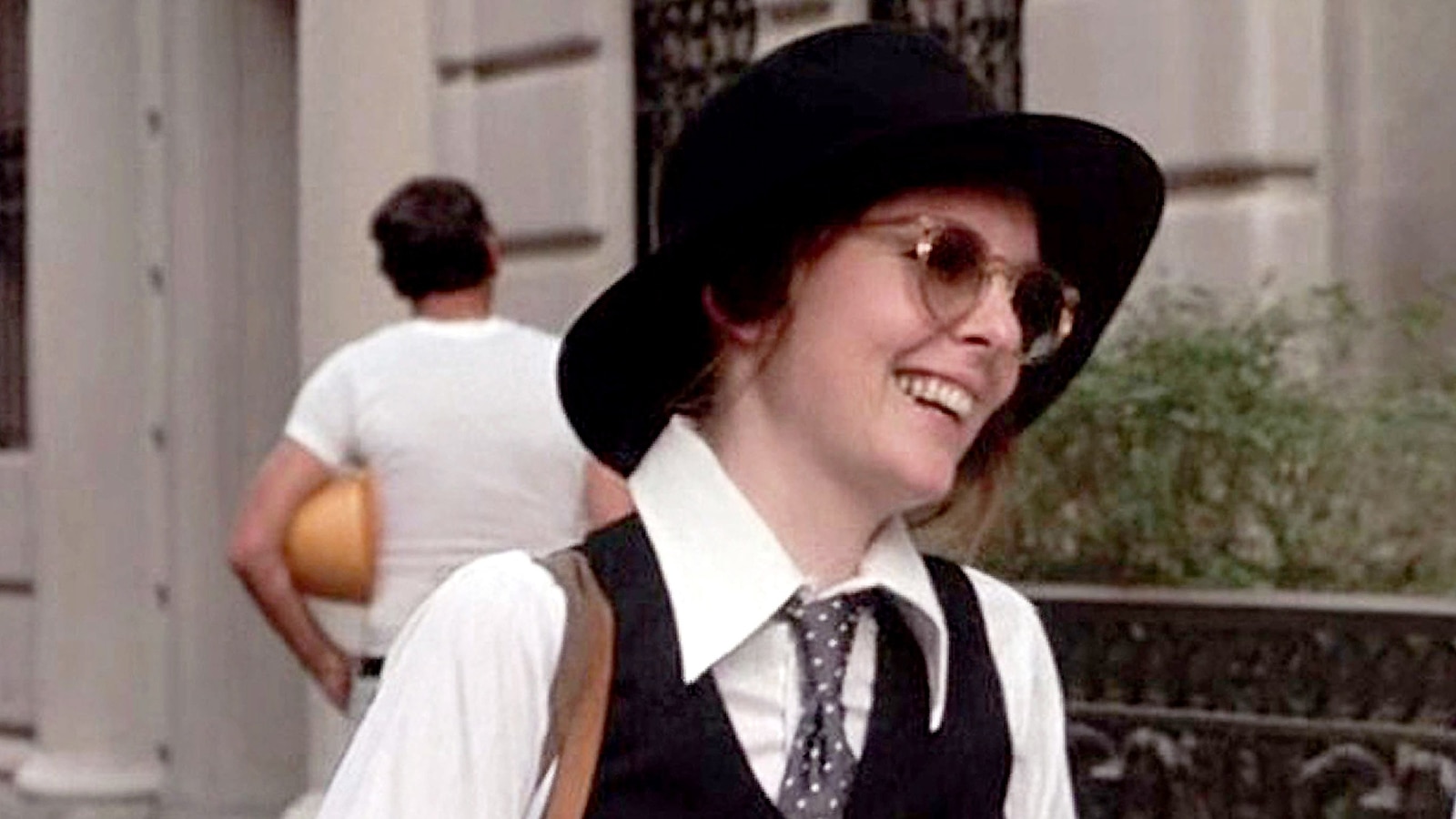
NEW YORK — When Bonhams catalogued Diane Keaton’s black felt bowler hat, it was estimated the way hats are estimated, at a few hundred dollars. When the bidding closed this week, the hat brought $19,200. It outsold her Cartier.
The hat was one of 787 lots spread across four sales that Bonhams ran under the title “Diane Keaton: The Architecture of an Icon,” closing in sequence between June 8 and June 11 in New York and Los Angeles, according to the auction house’s results. Together they amount to the first public accounting of the actress’s possessions since her death in October at 79, and the first time the market has been asked, directly, what her persona was worth. The answer was emphatic and a little strange.
In the “Tailored & Timeless” sale, 241 lots of the wardrobe that made menswear a female movie star’s signature, the conventional valuables performed the way conventional valuables do. A stainless Rolex Oyster brought $20,480. A Cartier Tank Française from around 2002 made $17,920. Then came the things that had no business near those numbers: the bowler at $19,200, a Bottega Veneta woven tote at $8,960, a Ralph Lauren Purple Label evening tailcoat, the kind of thing she wore to award shows while everyone else wore gowns, at $8,320.
The pattern is not subtle. Bidders were not pricing felt, leather or wool. They were pricing the character Keaton spent fifty years constructing, the ties and turtlenecks and hats that began as Annie Hall’s borrowed-from-the-boys wardrobe and hardened into a uniform she never once broke, in an industry that punishes women for far smaller consistencies. The watch is a watch anywhere. The bowler only means something because she refused to take it off.
The other half of the persona lived in her houses, and the Los Angeles sale priced that too. “At Home with Diane,” 267 lots from her residences, was topped by William Frederick Ritschel’s desert painting “Desert Wanderer, Navajo” at $48,640, the most expensive lot of the entire series, Bonhams’ Los Angeles results show. A pair of iron-mounted Monterey club chairs from about 1930 made $15,360, matched exactly by two California Hillside Pottery vases, with a pair of Monterey settees at $10,880. Keaton restored, photographed and wrote books about California houses with the same obsessiveness she brought to a costume, and the buyers evidently knew it.
The series was built like a retrospective. A 50-lot live sale opened it in New York on June 8. The two big online sales carried the wardrobe and the houses. The final auction, “Chapters of an Edited Life,” closed June 11 with more than 150 lots of books, photographs, collages and scripts, the raw inputs of her taste rather than its finished products. An estate that wanted maximum prices would have sold the Oscar-adjacent memorabilia and kept the safety pins. This one sold the whole sensibility.
Keaton won her Academy Award for “Annie Hall” in 1978 and spent the decades after it as one of the few American stars whose off-screen self was as recognizable as any role, the bowler and the gloves and the high collars constituting a kind of standing argument about how a woman in Hollywood was allowed to look. She died in October 2025, and the months since have produced the usual tributes. The auction is a blunter kind of tribute. It put numbers on the argument.
It also lands in a week when the industry kept being asked what personas are worth. Idris Elba spent it explaining his conclusion that global markets would never accept his James Bond, and Helen Mirren’s next thriller found a distributor on the strength of a name that has meant the same thing for forty years. Keaton’s sale is the posthumous version of the same transaction, with the persona finally separable from the person and sold by the lot.
Some numbers are still missing. Bonhams has not published a combined total for the four sales, the estate has not said where the proceeds go, and the buyers, as always, are anonymous. Whether the bowler went to a museum, a collector or a fan who simply wanted the thing itself is not public, and may never be.
What is public is the arithmetic. The estimate priced felt and ribbon. The winning bid priced five decades of wearing it like a flag. Somewhere this week, a box is being packed with the most famous hat in American movies, and whoever opens it will discover what the estate already knew: it is just a hat, and it is not remotely just a hat.