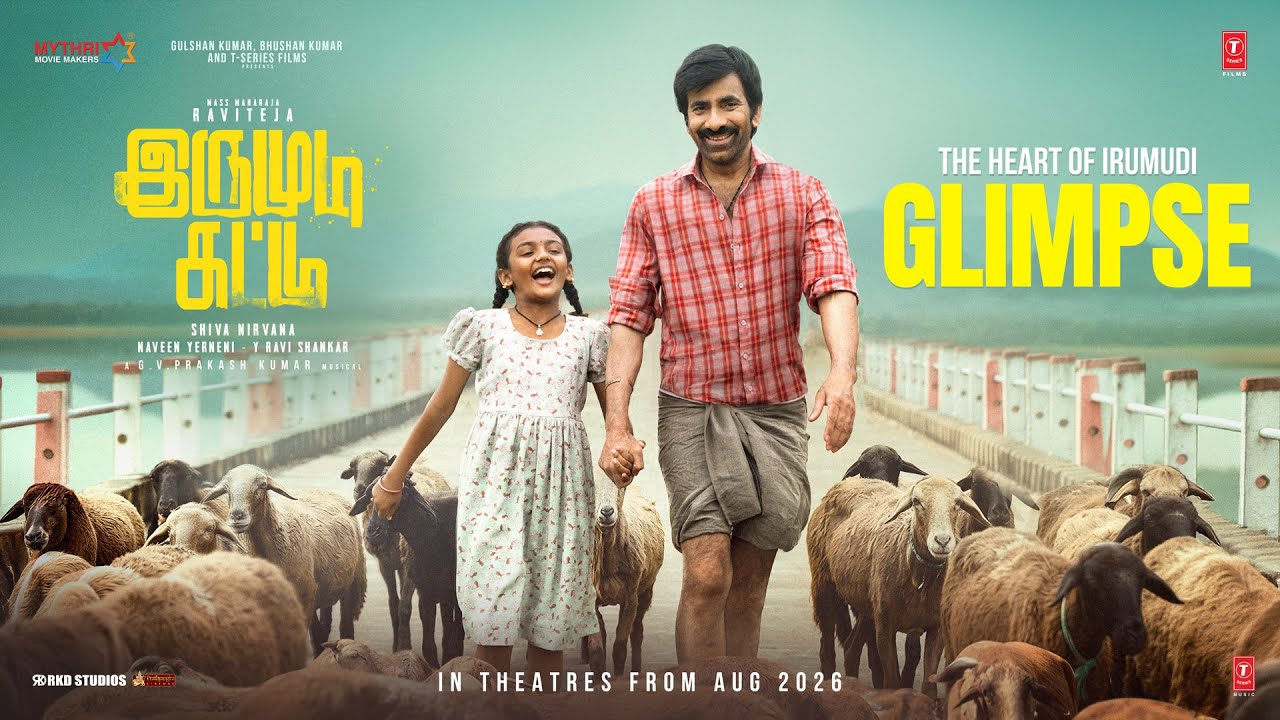

Ravi Teja, the actor Telugu cinema has called Mass Maharaja for two decades of high-energy action comedies, is preparing what may be the most unexpected pivot of his career. Irumudi, directed by Shiva Nirvana and produced by Mythri Movie Makers, is a family drama centered on the Ayyappa Deeksha, the 41-day spiritual discipline undertaken by devotees before their pilgrimage to the Sabarimala temple in Kerala. Ravi Teja plays a father who commits to abandoning his drinking habits by undertaking the Deeksha, motivated entirely by his relationship with his daughter. The film is set for a worldwide theatrical release on August 21, 2026, in both Telugu and Tamil, with the Tamil version titled Irumudi Kattu.
The tonal departure is significant enough that it has become the film’s primary talking point. The glimpse trailer, titled The Heart of Irumudi, presented Ravi Teja in a register his audience has rarely seen: introspective, emotionally vulnerable, and defined by his failures as a father rather than his capacity for violence or comedy. The actor acknowledged the shift himself, stating that some stories choose you at the right moment in life. For an actor whose box office identity has been built on punch dialogues and mass appeal, a film about spiritual surrender and personal accountability represents a genuine creative risk.
Director Shiva Nirvana has built his career on emotionally resonant storytelling, with films that find drama in domestic relationships rather than in external conflict. His approach to Irumudi appears to treat the Ayyappa Deeksha not as a backdrop for conventional drama but as the mechanism through which the central character confronts his own weaknesses. The 41-day discipline, which requires strict vegetarianism, celibacy, walking barefoot, wearing black clothing, and maintaining a state of spiritual purity, provides a natural dramatic structure: a man whose habits have damaged his family forced into a framework of accountability that he cannot fake or shortcut.
Priya Bhavani Shankar plays Kaveri, the protagonist’s wife, with Baby Nakshathra cast as their daughter. The supporting cast includes Sai Kumar, Ajay Ghosh, Ramesh Indira, and Swastika, though the film’s dramatic weight appears to rest primarily on the father-daughter relationship. GV Prakash Kumar composes the score, bringing his experience across Tamil and Telugu cinema to material that demands both devotional textures and the emotional warmth of a family story. Cinematographer Vishnu Sharma and editor Prawin Pudi complete the core technical team.
Mythri Movie Makers, founded by producers Naveen Yerneni and Y. Ravi Shankar, has established itself as one of Telugu cinema’s most commercially successful production houses, backing films ranging from Pushpa to Sarkaru Vaari Paata. Their involvement in Irumudi signals confidence that Ravi Teja’s audience will follow him into material that operates outside his established commercial formula. Mythri’s parallel production of Chiranjeevi’s Mega158 and their position as the production house behind Pawan Kalyan’s OG franchise make them arguably the most significant studio in contemporary Telugu cinema.
The August 21 release window positions Irumudi in a relatively uncrowded corridor, avoiding the major festivals that typically attract the biggest Telugu releases. That scheduling choice may reflect an understanding that the film needs room to build an audience through word of mouth rather than competing on opening-day spectacle. The Ayyappa Deeksha subject matter also connects the film to a specific devotional demographic in Andhra Pradesh, Telangana, and Kerala, where the Sabarimala pilgrimage is a deeply embedded cultural practice that millions undertake annually. Telugu cinema’s recent willingness to experiment with unconventional material, from Singeetham Srinivasa Rao’s dialogue-free musical Sing Geetham to Nag Ashwin’s science fiction, creates a context in which Irumudi’s spiritual subject matter feels less like an outlier and more like part of an industry broadening its creative vocabulary.
Reports have also emerged that director Hari of the Singam franchise has pitched a story concept to Ravi Teja for a potential collaboration after Irumudi, suggesting that the actor may alternate between emotional dramas and more conventional commercial fare rather than abandoning his mass persona entirely. That balance, if it holds, would represent a maturation of his career rather than a reinvention, allowing him to demonstrate range without alienating the audience that has sustained his three-decade filmography.
Whether Irumudi can translate its emotional sincerity into box office returns will depend on whether Ravi Teja’s fanbase is willing to meet him in unfamiliar territory. The Ayyappa Deeksha offers the film a connection to faith and family that transcends typical genre categories, and Shiva Nirvana’s direction appears to trust that connection rather than diluting it with the action set pieces that a more commercially cautious production might have demanded. For an industry where reinvention is often discussed but rarely attempted at the level of its biggest stars, Irumudi represents a test of whether Telugu cinema’s audience sophistication matches its filmmakers’ ambitions.