
Every Sunday, the Quordle game delivers its most cinematic hour. There is no weekday pressure, no Tuesday ambition, no Thursday grind. There is only a blank grid, nine guesses, and four words that Merriam-Webster has decided you must find simultaneously. Game #1602, landing on June 14, 2026, is no different in its architecture and entirely distinctive in its execution. Today’s quartet targets a very specific kind of solver: one who is confident, pattern-dependent, and therefore dangerously exposed.
If you arrived here for hints, scroll slowly and stop the moment the grid unlocks. If you are here for the answers, they are confirmed, fully verified, and waiting at the bottom.
What Is Quordle?
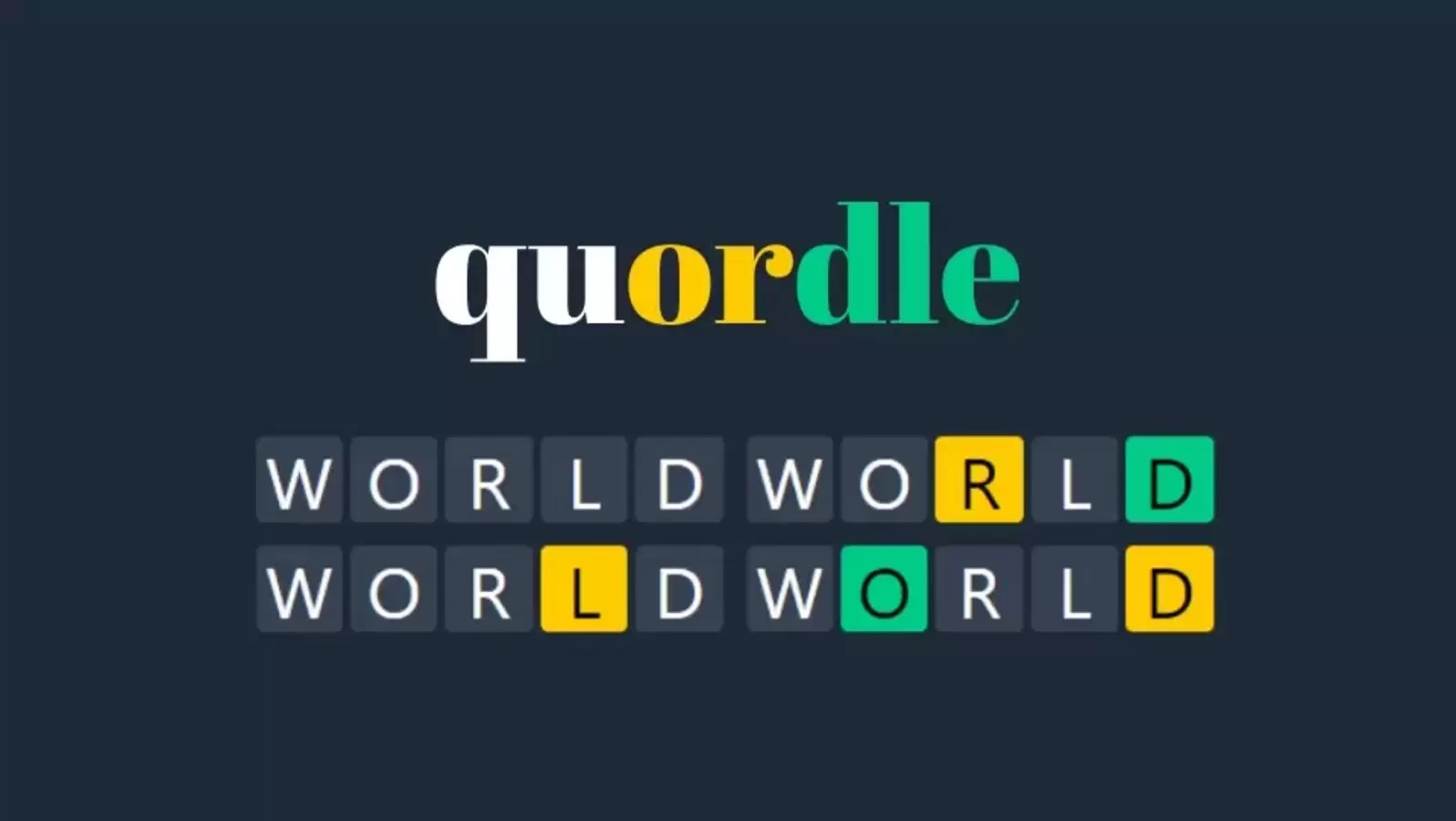
Quordle is a daily word puzzle hosted on the Merriam-Webster platform that challenges players to solve four five-letter words simultaneously within nine attempts. Each guess is applied across all four grids at once. Colored tiles return positional feedback: green marks the correct letter in the correct position, yellow indicates the correct letter in the wrong position, and gray signals the letter is absent from that particular word. One puzzle is published each day, shared globally, and designed to test the limits of parallel deduction.
Unlike conventional word games that reward linear thinking, this format punishes tunnel vision. Overcommitting to one grid burns guesses that were borrowed from three others. That structural asymmetry is the game’s defining feature and its most reliable source of difficulty.
Quordle Hints for June 14, 2026 (Game #1602)
Today’s four-word challenge serves up a deceptively tricky set. Two words share identical opening and closing letters, differing only at their centers. A third is one of the most culturally omnipresent adjectives of the last decade. The fourth is a twentieth-century industrial invention that most players will not immediately connect to a five-letter answer. Use the hints below progressively and stop reading the moment you feel confident about a word.
General Clues Across All Four Words
- The letter Y appears in three of the four answers.
- Two words begin with W and end with Y.
- No answer today uses the letters Q, Z, X, or J.
- One answer has double letters bookending the word.
Word 1 (Top-Left): Hints
The Vibe: Lacking courage, strength, or backbone. The word describes a character who shrinks from confrontation and draws from the same colloquial root as a word for a feeble, ineffectual person.
Boundary Clues: Starts with W, ends with Y. Four consonants and one vowel. No repeated letters.
The Category: Adjective. Behavioral. Unflattering.
The Giveaway: You would use this word to describe a cartoon villain too frightened to follow through on his own plans.
Word 2 (Top-Right): Hints
The Vibe: Thin, ethereal, barely substantial. Think of cirrus clouds at altitude, or the trailing end of smoke dissolving into still air.
Boundary Clues: Starts with W, ends with Y. Identical boundary letters to Word 1. The middle consonant is entirely different.
The Category: Adjective. Visual. Descriptive of texture or density.
The Giveaway: Poets use this word for hair, for memory, for anything that barely holds its form.
Word 3 (Bottom-Left): Hints
The Vibe: Infectious, explosive, spreading without containment. This word entered clinical language centuries ago and conquered the internet sometime around 2012.
Boundary Clues: Starts with V, ends with L. Two vowels, three consonants. Clean alternating structure. No repeated letters.
The Category: Adjective. Originally medical. Now universal.
The Giveaway: A video that gains ten million views overnight. Or the thing you hope your seasonal cold is not.
Word 4 (Bottom-Right): Hints
The Vibe: Synthetic, durable, industrial. This material changed the twentieth century quietly and permanently, appearing in stockings, toothbrush bristles, parachutes, and climbing ropes.
Boundary Clues: Starts with N, ends with N. The same letter bookends the word. The Y inside functions as a vowel. No other repeated letters.
The Category: Noun. Polymer. DuPont invention.
The Giveaway: It debuted at the 1939 New York World’s Fair and caused a cultural sensation that is difficult to explain today.
Today’s Answers for Quordle June 14, 2026
Spoiler warning. The four confirmed answers for Quordle Game #1602 appear directly below.
- Word 1 (Top-Left): WIMPY
- Word 2 (Top-Right): WISPY
- Word 3 (Bottom-Left): VIRAL
- Word 4 (Bottom-Right): NYLON
Word Breakdown and Etymology
WIMPY
WIMPY is an adjective meaning frail and lacking backbone, physically or morally weak, easily intimidated or dominated. The word descends from “wimp,” which entered American colloquial usage in the early twentieth century through unclear origins, though linguistic historians have traced competing theories to British dialect and Harvard slang. Its most durable cultural imprint came through J. Wellington Wimpy, the perpetually hungry and chronically cowardly character in E.C. Segar’s Popeye comic strip, whose name became synonymous with spinelessness. WIMPY traps today’s players because it shares its W-opening, Y-closing frame with the word directly across the grid.
WISPY
WISPY is an adjective describing something fine, delicate, or insubstantial in appearance, lacking density or solidity. It derives from “wisp,” a Middle English word for a small bundle of straw or hay, which evolved to describe anything thin, trailing, or barely present. Cirrus clouds are wispy. So is hair after a long illness, or a childhood memory that refuses to resolve into detail. The word’s structural danger today is significant: its W and Y boundaries, identical to WIMPY’s, mean that players who do not have both words confirmed by guess five are likely to waste attempts cycling between them.
VIRAL
VIRAL is an adjective with roots in Latin “virus,” meaning poison or slime, and has carried a medical definition since the late nineteenth century, pertaining to or caused by a virus. Its second life began in the early social media era, when it expanded to describe anything spreading rapidly via digital networks, the internet-era equivalent of contagion. A dance, a photograph, a moment of recorded embarrassment: all can go viral now. VIRAL is the easiest solve on today’s board. Its alternating vowel-consonant structure, V-I-R-A-L, responds generously to standard opening guesses, and its cultural ubiquity ensures that the vast majority of players will identify it by guess four. It is today’s stabilizing word, the one that anchors the grid while WIMPY and WISPY fight for resolution.
NYLON
NYLON is a noun referring to a synthetic polymer material developed by Wallace Carothers at DuPont Laboratories in 1935. It was the world’s first commercially successful synthetic fiber, derived entirely from petrochemicals and designed to replicate the feel and durability of silk at a fraction of the cost. The name itself is an invention, a marketing construction with no etymological ancestors, which makes it one of the stranger entries in English lexicography. When nylon stockings went on sale to the American public in May 1940, four million pairs sold in the first four days; the word’s puzzle difficulty stems from its double-N bookends and from the Y functioning as a vowel interior, a structural quirk that players focused on conventional vowels may not immediately detect.
Difficulty Rating: Game #1602
Overall Difficulty: 3.5 / 5
Hardest Word: WIMPY. Not because it is obscure. Because WISPY exists on the same board, once a player identifies one of the two W-words, they are immediately primed to look for the other and will frequently overfocus, burning two or three attempts on variants before differentiating the middle consonants. The trap factor is among the highest this puzzle has deployed in June.
Easiest Word: VIRAL. Culturally omnipresent and structurally transparent, it responds to almost any strong opening sequence and rarely survives past the third guess for experienced players.
Trap Factor: HIGH. The WIMPY/WISPY pairing is this puzzle’s landmine. The letter Y appears in three of the four answers. Players who identify the pattern early may find themselves assuming Y-endings where none exist, particularly if they attempt to resolve NYLON through the lens of the dominant Y pattern across the grid.
Sunday’s Quordle puzzle is consistent with the structural philosophy that has defined recent editions, particularly last Sunday’s Game #1595, which built its difficulty around a rare Q-opening and an unfamiliar scientific vocabulary entry. Today’s challenge is different in texture but identical in intent: familiar words arranged to produce unfamiliar pressure.
Strategy Guide for Game #1602
Open with a word that aggressively targets W, Y, and the high-frequency consonants M, S, P, and N. A first guess of WIMPS or SWAMP would immediately place letters across multiple target positions in today’s grid. The priority in the first two guesses is to establish which middle consonant separates WIMPY from WISPY before either has been fully confirmed. Guessing both letters into the grid early, M in one guess and S in the next, is more efficient than attempting to solve either word from boundary letters alone.
For NYLON, the double-N bookend is the anchor. Once N is confirmed as both an opening and closing letter, the interior Y-as-vowel structure should resolve naturally if your opening guesses have already exposed the L and the O. Players who have not encountered NYLON in a puzzle context before may briefly confuse its structure with words that carry conventional vowels in the same position.
VIRAL, as the board’s most accessible word, should be used strategically. Confirming it early allows the solver to eliminate V, I, R, A, and L from the remaining three grids, which meaningfully narrows the field for the W-words and for NYLON. The four-board grid rewards players who treat each confirmed answer as a letter-clearing event rather than a standalone victory.
Today’s board also demonstrates a dynamic that has appeared across several June puzzles: the presence of repetition traps, where structural similarity between answers creates false confidence and late-game collapse. Managing that pattern is the difference between a clean sweep and a failed streak.
Recent Quordle Answers Archive
| Date | Game # | Answers |
|---|---|---|
| June 14, 2026 | #1602 | WIMPY, WISPY, VIRAL, NYLON |
| June 13, 2026 | #1601 | DEALT, STEED, BELIE, GULLY |
| June 7, 2026 | #1595 | QUERY, AXION, LILAC, SWORD |
| May 24, 2026 | #1581 | RIGHT, STALE, FLUKE, LINEN |
| May 17, 2026 | #1574 | EPOCH, SPIKY, FAINT, PENNE (May 15) |
| May 16, 2026 | #1573 | DEMUR, THREE, SLEEP, CRUDE |
| May 13, 2026 | #1569 | AGLOW, AVAIL, BADLY, STING (May 12) |
| May 10, 2026 | #1567 | SHALL, ERUPT, WISER, DRIER (May 9) |
How Quordle Fits the Daily Puzzle Ecosystem
Quordle operates differently from the rest of the daily puzzle landscape. Where the NYT Wordle offers a single word and a measured six attempts, Quordle demands four words in nine guesses across simultaneous boards, compressing the margin for error while multiplying the cognitive load. The game has maintained its daily audience not through novelty tricks or mode proliferation alone, but through a puzzle design philosophy that consistently generates tension from familiar vocabulary. WIMPY, WISPY, VIRAL, and NYLON are all words that most English speakers have encountered hundreds of times. None of them should be difficult. The grid makes them difficult, and that design choice is deliberate.
The puzzle’s home on the Merriam-Webster platform gives it an institutional weight that browser-based imitators lack. Every answer is a dictionary-verified English word, which means the game can never be accused of inventing difficulty through obscurity. Today’s answers are proof of that commitment: four ordinary words, engineered into an extraordinary trap.
Tomorrow’s puzzle resets at midnight. Every streak that survives today deserves recognition. Every streak that does not has a clean grid waiting.