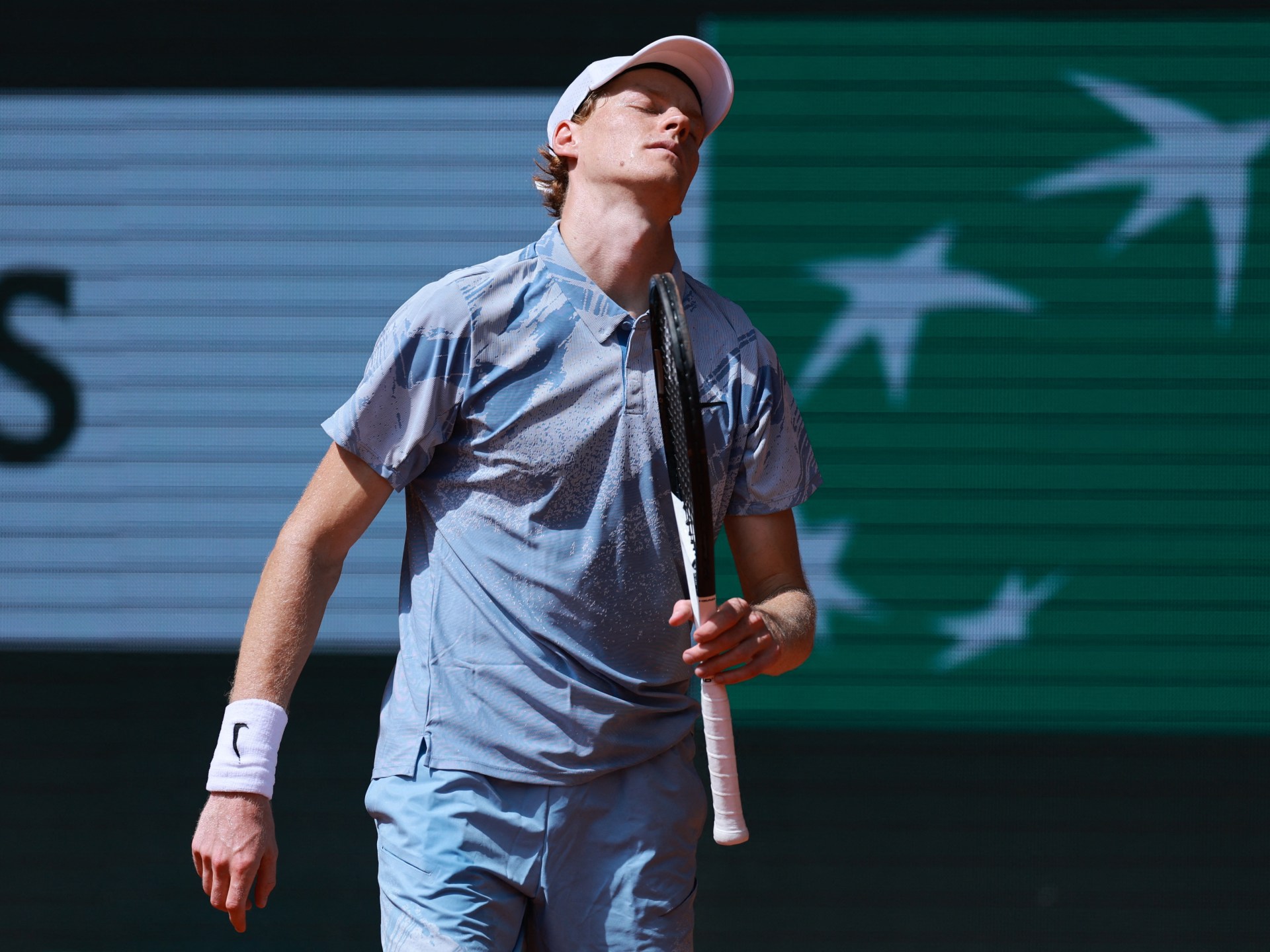
PARIS — Jannik Sinner’s capitulation at Roland Garros lasted an hour and forty-five minutes before it was already over in any meaningful sense. He had won sixteen of the first eighteen games, led 5-1 in the third set, and was one hold away from a scoreline that would have left Juan Manuel Cerundolo, ranked fifty-sixth in the world, with nothing more than a minor historical footnote. Then the heat took him. His racket became a walking stick. He leaned against the advertising boards at Court Philippe-Chatrier, wincing, and the next eighteen games belonged to the Argentine.
Days later in Paris, Andre Agassi sat at the TNT Sports desk and said what a lot of people in tennis had been thinking but were reluctant to say out loud.
“There’s no excuse for him to run into a wall at one hour, 45,” Agassi told TNT’s Roland Garros panel. “It’s not that that dude doesn’t work hard. It’s not that he’s not fit.”
Agassi, the 1999 Roland Garros champion and the last American man to win the singles title in Paris, spent a year working with Sinner’s current coach Darren Cahill before Cahill joined the Italian’s team in 2022. That history gave his words a different weight. He wasn’t commentating from a distance. He was speaking about a man he trusted with a player who now had, in Agassi’s reading, a repeating problem that the staff around him had not solved.
“I’m sure he has a staff of doctors and people,” Agassi said. “But repeating the same thing twice and expecting a different result, that’s where I call a little Yahtzee on all of it. He needs to figure out what to change. It’s got to be some form of hydration issue.”
The comparison to Melbourne was unavoidable. At the Australian Open earlier this year, Sinner had been in serious difficulty against American qualifier Eliot Spizzirri when tournament officials closed the retractable roof over Rod Laver Arena. The change in conditions gave Sinner enough recovery time to survive and eventually reach the semifinals. No such reprieve existed in Paris. Court Philippe-Chatrier’s roof was not deployed. Sinner, who had arrived at Roland Garros on a thirty-match winning streak and as the overwhelming favourite to complete his career Grand Slam, lost sixteen of the last eighteen games and departed in the second round.
The final scoreline — 3-6, 2-6, 7-5, 6-1, 6-1 in favour of Cerundolo — carried its own strange logic. Cerundolo, who told the media that he “couldn’t win more than three games in a set” and felt he had been somewhat fortunate, reached the third round of a Grand Slam for the first time in his career. The first player to oust a top seed at Roland Garros before the third round since Karol Kucera in 2000 had done so mainly by waiting while Sinner disintegrated.
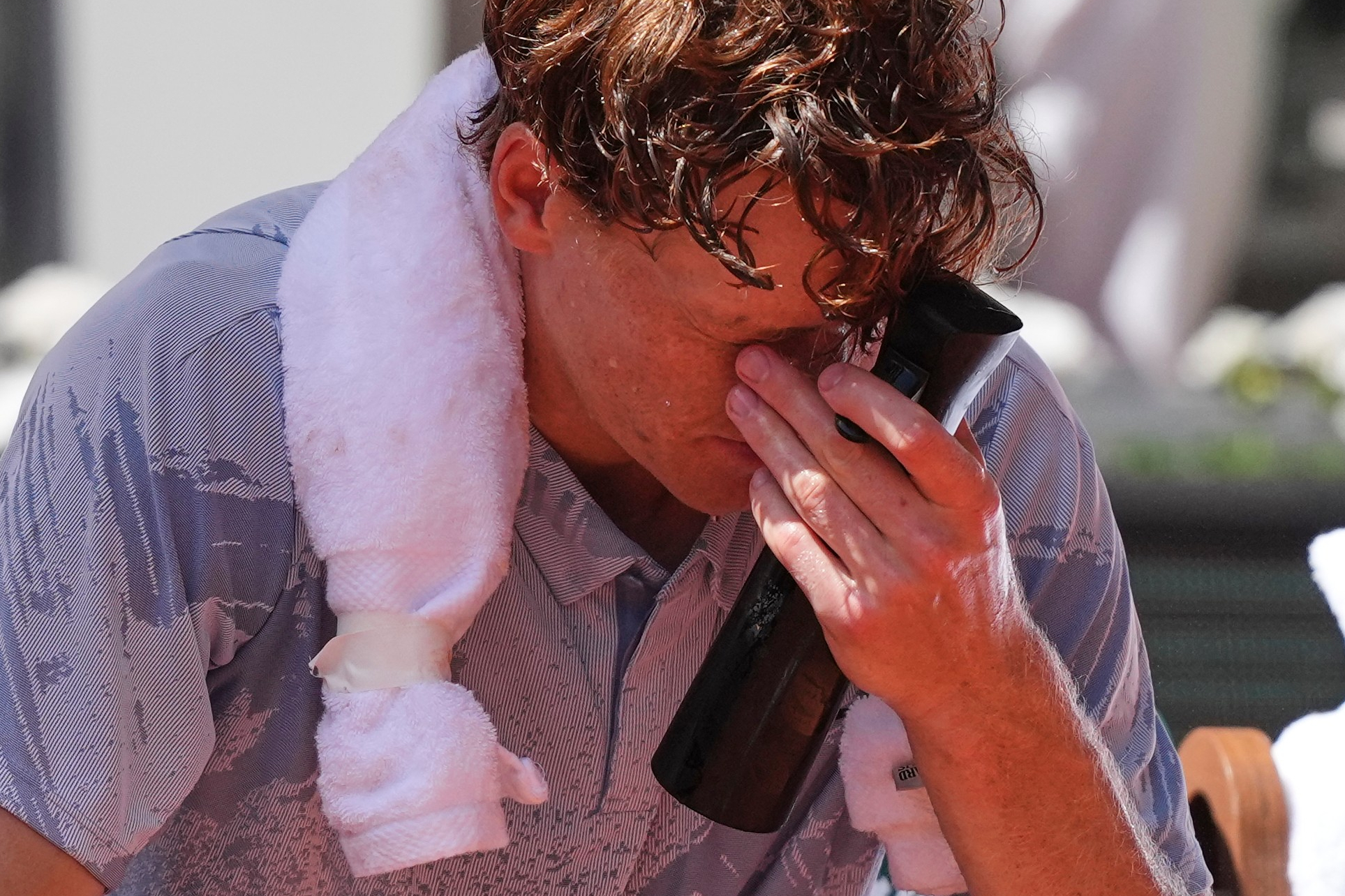
Sinner’s own account after the match was characteristically unadorned. He said he had not felt well that morning, had not slept well, and had started feeling dizzy and low on energy midway through the third set. He tried to conserve something for a fifth set by conceding the fourth. There was nothing left for the fifth. He rejected any suggestion that the heat should serve as an excuse, saying the conditions were “OK to play.” The fault, in his telling, was his alone.
That honesty did not close the question. Agassi, leaning on his own experience of playing best-of-five matches in extreme heat, described in precise terms what he believed adequate preparation required. In the twenty-four hours before a match in hot conditions, he said he consumed ten to twelve litres of water, maintained a four-to-one carbohydrate-to-protein ratio, and forced intake regardless of thirst. “It’s better to have it in you and not need it than to need it and not have it,” he said. He added that his body’s clock for playing in heat was roughly three hours and fifty minutes — and that Sinner had not reached two hours before his body gave out.
What made the argument harder to dismiss was what it rested on. Agassi did not question Sinner’s talent or his fitness in the conventional sense. He was making a narrower and more specific claim: that fitness and heat preparation are not the same thing, and that the gap between them had now cost Sinner at two consecutive major tournaments. The five-and-a-half-hour final against Carlos Alcaraz at Roland Garros last year — where Sinner served for the match and lost in five sets — demonstrated he could sustain that kind of physical punishment when conditions did not work against him. The question Agassi was raising was whether the preparation that made that performance possible was adequate for the heat that defeated him in Melbourne and Paris.
The broader implications are not trivial. Sinner’s exit ended a run of nine successive Grand Slam titles shared between him and Alcaraz, who withdrew from Roland Garros with a wrist injury before the tournament began. With Alcaraz also absent, the door opened for the first new major winner since the 2024 Australian Open. Novak Djokovic, who beat Sinner in Melbourne and last won a major at the 2023 US Open, remained in the draw. The duopoly that had defined men’s tennis for two years was, at least for a fortnight, suspended.
For Sinner, the next major is Wimbledon, which begins June 29. He said after his Paris exit that he would skip the grass-court tune-up tournaments and rest. His ranking remains intact, his season record stands at 37-3 according to the ATP, and he has won three consecutive clay titles. The talent is not in doubt. But Agassi’s assessment left an uncomfortable question hanging over the grass season: if the same conditions arise at a Grand Slam, is anything about the preparation actually different?
Cahill, who has previously coached Lleyton Hewitt and Simona Halep to the world No. 1 ranking and guided Sinner from outside the top ten to the summit of the ATP, has not publicly responded to Agassi’s remarks. The French Open heat crisis exposed a vulnerability that both Paris and Melbourne confirmed. Whether the answer is a change in hydration protocol, a reduction in pre-Slam scheduling, or something the team is still working out is, as of the time of writing, unknown. That gap — between what Agassi suspects and what Sinner’s camp has or hasn’t done — is the thing this tournament left unresolved.