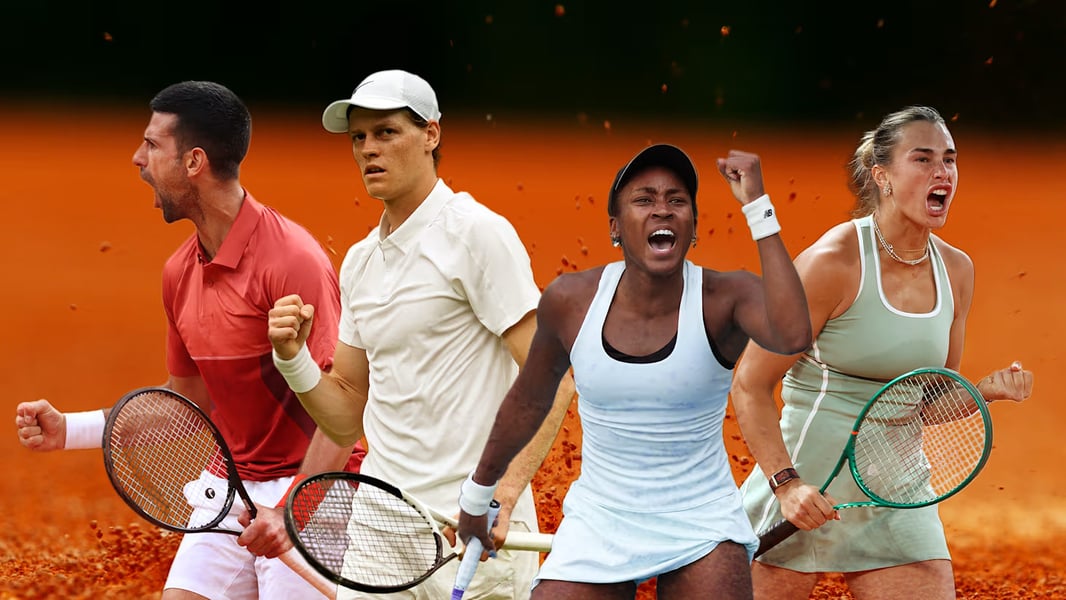

Sinner’s dominance reshapes Roland Garros 2026
Sinner’s rise into the 2026 clay season has been defined by relentless consistency and physical evolution. His performances across Monte Carlo, Madrid, and Rome have confirmed his transformation into a complete all-surface champion, with clay no longer considered a vulnerability but a weapon.
His statistical and competitive rise has been widely tracked by analysts, with his dominance in Rome and Masters-level events reflecting a new era in men’s tennis shaped around his consistency and shot tolerance.
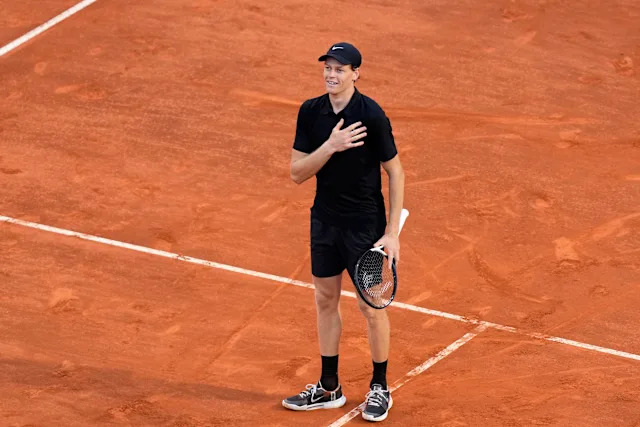
Opening round: controlled start, minimal risk
Sinner begins his Roland Garros campaign against French wildcard Clément Tabur, a matchup that heavily favors the World No. 1 on paper. The opening round is expected to serve more as a rhythm-building exercise than a competitive challenge.
However, the intensity of Grand Slam tennis means early rounds still carry psychological importance. Sinner’s ability to manage expectation and maintain focus has been one of his strongest traits in recent majors.
The French Open itself remains the most demanding test in tennis, with conditions at Roland Garros consistently challenging even the most dominant players. Official tournament conditions and structure can be explored via the Roland Garros official tournament coverage, which outlines draw format, scheduling, and surface characteristics that define Paris every year.
Draw dynamics and emerging threats
While Sinner sits at the center of the tournament narrative, the draw still presents potential challenges deeper in the second week.
Novak Djokovic remains a potential final-stage opponent, while Alexander Zverev anchors the opposite side of the bracket. Rising talents such as Arthur Fils add unpredictability, particularly in front of a home crowd that often elevates French players in early rounds.
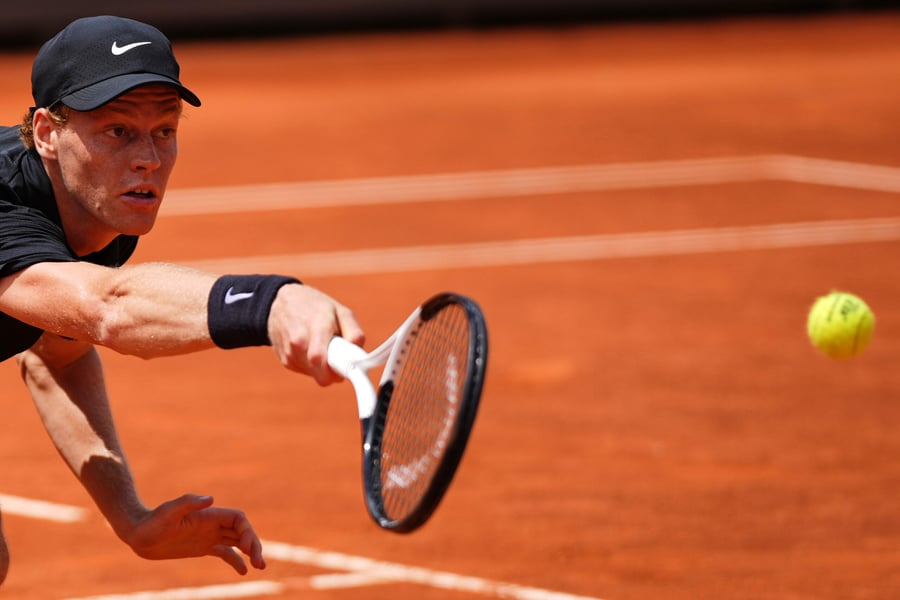
Career Grand Slam within reach
The defining storyline in Paris is Sinner’s pursuit of the career Grand Slam. Having already captured titles at the Australian Open, US Open, and Wimbledon, Roland Garros remains the final missing piece.
His near-miss in last year’s French Open final, where he held championship points before a dramatic defeat, remains a key reference point in his development as a champion capable of handling the sport’s most extreme pressure moments.
Now, returning as World No. 1 and statistically the most consistent player on tour, Sinner is no longer chasing validation. He is chasing completion.
Rivals under pressure in fragmented field
The broader ATP field enters Roland Garros 2026 in a rare state of fragmentation. Djokovic’s preparation has been uneven, Zverev’s fitness remains a variable, and other top contenders have struggled for sustained form during the clay swing.
This imbalance has created a tournament environment where one player stands clearly above the rest in terms of consistency and momentum.
Even global tennis reporting has highlighted this shift in competitive structure, with Reuters sports reporting emphasizing how the current generation transition is accelerating around Sinner’s dominance.
Pressure, expectation, and the Paris test
Beyond tactics and rankings, Sinner’s biggest challenge in Paris is psychological. The expectation of completing a career Grand Slam adds a different layer of pressure that cannot be measured through statistics alone.
Every match in Paris becomes part of a larger narrative, where dominance must be maintained under the weight of history. Unlike other tournaments, Roland Garros rewards endurance, patience, and mental resilience as much as technical ability.
Sinner’s ability to remain composed in extended rallies and high-pressure sets has become one of his defining strengths, but Paris is a unique environment where momentum can shift rapidly across five-set battles.
A tournament shaped around one question
As Roland Garros 2026 begins, the tournament is no longer framed by uncertainty at the top. Instead, it is defined by a single question: can anyone stop Jannik Sinner?
With form, fitness, and confidence aligned, the World No. 1 enters Paris not as a contender among many, but as the benchmark the rest of the field must overcome.
Whether the French Open ends in history or resistance, the entire tennis world is focused on one player and one outcome that could redefine the modern era of the sport.