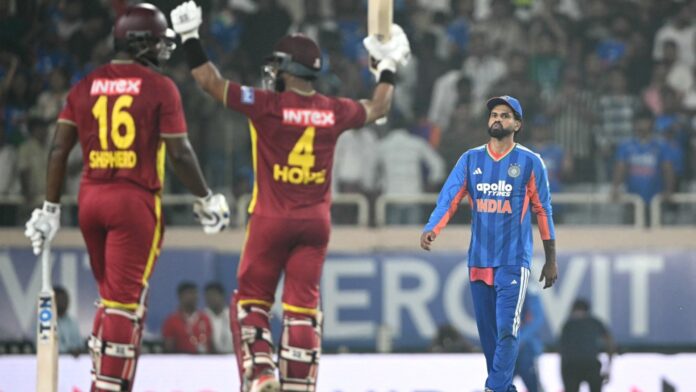

MUMBAI – Even by Indian cricket standards, the crowd at Brabourne on August 6 was operating at a different frequency. Tilak Varma, who at 21 has already batted through full-capacity IPL grounds without visible anxiety, walked off the field after India’s warm-up against South Africa and admitted the reception had surprised him. That detail – a professional cricketer genuinely startled by a pre-tournament friendly – says everything about what the ICC Men’s T20 World Cup means when it comes home to India.
India won the warm-up comfortably, with Varma among the batting contributors as Suryakumar Yadav‘s side used the Mumbai fixture to arrive mentally, not just physically, at what would become their most convincing run to a T20 World Cup title.
South Africa brought a different kind of preparation to the tournament: one built on results. Aiden Markram’s side navigated the group stage without losing a match. It was a run that drew increasing attention with each fixture. The Proteas bowled with variety, batted with composure under pressure, and kept each win looking like they had more in reserve. There was genuine belief, after each result, that this might finally be the year South Africa converted a promising campaign into the last step.
Kagiso Rabada had talked about the difficulty of winning finals before the tournament began. South Africa reached the T20 World Cup final for the first time in 2024, only to lose to India in a match settled by the smallest of margins. The group stage of 2026 looked different from 2024. So did the expectations.
The semifinal against New Zealand ended that conversation in 33 balls. Finn Allen, New Zealand’s opening batter, reached a century in 33 balls – the fastest hundred in T20 World Cup history – as New Zealand chased down South Africa’s total. The innings did not just win a match; it redefined the threshold for what fast scoring looks like in a knockout environment. South Africa’s bowlers, who had looked disciplined through six group games, did not have answers for it.

India’s other semifinal, against England, produced a different kind of record. Sanju Samson scored 89 from 42 balls and India reached 253 for 7, the highest total in T20 World Cup history. England’s chase was academic from the third over. Jasprit Bumrah, whose presence had been carefully managed through an earlier tour of England in which India conceded a 5-0 T20I series defeat, was not required to bowl his full allotment. The semifinal confirmed that India’s batting, when it functions at full capacity, does not leave enough for anyone else to do.
The period between India’s 2024 title and this tournament had not been without turbulence. India lost a T20I series for the first time in nearly three years, went through a captaincy reassessment, and relied on domestic performances to shape their selections. Vaibhav Sooryavanshi, in the richest form of any young Indian batter in the weeks approaching the tournament, was emblematic of the depth that gave India options other countries could not match.
The final at Narendra Modi Stadium in Ahmedabad on August 9 placed India against New Zealand – the two sides who had just dismantled the tournament’s other contenders. India scored 256 runs, and Bumrah took 4 wickets to restrict New Zealand to 159. The margin was 96 runs. It was India’s third T20 World Cup title, confirmed by All India Radio News as the only nation to have won the tournament three times.
The BCCI announced prize money of Rs 131 crore for the winning squad. Bumrah, named Player of the Match in the final, was the story within the story: a bowler managed away from non-essential summer fixtures and delivered to the tournament in the condition that mattered. Suryakumar Yadav’s captaincy handled the pressure of defending champions without visible crisis.
South Africa’s tournament, ending in the semifinal rather than the final, does not resolve as a straightforward failure. Going unbeaten through the group stage of a T20 World Cup is not a common achievement. Losing to the side that produced the fastest century in tournament history is not an underachievement story. What it leaves is the persistent question in South African knockout cricket: when does disciplined group cricket become enough?
The next test comes in October, when South Africa tour India for a bilateral T20I series. The first match is at Barsapara Stadium in Guwahati on October 1. The context is different from August – ranking points rather than a trophy – but the tactical questions from the tournament will travel. India will again be playing in front of audiences that do not understand the concept of a low-stakes fixture. Tilak Varma found that out in Mumbai on August 6. The crowd was right.