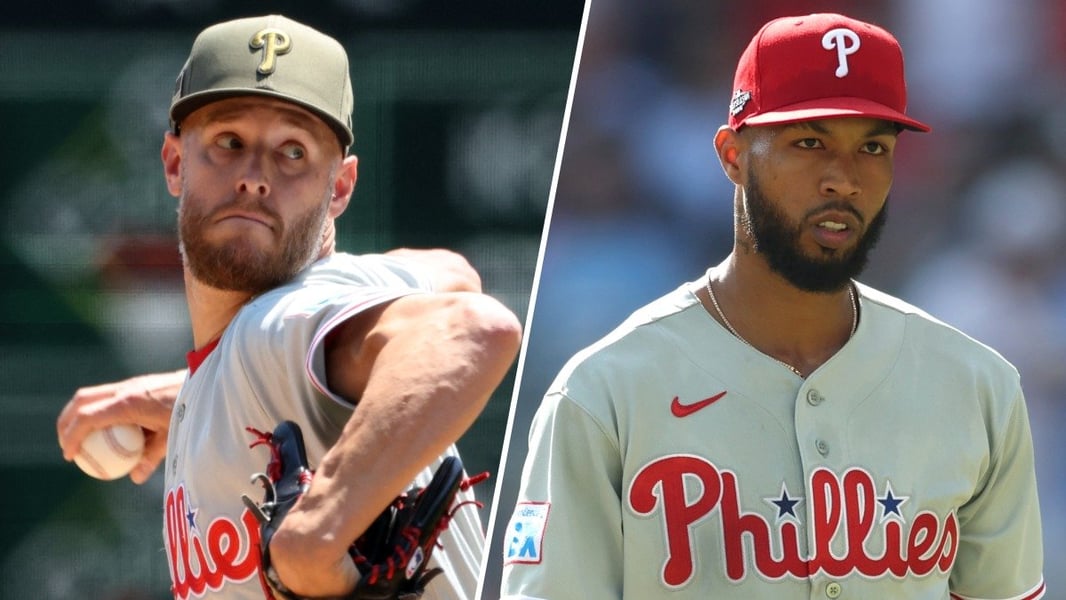

LAS VEGAS – Zack Wheeler reclaimed his place in Philadelphia’s rotation after surgery. Yordan Alvarez reclaimed far more than a place in Houston’s lineup. On Wednesday night, baseball rewarded both returns with its Comeback Player of the Year awards.
Wheeler won the National League honor and Alvarez took the American League award at the MLB Awards in Las Vegas. For Alvarez, it was one of five honors on a night that also brought his first Edgar Martinez Outstanding Designated Hitter Award, ending Shohei Ohtani’s five-year run.
Their seasons show why a comeback cannot be measured by one number. Wheeler had to rebuild the workload of a starting pitcher after thoracic outlet decompression surgery. Alvarez had to stay in the lineup after a fractured hand and an ankle injury had reduced his previous season to 48 games. Both returned to elite production, but they took different routes there.
Major League Baseball’s announcement put the scale of Wheeler’s recovery in precise terms. The 36-year-old returned on April 25 and made 28 starts, finishing 14–5 with a 3.00 ERA, 193 strikeouts and 47 walks in 162 innings.
That was not simply a successful appearance after an operation. Wheeler completed at least five innings in 24 of those starts and allowed two or fewer earned runs in 20. His return gave the Philadelphia Phillies repeated opportunities to use him deep enough into games to matter, rather than a handful of encouraging outings.
The starting point was serious. MLB said a blood clot in Wheeler’s right upper extremity ended his 2025 season in mid-August. He underwent thoracic outlet decompression surgery that September and missed the beginning of the following campaign. His award recognizes what followed on the field; it is not a medical guarantee about future seasons.
Wheeler’s strikeout total also carried a career landmark. On September 22, he reached 2,000 career strikeouts during an 11-strikeout performance in a 6–4 Philadelphia victory. MLB recorded it as his 310th career game, tying him for the 13th-fewest games needed to reach that mark.
For Alvarez, the most revealing figure may be 158. That was a career high in games played, 110 more than he managed in 2025. A right-hand fracture sustained on May 2 of that earlier season and a left-ankle sprain that ended it on September 15 had interrupted a player already established among the league’s most dangerous hitters.
The 29-year-old answered with his first AL batting title, hitting .316 with 42 home runs, 106 RBIs and a 1.033 OPS, the sum of on-base percentage and slugging percentage. He led the AL in on-base percentage at .432 and slugging at .601, combining frequent trips onto base with extra-base power.
The Houston Astros therefore received more than improved availability. Alvarez finished second in the AL in RBIs and tied for second in home runs. He fell short of the Triple Crown, which requires leading the league in batting average, home runs and RBIs, but his production extended well beyond the category he won.
There is an important distinction inside his awards haul. The league’s designated-hitter announcement credits Alvarez with a .305 average, 34 home runs, 83 RBIs and a .997 OPS in 134 games as a DH. Those figures describe only his work in that role. They do not replace his full-season totals.
Treating the two sets of numbers as interchangeable would understate his overall season or overstate his DH production. Alvarez also started 24 games in left field, MLB’s account noted. His full-season line and his positional award line answer different questions.
Kyle Schwarber finished second in the DH voting for the second consecutive season. Ohtani, who had won each of the previous five awards, was among the other players receiving votes. Alvarez became the first Astros player to win the honor.
His other Wednesday awards were the AL Hank Aaron Award, the Rod Carew AL Batting Title and All-MLB First Team designation at DH. Together with Comeback Player of the Year and the Edgar Martinez award, those made five honors. They did not include an MVP award: that result remained due Thursday night.
The comeback awards themselves were decided by MLB.com’s 30 club beat reporters. The DH ballots came from club beat writers, broadcasters and public relations departments, a separate process. Neither result should be presented as the outcome of the forthcoming MVP vote.
Both players became only the second recipients from their respective franchises. Wheeler followed Brad Lidge’s 2008 award for Philadelphia; Alvarez followed Justin Verlander’s 2022 honor for Houston. Their returns now sit in the same award history, though the practical achievement was different: Wheeler kept taking the mound after surgery, and Alvarez kept coming to the plate after a season in which he rarely could.