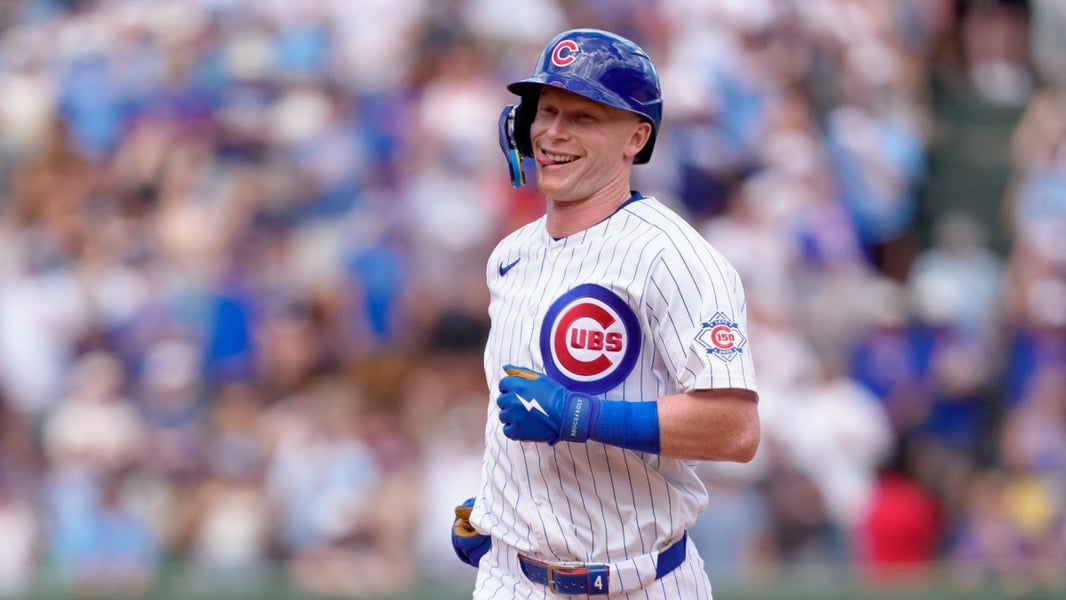

CHICAGO – The Cubs’ decade-long wait for another National League MVP ended without a single dissenting first-place vote. Pete Crow-Armstrong won the award Thursday, turning a season of power, speed and center-field defense into a distinction no previous Chicago winner had achieved unanimously.
The 24-year-old received all 30 first-place votes and the maximum 420 points. Shohei Ohtani of the Los Angeles Dodgers finished second with 264, followed by Milwaukee’s Brice Turang with 190. Crow-Armstrong ended Ohtani’s two-year reign as NL MVP while becoming the first Cub to win since Kris Bryant in 2016.
The result recognizes more than a spectacular collection of catches or membership in the 40-40 club. Crow-Armstrong combined both with a more selective approach at the plate, giving Chicago an everyday player whose offensive ceiling rose without surrendering the defense that first made him exceptional.
The Baseball Writers’ Association of America’s official results placed Crow-Armstrong first on every ballot, while Ohtani received 26 second-place votes, two thirds and two fourths. It was a decisive outcome even with a runner-up who has finished first or second in six consecutive MVP elections, a record identified by the association.
Crow-Armstrong completed the 40-40 pursuit that defined his September with 45 home runs and 41 stolen bases. That made him the seventh player to reach both thresholds in one season and the first to do it for the Cubs. His home-run total tied Kyle Schwarber for the major-league lead.
In MLB’s award-night report, Crow-Armstrong said he had not approached the season as a personal campaign to dethrone Ohtani. He described the challenge as “me vs. me every day,” saying that focusing on another player would have prevented him from getting the most out of himself.
The season’s batting line gives that explanation substance. Crow-Armstrong hit .280 with a .372 on-base percentage and a National League-leading .570 slugging percentage. His .942 OPS, the sum of on-base and slugging percentages, also led the league. He topped the majors outright with 84 extra-base hits, 119 runs and 357 total bases.
The change underneath those totals was patience. MLB’s account of Cubs MVP history recorded his walk rate climbing from 4.5 percent in 2025 to 11.4 percent this year. He became Chicago’s primary leadoff hitter on May 23 and hit .301 with a .397 on-base percentage and .652 slugging over the following 111 games, including 39 home runs.
That progression connects the spectacular moments to something more repeatable than a hot week. By the time his 42nd home run helped lift Chicago in the wild-card race, he was already matching Billy Williams’ club record for a left-handed hitter. He finished three homers beyond the mark Williams set in 1970.
His glove remained part of the case, not an accessory to the offense. Crow-Armstrong won his second Gold Glove, the NL Platinum Glove and the league’s Hank Aaron Award for offensive performance. MLB credited him with a major-league-best fielding run value of plus-26, the highest single-season figure for an outfielder under Statcast.
That combination fits the BBWAA’s voting instructions, which ask writers to consider the strength of offense and defense without prescribing one definition of “most valuable.” The unanimous ranking establishes that all 30 voters preferred him; it does not establish that they assigned identical weights to hitting, fielding and baserunning.
FanGraphs’ wins-above-replacement model put his season at 10.6 WAR, best in the majors and second in Cubs history behind Rogers Hornsby’s 11.0 in 1929, MLB reported. That is a named model’s estimate of overall value, not a literal count of victories he won alone. It also supplies a precise historical comparison rather than an unqualified claim that every measure ranks this as Chicago’s greatest individual season.
The franchise count needs a similarly clear boundary. As MLB’s historical list explains, Crow-Armstrong is the ninth different Cubs player to win the BBWAA award since the association began presenting it in 1931. Ernie Banks won twice, so those nine players account for 10 winning seasons. Earlier MVP recognitions belong to a broader historical count.
The sweep also forms part of an unprecedented awards year. With Yordan Alvarez unanimously elected in the American League and both Cy Young winners sweeping their ballots, the BBWAA recorded the first season since the pitching award began in 1956 in which all four winners were unanimous. The NL MVP itself has now been unanimous four years running.
None of that voting was a verdict on October. Writers submitted their ballots before the postseason, and the instructions limit consideration to regular-season performance. The San Diego Padres subsequently swept the Cubs out of the wild-card round, leaving Crow-Armstrong’s individual recognition separate from the championship Chicago did not win.
Crow-Armstrong made that distinction himself. While acknowledging the award as a major accomplishment, he told MLB that success meant being called a winner and that he was “not necessarily there yet.” He hopes eventually to answer questions as both a World Series champion and an MVP. The second title is now settled; the first is not.