
DUBAI – Virat Kohli was not supposed to be the only reason Pakistan lost this match. He was supposed to be one of several Indian batters who collectively managed a chase of 241. He arrived at the crease with India past the powerplay and the score progressing without drama. By the time he left with 100 runs unbeaten against his name, the match was concluded with more than seven overs remaining, and Pakistan’s departure from the Champions Trophy had become a question of when rather than whether.
It was February 23, 2025. Pakistan batted first at Dubai International Cricket Stadium after winning the toss and electing to bat. The decision had reasonable logic. Pakistan’s order had depth and experience. A first-innings total of 260 or 270 would have placed India in a different kind of contest. The 241 they produced in 49.4 overs handed Kohli the kind of target he has spent most of his ODI career converting without requiring a supreme effort.
Saud Shakeel top-scored for Pakistan with 62. His innings was the highest individual contribution in a Pakistan batting effort that never built the partnership structure a challenging total required. The middle order arrived at the crease in situations created by Shakeel and failed to extend them. Kuldeep Yadav’s figures of 3 for 40 were central to that collapse: he removed the key contributions before Pakistan could shift through gears in the final ten overs. The tail added without enough to spare. At 241 in 49.4 overs, Pakistan had set a total that was not undefendable, but one that required their bowling to execute on terms India’s batting unit is specifically designed to resist.
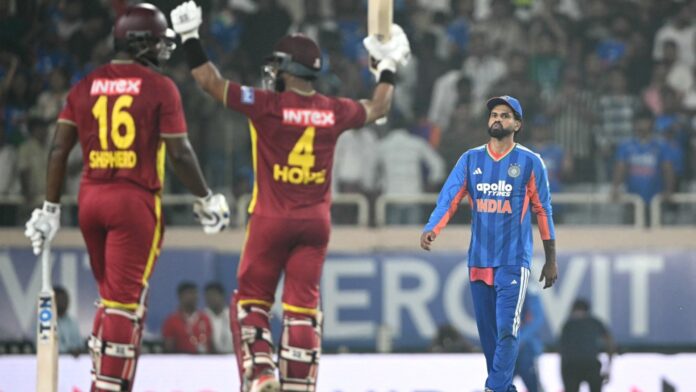
Shaheen Shah Afridi took 2 for 74 in 8 overs. He claimed the wickets his team needed, but the economy rate was too high for India’s chase to be destabilised. India lost 4 wickets in total, absorbing Pakistan’s best bowling effort without the scorecard pressure that might have forced a run-rate panic. Once Kohli had established himself in the middle of the order, the question was no longer whether India would get there but by what margin.
He reached his century off 111 balls. India closed at 244 for 4 in 42.3 overs, winning by 6 wickets. The 45 remaining balls made the margin of victory look as clear in overs as it had always felt in terms of control. Pakistan’s bowling, considered one of the more potent attacks in the world heading into the tournament, had produced two wickets at significant cost and conceded a chase with minimal drama after the fifth over.
The century was Kohli’s 51st in ODI cricket, a format in which he has occupied a position of numerical dominance for the better part of a decade. It also made him, at 36 years and 110 days, the oldest player in Champions Trophy history to score a century in the format, per ICC records. During the course of the innings he completed 14,000 runs in one-day internationals, the fifth player in history to reach that mark. He surpassed Shikhar Dhawan’s tally to become India’s highest run-scorer in Champions Trophy history. Three records, one afternoon, against Pakistan, in a match where his total was the number that made all the preceding arithmetic meaningless.
Kohli’s 52nd ODI century came the following December in a different bilateral context. But the 51st carried a specific weight that no subsequent milestone could replicate: it was the first time in Champions Trophy history that he converted a substantial innings into three figures, and it arrived in the one fixture within the format that commands the largest viewing audience in world cricket. The occasion and the performance aligned in a way that a less public venue might not have.
Pakistan’s broader Champions Trophy campaign never recovered from this afternoon. Their match against Bangladesh was abandoned due to rain, denying them even a consolation outcome in the group stage. The structural question their campaign raised was not whether they could beat India on a given day, but whether 241 was ever going to be enough to do it at this venue, against this batting order. The answer the afternoon provided was straightforward.
Kohli’s 84 against Australia in the semi-final ten days later confirmed that the Pakistan match had not been an outlier. He was in a form that found surfaces and conditions in Dubai specifically conducive to building innings. The tournament’s format, concentrating matches in the UAE for the neutral-venue games, placed Pakistan and Australia in contests against an Indian batting order that was consistently making 240-plus totals look manageable. By the time India beat New Zealand in the final to claim their third Champions Trophy title, the group-stage result against Pakistan had become a footnote to a broader pattern.
There is an argument that Pakistan’s attack was undermined by the surface conditions as much as by any individual failure. Virat Kohli batting on a slow Dubai pitch with a settled mind and without the pressure of a steep target is a specific combination that most bowling attacks in the world currently struggle to address. Shaheen Afridi is not most bowlers, and yet the figures tell the story of a match where the bowling was neither poor enough to exonerate Pakistan’s batters nor penetrating enough to prevent what happened in 42.3 overs. The records Kohli set on February 23, 2025 are the arithmetic of a match that went as a match of this kind, between these sides, in these conditions, was structurally likely to go.