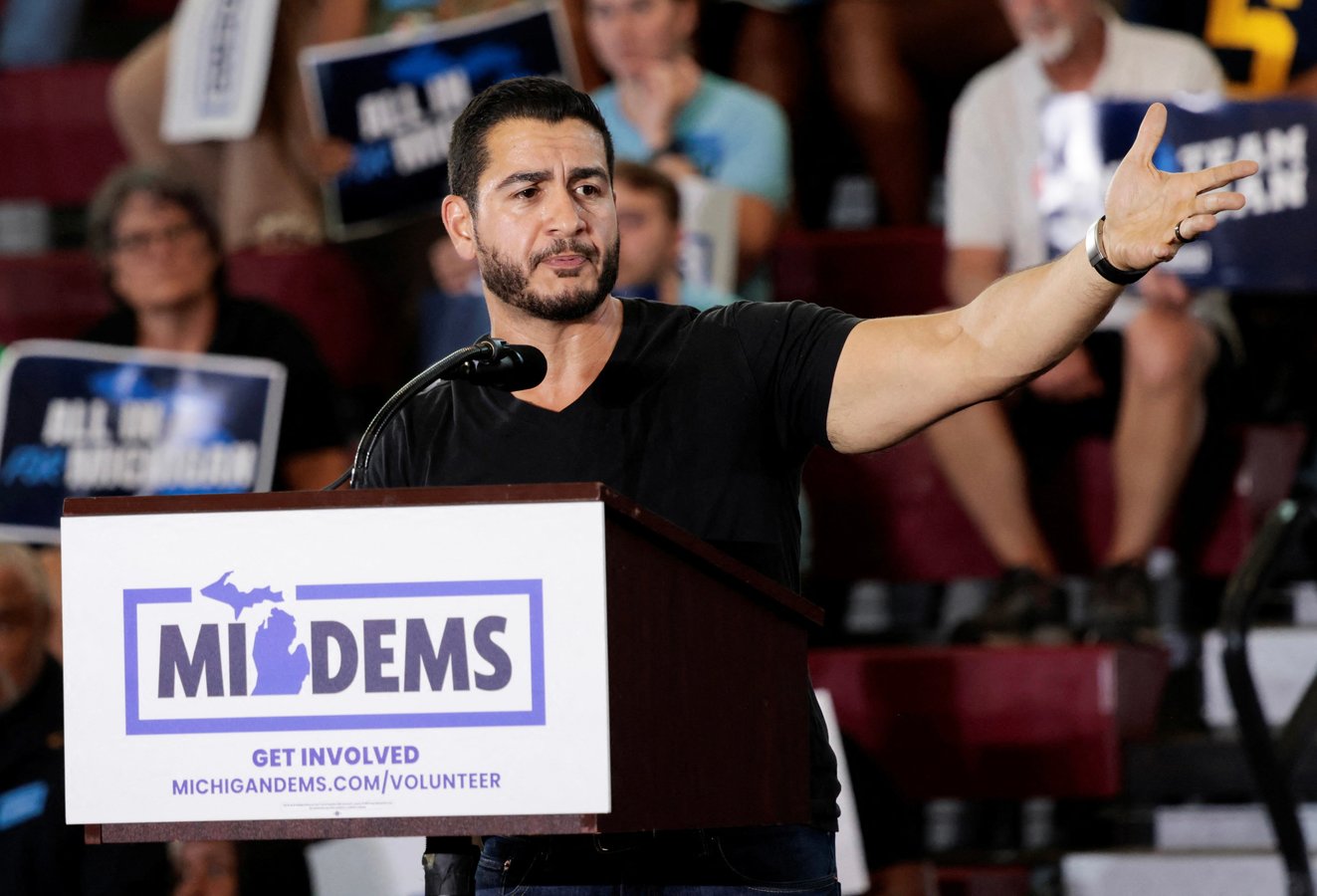

DETROIT – By the time Abdul El-Sayed appeared on NBC’s “Meet the Press” on Sunday morning, the primary was four days behind him and the phone call he had been waiting to discuss was about to become public.
Barack Obama had called him on Friday, El-Sayed told the program. The conversation, which El-Sayed described as “very warm, very inviting,” had turned to unity and to the role Michigan would play in the general election. “Sometimes, you should meet your heroes,” El-Sayed said. Obama, he added, “knows the critical role that Michigan is going to play.”
The call marked the clearest signal yet that the Democratic Party’s most recognized figure intended to involve himself in Michigan’s general election, though in what capacity remained unconfirmed. El-Sayed said he hoped Obama would campaign with him in the state against Republican Mike Rogers, a former congressman who has already begun appealing to Democrats disillusioned by the primary’s outcome. Obama reached out to both El-Sayed and Representative Haley Stevens, the candidate he defeated, in the days following the Michigan Senate primary, a gesture widely read as the party’s elder statesman attempting to play a unifying role.
The question is what unity is worth in a race where the primary’s wounds are still fresh.
El-Sayed, a 41-year-old physician and former Detroit health director, narrowly defeated Stevens in Tuesday’s contest, PBS NewsHour reported. The primary was too close to call for much of election night, and when results were confirmed the outcome exposed the fracture lines running through Michigan’s Democratic coalition. Stevens, backed by the party establishment and national moderates, had argued that El-Sayed’s progressive platform and his identity as a Muslim American would be liabilities in a state both parties consider essential to controlling the Senate. El-Sayed’s supporters answered that argument by turning out in sufficient numbers to produce a narrow win, making him the first Muslim American to receive a major-party Senate nomination in Michigan’s history.
“We might see the world differently,” El-Sayed said Sunday. “But we also recognize the responsibility to come together.”
Stevens has not yet said how actively she will work for her primary opponent. That decision will carry real weight. Rogers, watching the Democratic fractioning from the Republican side, offered an opening of his own. “You have a home with us,” he said to Democrats who had supported Stevens, a pitch aimed at voters already disposed toward a moderate candidate. The Kansas Senate Democratic primary earlier this month showed how intraparty divisions can reshape a competitive state’s general election map. Michigan’s stakes are considerably higher.
Islamophobia has surfaced quickly as a weapon. Conservative commentators and Trump allies began circulating comments about El-Sayed’s faith within hours of Tuesday’s result, with at least one prominent figure asking rhetorically, “hint hint, he’s Muslim?” The comment was framed as political observation while operating as a threat. It follows a pattern of organized anti-Muslim hostility that has tracked the rise of Muslim American candidates in national politics, a pattern that turned violent in May when the San Diego mosque shooting placed that hostility in its most brutal terms. El-Sayed has said he “embraces” representing “a very different” America, and that his candidacy demonstrates the country’s capacity to expand the circle of who can hold national office.
The general election will be contested against a backdrop of unresolved fiscal questions. The Senate returned from recess this week carrying an unfinished Republican budget reconciliation package that will shape the economic context for every competitive race this fall. El-Sayed and Rogers will each have to explain what they intend to do for Michigan workers, particularly in an automotive sector navigating the electric transition, and the distance between their positions will form one of the primary contrasts of the general election campaign.
El-Sayed’s primary coalition drew heavily from younger voters, Arab and Muslim American communities concentrated in Dearborn and other southeast Michigan cities, and progressives who had grown impatient with the centrist wing of the party. That coalition was sufficient for Tuesday. A general election requires more, and whether El-Sayed can build beyond his base while holding it is the central uncertainty his campaign now faces.
Other 2026 primary contests have produced similar tests. The Hawaii Senate primary produced a dynamic where an establishment incumbent survived a progressive challenge and now faces the work of reassembling a coalition for November. In Michigan, the direction runs the other way: the progressive won, and it is the establishment whose support he needs. Whether Obama’s phone call represents the beginning of that convergence or only its opening gesture is what the next several months will determine.
The party’s national infrastructure is watching carefully. The DCCC, which has expanded its list of competitive House targets across the industrial Midwest, will be calibrating how Michigan fits into the broader midterm picture before committing resources that signal genuine investment. Obama’s aides have not indicated the full scope of his planned 2026 involvement, and his relationship with El-Sayed is new enough that a phone call and a campaign appearance represent different levels of commitment.
What El-Sayed has, for now, is a nomination no Muslim American has previously won in Michigan, a phone call from the party’s most prominent figure, and a Republican opponent telling Democratic voters they have a home elsewhere. What he makes of those three things, and whether Stevens’ voters follow their candidate’s lead once she decides what that lead is, will determine whether Tuesday’s result becomes a pivot for the party or remains a historic first with no sequel.