
MOSCOW — Russia accused Ukrainian authorities and unnamed Western nongovernmental organisations on Friday of helping turn Ukraine into a major synthetic-drug production centre, raising allegations that go beyond what the independent evidence reviewed establishes.
Foreign Ministry spokesperson Maria Zakharova made the accusation in a written response to a European anti-drug initiative. She alleged that Ukrainian authorities worked with criminal drug networks and Western NGOs to make the country both a transit point for prohibited substances and “one of the world’s largest” synthetic-drug laboratories, according to a translation of the ministry’s Russian-language statement.
The underlying problem is documented. A United Nations study describes expanding synthetic-drug production and consumption in Ukraine, while cross-border investigations have uncovered extensive laboratory networks. But neither the UN findings nor the enforcement operation examined for this article establishes that Western NGOs organised the production, or provides a global ranking supporting Zakharova’s description.
Zakharova did not identify the NGOs she accused. Her Foreign Ministry statement also did not present financial records, named criminal proceedings or production estimates connecting those organisations to clandestine laboratories. The allegation therefore remains a Russian government claim rather than an independently established finding.
The distinction matters because evidence that criminal networks operate inside a country is not, by itself, evidence that its government directs them. Nor does the discovery of laboratories establish the involvement of foreign civil-society organisations. Those are separate allegations requiring separate evidence.
Earlier coverage of drug use on Ukraine’s front lines concerned consumption under wartime conditions, a different question from who operates clandestine laboratories. That reporting should not be read as evidence of the Western NGO involvement alleged here.
The United Nations Office on Drugs and Crime examined the country’s illicit markets in its July 2025 report, Ukraine: Organized Crime Dynamics in the Context of War. Drawing on official statistics, court decisions, published research and interviews, it found that Ukraine’s synthetic-drug market had expanded in line with wider regional trends. Its principal research period ran from January 2021 to June 2024, with earlier data included for context.
The report identified rising demand for synthetic stimulants, synthetic opioids, principally methadone, and new psychoactive substances. It also described the increasing importance of cathinones, a category of stimulants, and the role of structured criminal organisations in producing and distributing synthetic drugs. These developments were not confined to Ukraine: the report placed them within a broader shift across Eastern Europe and Central Asia.
Ukrainian authorities’ figures cited in the report showed a substantial increase in dismantled clandestine laboratories over several years. The recorded totals were 17 in 2019, 79 in 2020, 94 in 2021, 61 in 2022 and 102 in 2023.
Those figures measure laboratories detected and dismantled, not total national production. The report also cautioned that increases in some seizures could reflect renewed enforcement attention, more checkpoints and security measures. They cannot be read as a direct measure of how much the country produces, or used alone to rank it against other producers.
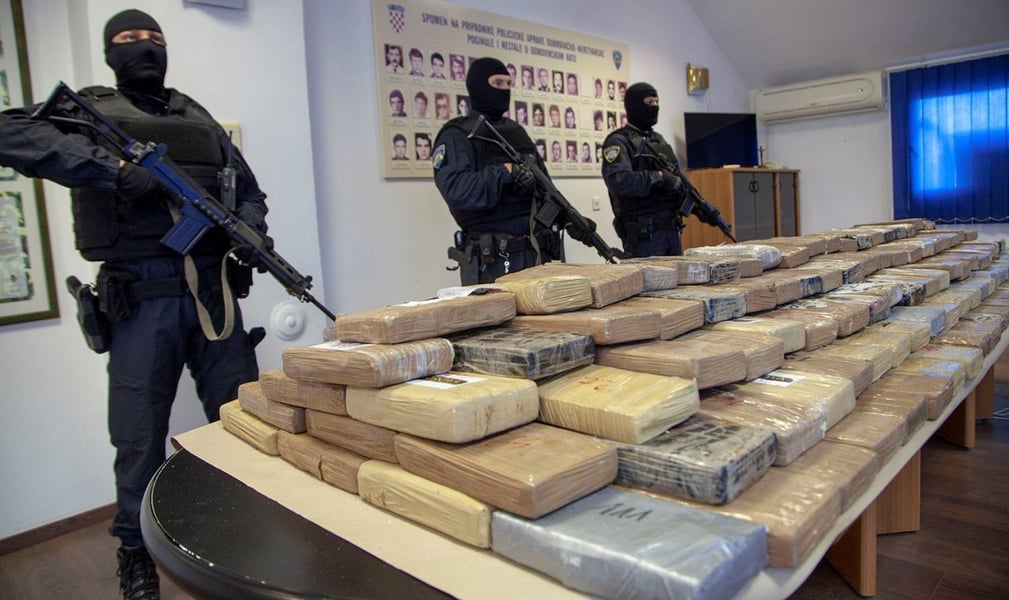
A more recent investigation illustrates the scale of individual networks. In February 2026, authorities in Ukraine, Poland and Moldova, supported by Europol, conducted a coordinated operation against synthetic-drug production and trafficking. OCCRP reported that the operation dismantled 36 laboratories across Ukraine and Poland and resulted in more than 100 arrests.
The national breakdown is important. Ukrainian police reported dismantling 34 laboratories and 74 storage facilities, while Polish investigators reported shutting two laboratories. The 36-laboratory figure was a combined cross-border total, not a count of sites discovered solely in Ukraine.
Investigators said the network operated a production chain stretching from the importation of chemical precursors to the distribution of finished drugs in Ukraine, Poland and Moldova. Europol said it misused legal business structures operated by Polish and Lithuanian individuals with previous involvement in synthetic-drug production. OCCRP’s account did not identify Western NGOs as participants.
The UN study also recorded an active Ukrainian law-enforcement response. It found that national institutions continued to combat organised crime during the war through legislative measures, investigations, prosecutions and convictions. Police and security agencies had disrupted dozens of organisations involved in drug production and trafficking, including cross-border operations.
That does not rule out corruption or official complicity in particular cases. It does mean the available record contains both evidence of criminal expansion and evidence of state action against it. The broader allegation that Ukrainian authorities collectively transformed the country into a drug-production enterprise requires more than the existence of illicit laboratories.
Zakharova’s remarks formed part of a wider argument over international cooperation. The Foreign Ministry said it was responding to a statement by leaders of the European Coalition against Drugs, which it described as involving the European Union, Britain and their partners. Moscow welcomed cooperation on enforcement, cross-border investigations and information-sharing, while rejecting accusations that Russia had worsened Ukraine’s drug situation.
She also urged European governments to remove what Moscow described as politicised restrictions on law-enforcement cooperation with Russia. That was the diplomatic demand accompanying the drug-production allegations. The precise wording of the European declaration was not independently verified for this draft, so Moscow’s description of it should not be treated as the declaration itself.
The evidence reviewed supports reporting that Ukraine faces a serious synthetic-drug problem involving domestic production and transnational criminal organisations. It does not establish the alleged Western NGO role or the claimed global standing. Zakharova’s statement leaves both unresolved: which organisations Moscow accuses, and what evidence would connect them to the laboratories.