
NAIROBI – For Caitlin Brady, the country director of the Danish Refugee Council in Congo, the news was the thing that changed every calculation. Ebola had reached Kpanga.
“We are all really worried that Ebola in these camps will spread extremely quickly,” Brady told Reuters, “and that there will be panic and people will flee all over whether or not they are contacts, whether or not they are ill.”
The Kpanga camp in Ituri province holds 30,000 internally displaced people. Hundreds of residents share a single toilet. Two of them died from the Bundibugyo strain of Ebola on May 31 and June 1, the United Nations refugee agency confirmed Thursday – the first fatalities recorded inside a displacement camp since the outbreak was declared on May 15. The virus has now spread across three provinces: Ituri, North Kivu, and South Kivu.
That geographic fact matters less than what the World Health Organization said alongside it. Olivier le Polain, the agency’s head of epidemiology and analytics, told reporters Friday that cases are being identified in new health zones within those three provinces on a near-daily basis. More revealing was what he said about the ones that aren’t being identified at all.
“There are still many blind spots in some areas that are high risk,” le Polain said. “The full scale of the outbreak is not yet clear, and we will get more clarity as surveillance improves.”
That is a precise and significant admission. For weeks, epidemiologists tracking the Bundibugyo outbreak in eastern Congo have described a response that was chasing the virus rather than getting ahead of it. What has shifted since the camp deaths is the nature of what is being chased. Until recently, new cases in previously unaffected areas could be traced back to travel from known hotspots. That traceability is now eroding. Le Polain said the WHO is also seeing “local community spread in new areas” – transmission that does not connect back to a single source and cannot be predicted or contained through contact-tracing alone.
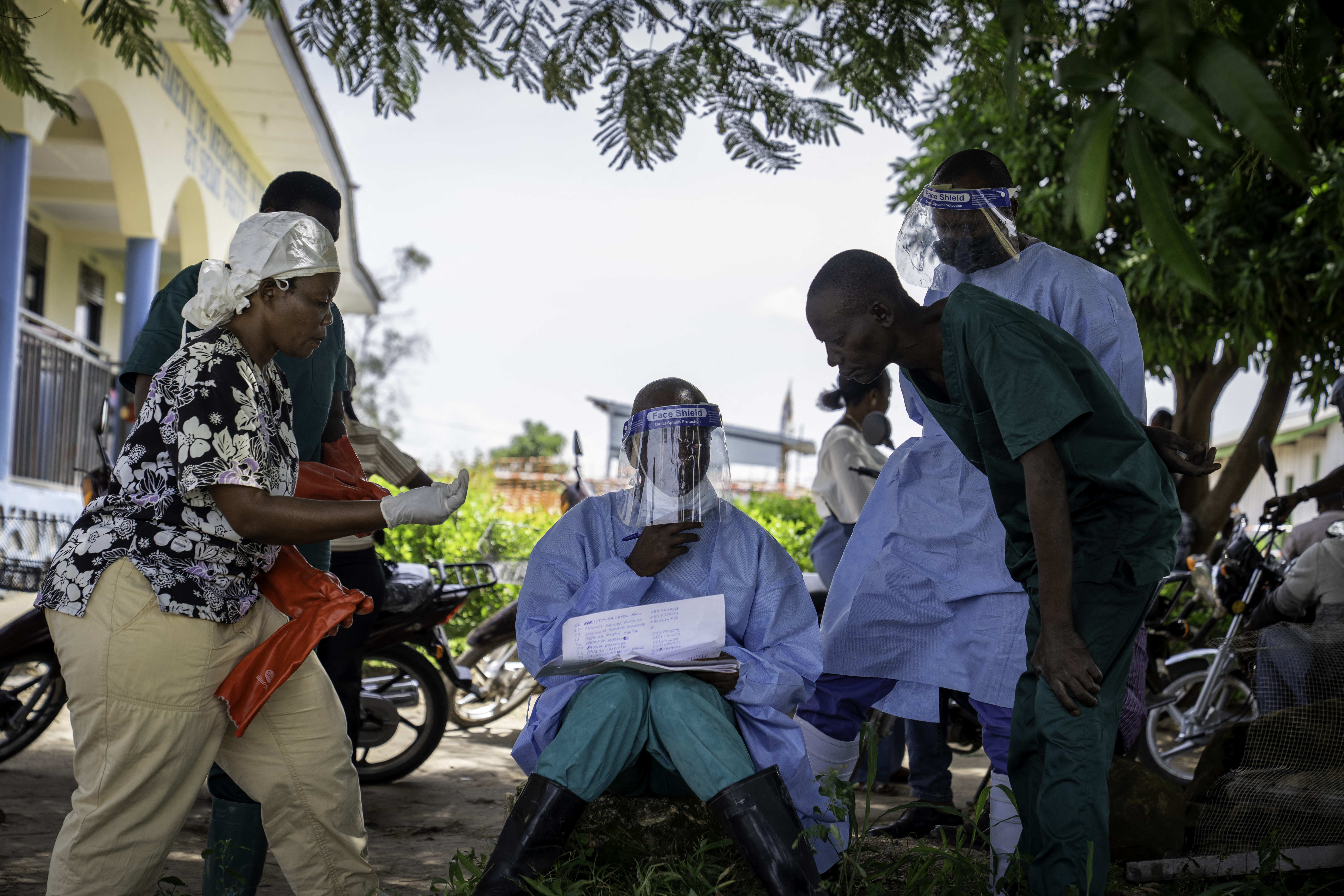
The outbreak, DRC’s 17th involving Ebola, is caused by the Bundibugyo virus – a species for which no approved vaccine or specific treatment exists. The case fatality rate in the two previous Bundibugyo outbreaks ranged from 30 to 50 percent, according to the WHO. As of Friday, 676 confirmed cases have been recorded in the DRC, with 136 deaths, and a further 119 suspected. Thirty-two patients have recovered. Uganda has confirmed 19 cases and two deaths, with the African Union’s health agency describing that situation as “under control.”
Control is the operative question inside Ituri. The province already hosts 273,000 displaced people, a product of decades of conflict over its mineral wealth. Armed rebels deny the government full administrative reach over significant portions of territory, leaving roads destroyed, clinics unstaffed, and communities cut off from response teams. Burial teams have been attacked. A treatment center was torched. The WHO has said isolation bed capacity remains far below what the outbreak’s scale requires.
Le Polain said contact tracing was improving but remained “still too low to ensure appropriate control.” The material problem is not only technical. “If you don’t have any space to put your patients safely, it becomes very difficult,” he said – meaning the bottleneck is not just identifying who is sick, but having somewhere to isolate them once identified.
The camp dimension adds a layer that previous phases of this outbreak did not carry. Displacement sites are, by design, dense. Kpanga is not exceptional; Ituri alone held more than 273,000 displaced people as of the most recent humanitarian count, and the province’s camps share the characteristics that make disease control difficult: inadequate water, sanitation, and shelter, combined with populations that have little reason to trust authorities who have repeatedly failed to protect them.
The WHO’s acknowledgment that the full scale is unknown is not a bureaucratic hedge. It is a structural description of a surveillance system that cannot see into areas where security prevents teams from operating. Le Polain said that in recent weeks, cases in new areas could at least be traced to travel from identified hotspots. That traceability provided a kind of mapping, however incomplete. With community spread now confirmed in new areas, that map is no longer reliable as a guide to where the virus will appear next.
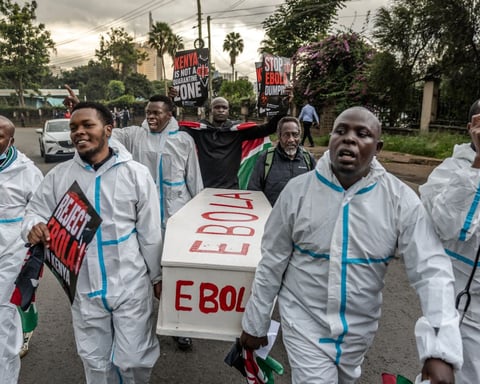
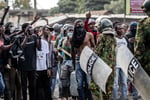
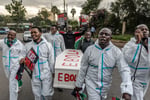
An American surgeon who contracted Ebola while working in Congo was discharged from Berlin’s Charité hospital earlier this month after treatment, becoming a signal moment in the outbreak’s international dimension. The United States has been attempting to construct a quarantine facility in Kenya, an effort that has sparked protests, a court injunction, and questions about the legal authority under which American public health infrastructure operates on foreign soil.
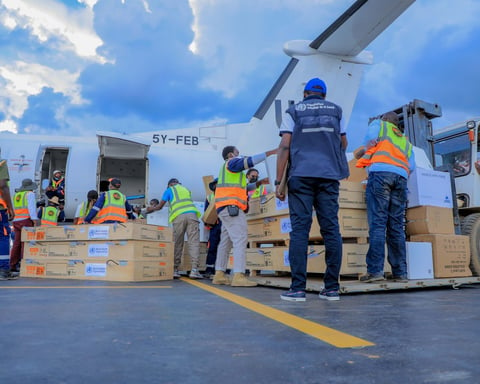
Al Jazeera reported that the WHO has said “a lot more needs to be done” across every dimension of the response – supplies, surveillance, isolation capacity, and community engagement. Whether the international community can supply that, and quickly enough to prevent further camp-to-camp spread, is what the next weeks will determine. The Kpanga deaths are not an aberration. They are the clearest signal yet that the outbreak has entered a phase its response infrastructure was not designed to manage.
What comes next in the camps – whether panic-driven movement does what the contact tracers could not contain – remains, for now, an open question.