
Google’s next move in artificial intelligence is becoming clearer and more disruptive. Internal code findings and multiple reports suggest the company is preparing to fundamentally reshape how its AI assistant works, not just by adding features but by removing familiar ones.
Recent findings from an APK teardown reveal that Google is planning to remove Gemini’s existing voice options altogether. Hidden code strings explicitly state that “legacy voices are going away,” signaling a major overhaul of how users interact with the assistant through speech. The current Gemini app offers multiple voice styles, but those may soon disappear without a direct replacement announced. The absence of details strongly suggests that Google is preparing something more advanced, possibly tied to generative AI voice synthesis or customizable voice creation.
This isn’t just a cosmetic change. Voice has long been central to digital assistants, dating back to the early days of Google Assistant. But as Gemini becoming more conversational and human-like, the company appears ready to move beyond traditional voice interfaces.
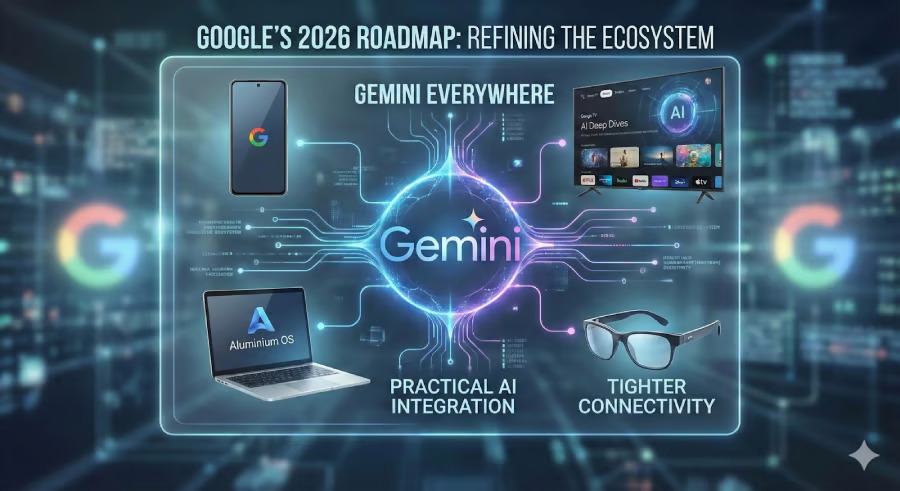
This evolution reflects a broader shift already underway, where Gemini is already operating proactively across Google services, preventing harmful content before users even encounter it. In a similar direction, the assistant is expanding its reach beyond traditional use cases, signaling a move toward a fully predictive AI ecosystem.
Google has emphasized privacy in this system, stating that the data used for proactive suggestions is processed entirely in a private, encrypted space on the device and is not used for AI training. Still, the implications of such deep integration are vast, especially as AI becomes more embedded in everyday workflows.
These changes are not happening in isolation. They are part of a larger, long-confirmed transition: Gemini is replacing Google Assistant across Android devices. The shift has already begun to take shape across platforms, including Gemini replacing Google Assistant across smart devices, marking a decisive break from the past decade of voice-first interaction.
The transformation also aligns with broader ecosystem expansion. From desktops to mobile devices, the Gemini app expansion across devices shows how Google is positioning its AI as a universal interface across environments.
Meanwhile, the company’s ambitions extend even further. Gemini is increasingly being integrated into browsers and productivity tools, demonstrating how Gemini is expanding beyond voice into contextual AI across apps is becoming a core part of Google’s long-term strategy.
At a macro level, this is part of AI reshaping app ecosystems globally, where predictive intelligence is redefining how users interact with software entirely.
At first glance, losing a few voice options might not sound like a big deal. But combined with proactive AI, it signals a turning point. Google is effectively redefining the assistant model from reactive to predictive, from voice-first to context-first, and from commands to continuous assistance.
This mirrors a broader race among tech giants to build AI systems that feel less like tools and more like companions. Yet, the risks are equally clear. Proactive AI depends heavily on access to personal data, and even with on-device processing, users may find the idea of an assistant that anticipates needs unsettling.
There is also the question of control. Traditional assistants respond when summoned. Proactive systems intervene on their own. That shift could blur the line between helpful and intrusive, especially as Android’s biggest AI transformation yet unfolds in the coming months.
In the near term, users may begin to notice gradual changes: the disappearance of existing voice options, the introduction of proactive suggestions, and interface updates designed around continuous assistance rather than one-time commands.
Long-term, the implications are far more significant. Gemini could become the default interface for interacting with devices quietly working in the background, surfacing information, and guiding decisions without explicit input.
Google isn’t just upgrading its assistant. It is replacing the very idea of what an assistant is. By removing legacy voice features and introducing proactive intelligence, Gemini is moving toward a future where AI doesn’t wait, it acts.
Whether users embrace that future or resist it may determine how far Google can push this next evolution of artificial intelligence.
Related Posts