
SANTA CLARA – Advanced Micro Devices reported record revenue on Tuesday, capping a quarter in which its data center business more than doubled and executives set a third-quarter revenue forecast suggesting the AI spending wave driving its competitors has arrived in full force on AMD’s own balance sheet.
Total revenue for the second quarter reached $11.536 billion, up 50 percent from the $7.685 billion AMD reported a year earlier and up 13 percent from the first quarter. It was the company’s highest quarterly revenue in its history.
The number that mattered most to investors was data center: $6.718 billion, a 107 percent increase from $3.240 billion in the second quarter of 2025. For the first time in the company’s history, data center revenue exceeded half of total quarterly revenue, accounting for 58 percent of the total. The division sells processors and graphics chips to hyperscale cloud providers and enterprises building out AI infrastructure.
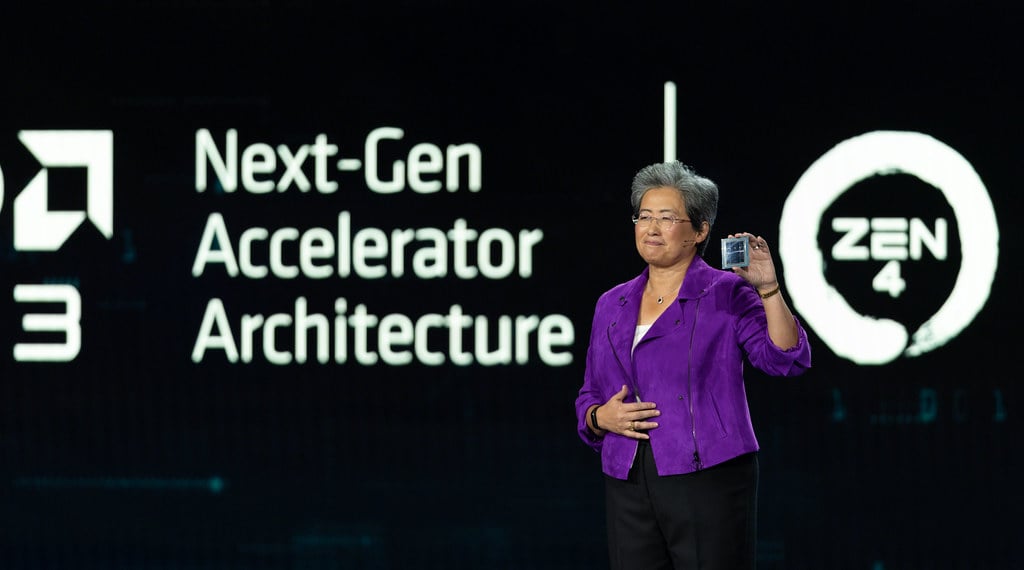
“We delivered an excellent quarter, with record revenue and profitability as Data Center revenue more than doubled year-over-year,” said Lisa Su, AMD’s chairman and chief executive.
Outside data centers, the picture was mixed. Client revenue, covering processors sold for personal computers and laptops, rose 23 percent to $3.062 billion from $2.499 billion a year earlier. Embedded revenue, covering custom chips used in communications and industrial equipment, climbed 19 percent to $977 million. Gaming declined 31 percent to $779 million from $1.122 billion as AMD continues to redirect production capacity toward data center applications rather than defending a consumer segment where margins are lower and AI tailwinds weaker.
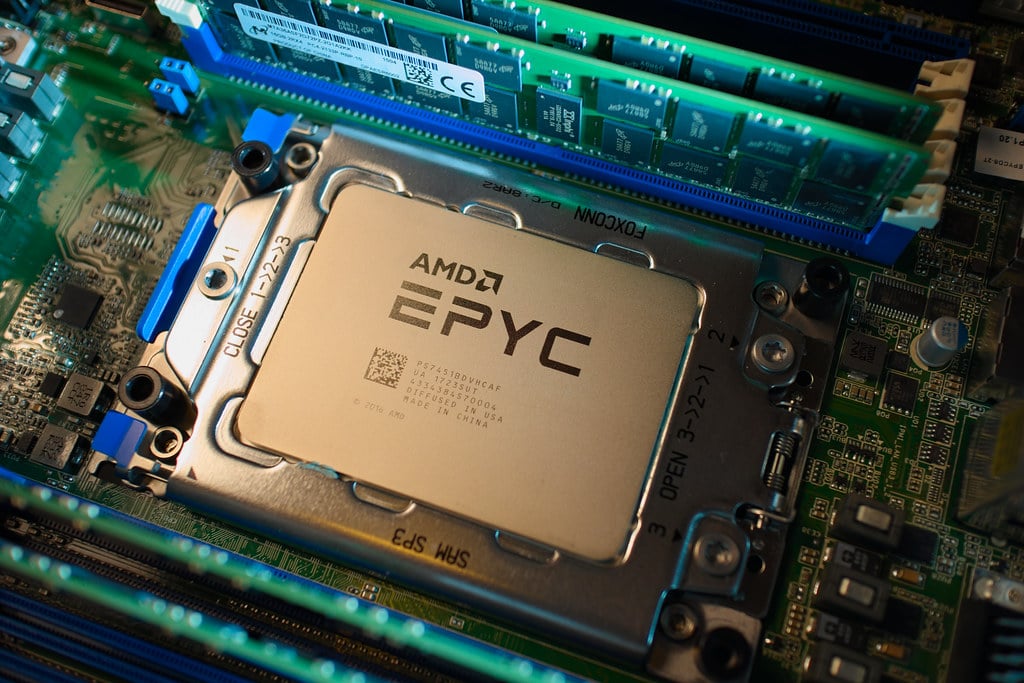
AMD’s Instinct accelerators, which compete with Nvidia’s Vera CPU and H-series GPUs in AI training and inference workloads, are the product line behind the data center surge. The company has also extended its EPYC server processor franchise into fifth-generation silicon, contributing to the data center total alongside Instinct. The question that has stalked AMD through the AI chip boom is software: whether its ROCm ecosystem has closed enough ground on Nvidia’s CUDA to win customers through compatibility rather than through price alone.
AMD’s operating income under generally accepted accounting principles reached $1.990 billion in the quarter, against an operating loss of $134 million in the second quarter of 2025. Net income under GAAP totaled $2.297 billion. The swing from a loss position to nearly $2 billion in GAAP operating income in twelve months shows how thoroughly AMD’s financial profile has shifted from a company generating thin profits on mixed consumer segments to one extracting meaningful margin from enterprise infrastructure. Non-GAAP earnings per share came in at $1.66, against $0.48 a year earlier.
The gaming segment’s 31 percent decline is by now a familiar line item for AMD shareholders. AMD deliberately exited integrated graphics chip contracts that once propped up gaming revenue, and the company has indicated it expects gaming to continue shrinking as it completes that pivot. The broader market absorbed the drop without apparent concern, because the data center gain dwarfs it by several times over. What mattered was that total company revenue kept growing at 50 percent even as one of its four segments contracted sharply.
For third-quarter 2026, AMD guided for approximately $13 billion in revenue, plus or minus $300 million, with a non-GAAP gross margin of around 56 percent. At the midpoint, $13 billion would represent roughly 41 percent growth from the third quarter of 2025. If AMD hits that number, it will have produced more revenue in the second half of 2026 than it generated in all of fiscal year 2023.
The broader context for AMD’s results is a capital-spending environment that has shown no signs of cooling. Anthropic committed $10 billion to a Norwegian data center buildout this week, and Samsung reported a similarly strong AI-demand signal in its own second-quarter results. The chipmakers most exposed to AI infrastructure have been reporting consistent revenue beats. The full details of AMD’s quarter are available in the company’s second-quarter earnings release.
What AMD has not done is threaten Nvidia’s dominance at the top of the AI chip market. Nvidia’s data center revenue in its most recent quarter exceeded AMD’s by a significant multiple, and the gap in software ecosystem depth remains AMD’s most persistent competitive disadvantage. But AMD no longer needs to displace Nvidia to be a meaningful beneficiary of the same spending wave. A market large enough for one dominant player and one credible alternative is still large enough to produce $11.5 billion quarters. Tuesday’s report was evidence that AMD has secured its position as that alternative, and that its executives are willing to say the third quarter will look even bigger.