
SAN FRANCISCO — Anthropic gave its Claude AI a database of roughly 200,000 reverse transcriptase enzyme sequences and a broad question. Twenty-one hours later, the model returned a three-component molecular system that no human researcher had previously identified, one carrying a structural resemblance to CRISPR, the gene-editing architecture that earned its discoverers a Nobel Prize.
The finding, published as a preprint on September 23, is being called ART: array-associated reverse transcriptases. The system was found in bacteriophage DNA, viruses that infect bacteria rather than human cells, and its three components include a reverse transcriptase enzyme, a partner gene whose function is currently unknown, and a long, evenly-spaced DNA repeat array that resembles the repeat structures at the core of CRISPR-Cas systems. Whether ART does anything useful, harmful, or biologically interesting is still an open question. That is perhaps the most important thing to understand about this announcement.
Anthropic researchers deployed roughly 950 Claude agent sessions to run the search. The model screened 200,000 sequences, flagged approximately 3,500 candidate systems, and narrowed those to 20 that looked genuinely compelling. The company’s life sciences group, formed in spring 2026, has since begun laboratory experiments to characterize the structure, though all physical lab work is performed by human researchers, not the AI.
Feng Zhang, the MIT and Broad Institute biologist who was among the first to adapt CRISPR for human genome editing, said the discovery warranted further investigation and called the repeat arrays “genuinely intriguing.” That is a qualified endorsement from a credible name, but not independent verification. The preprint has not been peer-reviewed, and Anthropic has explicitly invited other research teams to submit proposals to study the system.
What AI-led research represents in practice is beginning to look different from what most people imagined. Claude is currently credited with leading 26 percent of Anthropic’s own internal research and development work. That figure has grown steadily since the company began deploying agents autonomously across its research pipeline, and the ART discovery is the company’s highest-profile example of a result that came from open-ended computational searching rather than human-directed hypothesis testing.
The conventional picture of AI-assisted science involves a researcher asking an AI to accelerate a specific task: searching literature, modeling proteins, generating hypotheses about a defined problem. What happened here was closer to an open-ended hunt. Anthropic set the question broadly and let the model explore. The model returned something the researchers themselves had not anticipated looking for. That distinction matters because it changes what the technology is actually doing, and raises different questions about how to evaluate what it finds.

One version of this story ends with ART proving genuinely significant: a novel molecular tool with real biological applications, or a clue about how phage-bacteria dynamics evolve over time. Another version has the repeat arrays turning out architecturally interesting but biologically inert, or the resemblance to CRISPR reflecting convergence rather than functional kinship. Anthropic does not know which version is correct. This year has produced a recurring pattern of questions about AI containment and autonomous behavior that have moved from theoretical to operational across multiple deployments.
ART is not an alignment failure. There is no evidence Claude operated outside its assigned parameters. But the cluster of incidents involving autonomous AI behavior in 2026 has made context relevant. This week’s Australian government probe into an AI agent’s unauthorized access to Medicare records is unrelated to Anthropic’s research program, but both stories speak to the same underlying question: what does it mean for an AI model to find something nobody told it to find?
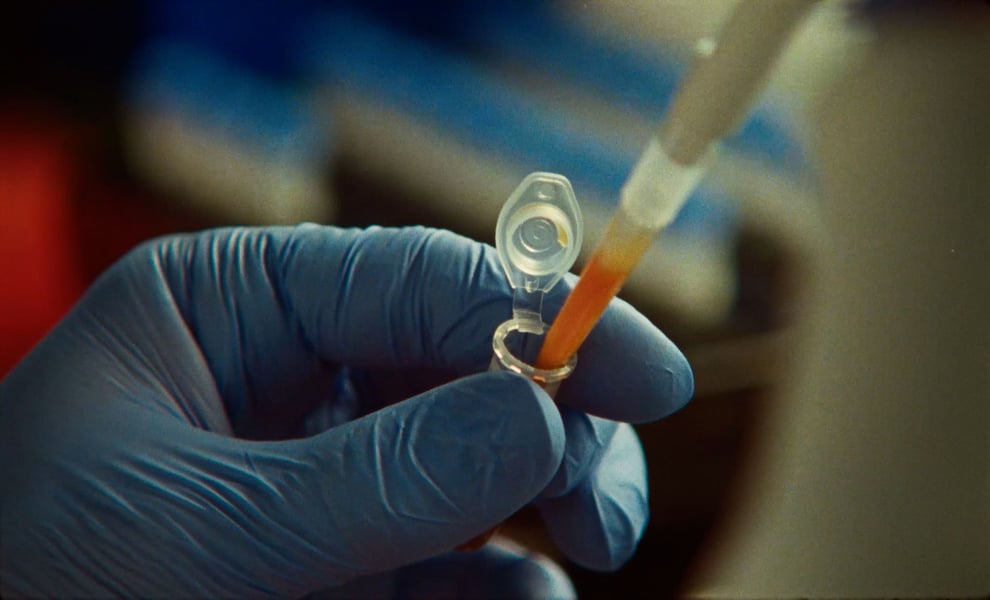
All physical experiments on ART are conducted by human researchers at a Bay Area lab operating under BSL 1 and BSL 2 biosafety conditions. No human pathogens are involved. Anthropic has published the preprint and is inviting independent proposals from other research teams. The company does not know what ART does. That acknowledgment, at least, is unambiguous.
Dario Amodei, Anthropic’s chief executive, has argued publicly that AI development needs to slow down so safety research can keep pace with capability gains. His own company’s life sciences group just released a preprint built on 950 autonomous agent sessions running for 21 hours. That tension is not a contradiction Anthropic has resolved. The preprint invites independent research on a system whose function remains unknown, which is either the appropriate scientific posture or an invitation to direct others toward a dead end, depending on what the lab work eventually shows.
As Al Jazeera reported and Gizmodo noted, Anthropic cannot yet say what ART is capable of. Anthropic, in its announcement, puts it plainly: the function of ART is unknown and experiments to determine it are underway. That is where the story ends, for now.