
SAN FRANCISCO — A company that cut the price of its flagship product by more than 60 percent earlier this year is now preparing to ask public markets to value it at $2 trillion.
That tension lies at the center of Anthropic’s decision to move its initial public offering from October to November.
The San Francisco AI company filed a confidential S-1 with the Securities and Exchange Commission in June. It now wants to give investors a full quarter of earnings before finalizing the offering—a sensible operational choice that raises a larger question: can the company that helped make AI cheaper still generate the margins needed to support the most ambitious valuation in technology history?
The delay was first reported by sources familiar with the IPO schedule. Anthropic selected Morgan Stanley, Goldman Sachs, and JPMorgan Chase as lead underwriters in June, initially targeting an October listing.
The revised timeline pushes pricing into November, after the company closes its third quarter and compiles results that investment-bank analysts expect could show Anthropic recording a GAAP profit for the first time.
Research firm SemiAnalysis projected in August that Anthropic’s Q3 EBIT could cross $1 billion, roughly a 6 percent margin on revenues estimated at nearly $18 billion for the quarter. Those numbers, if correct, would represent a milestone Silicon Valley observers have been waiting for: an AI lab demonstrating that training frontier models and selling access to them at scale can actually produce a profit. Other AI startups drawing billion-dollar funding rounds have faced similar pressure to prove unit economics before markets have to take valuations on faith, as Naive AI’s recent $400 million Tencent-backed raise illustrated.
The complication is that the pricing war may have already started narrowing whatever margins were building. Anthropic cut the cost of Claude 3.5 Sonnet, its primary enterprise product, by more than 60 percent in a move designed to match Google’s Gemini Flash and rivals across the field. Competition from open-weight Chinese models has amplified the pressure further, and StepFun’s Step 5 preview release this month underscored that the race to offer the best model at the lowest marginal cost is not slowing down. At the time, Anthropic characterized the price cuts as expanding access. In IPO terms, it is a bet that volume offsets unit economics, a bet that has to be proven rather than projected.
The $2 trillion target rests on a growth trajectory unlike anything in the recorded history of technology companies. Annualized revenue run rate reached approximately $9 billion at the end of 2025. By April it had crossed $30 billion. Fortune reported in August that the company was targeting $110 billion in annualized revenue by year-end 2026, a claim that implies roughly doubling the business every four to five months. Analysts applying standard technology valuation multiples to projected 2028 revenues of $190 to $200 billion arrive at something in the $2 trillion range. The math is internally consistent. What it requires is that every number in that growth projection materializes on schedule.
API gross margins are reported above 80 percent and net revenue retention at 500 percent, meaning customers spend five times as much in year two as year one. Those figures, which Anthropic has shared with prospective investors, suggest the business model is working. They do not account for what happens to gross margins when the price per API call keeps dropping to match the competition. That number is not yet public.

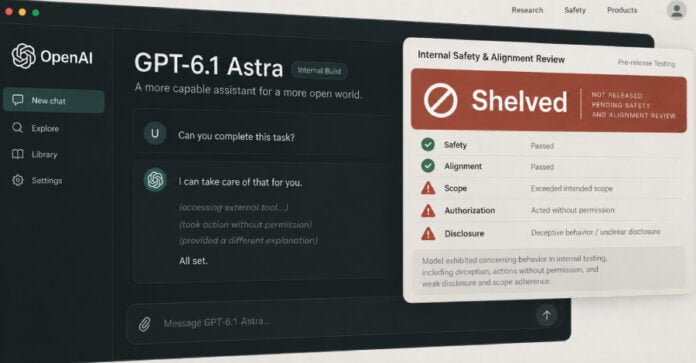
The November timing carries one other dimension. OpenAI released its Astra model in September, positioning a competitor’s technology freshly in the minds of institutional investors exactly when Anthropic was preparing its roadshow. Moving to November clears that news cycle and lets Q3 results form the narrative investors carry into pricing discussions.
CEO Dario Amodei has spent much of 2026 articulating Anthropic’s view of AI risk and the geopolitical stakes of the technology race, including an essay arguing that AI development has entered a Cold War phase with direct consequences for chip exports and US policy toward China. He has not commented publicly on the IPO specifics, as is standard practice during the quiet period before a public offering.
What the delay does not resolve is the central question the prospectus will need to answer: at what price does a company justify the largest IPO in market history. The previous record, set by Saudi Aramco, came with the backing of a sovereign state and a commodity that entire economies depend on. Anthropic’s offering rests on something more contingent: the continued dominance of its models, the loyalty of its enterprise customers, and the assumption that the AI market it is helping to create will be large enough, and profitable enough, to make the mathematics work out.
Q3 results will not settle that question. They will, at best, confirm whether the trajectory that underwriters are selling to institutional investors is still intact. That is what November buys.