
Intel is targeting a much larger AI computing budget for humanoid robots with Razor Lake-AX, a processor planned for 2028. The headline figure is 700 trillion operations per second, but the information disclosed so far does not establish how it would perform in a working robot.
VideoCardz reported, citing The Elec, that Intel executive Cho Min-sung presented the robotics roadmap at the Semiconductors Powering Humanoids conference in South Korea on October 16. It places Nova Lake in early 2027, followed by Razor Lake-AX in 2028.
Those dates concern the reported robotics roadmap. They should not be treated as confirmation of every leaked Nova Lake desktop specification, or as a retail launch date for every product using the same architecture name.
Intel’s current reference point is Panther Lake, branded Core Ultra Series 3. Its architecture announcement advertises up to 180 platform TOPS and identifies robotics among its edge applications. That is a platform total, not a standalone neural-processing-unit score or a guarantee for every Panther Lake device.
TOPS expresses theoretical operations per second. A larger number alone does not establish the speed of a robot’s perception, planning or movement, particularly when the arithmetic format and test conditions are not supplied. VideoCardz notes that Intel has not specified the numerical precision behind the 700 TOPS target.
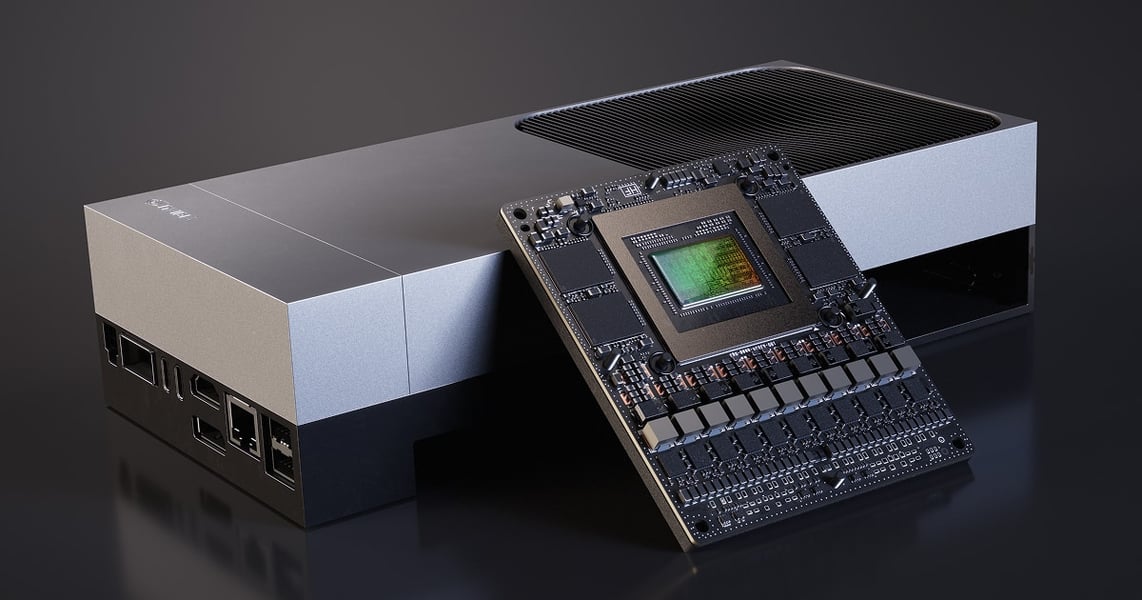
That missing detail matters when comparing competitors. Nvidia advertises Jetson Thor at up to 2,070 FP4 teraflops; VideoCardz identifies that figure as sparse FP4 performance. It is not a like-for-like benchmark against Intel’s unspecified 700 TOPS target, and neither number establishes which platform would complete a particular robotics workload faster.
The report also says Intel expects autonomous mobile robots to enter mass production at some customers in 2027, with humanoid systems following in 2028. These are reported expectations for customer deployments, not evidence that production targets have already been met.
Pricing, a final power budget, a definitive memory configuration and independent robotics benchmarks are not provided in the report. For now, the development is a clearer timetable and compute target, rather than proof of a finished robot processor’s real-world performance.