
The leak of Intel’s next-generation desktop processors has sent shockwaves across the semiconductor industry, pointing to a dramatic escalation in the battle for CPU dominance. In recent years, the semiconductor industry has become a geopolitical battleground, making every major architectural leap far more consequential.
Intel’s upcoming Nova Lake lineup, expected to debut as the Core Ultra 400 series, appears to signal one of the company’s most aggressive architectural shifts in years—one centered on brute-force core counts and unprecedented cache sizes.
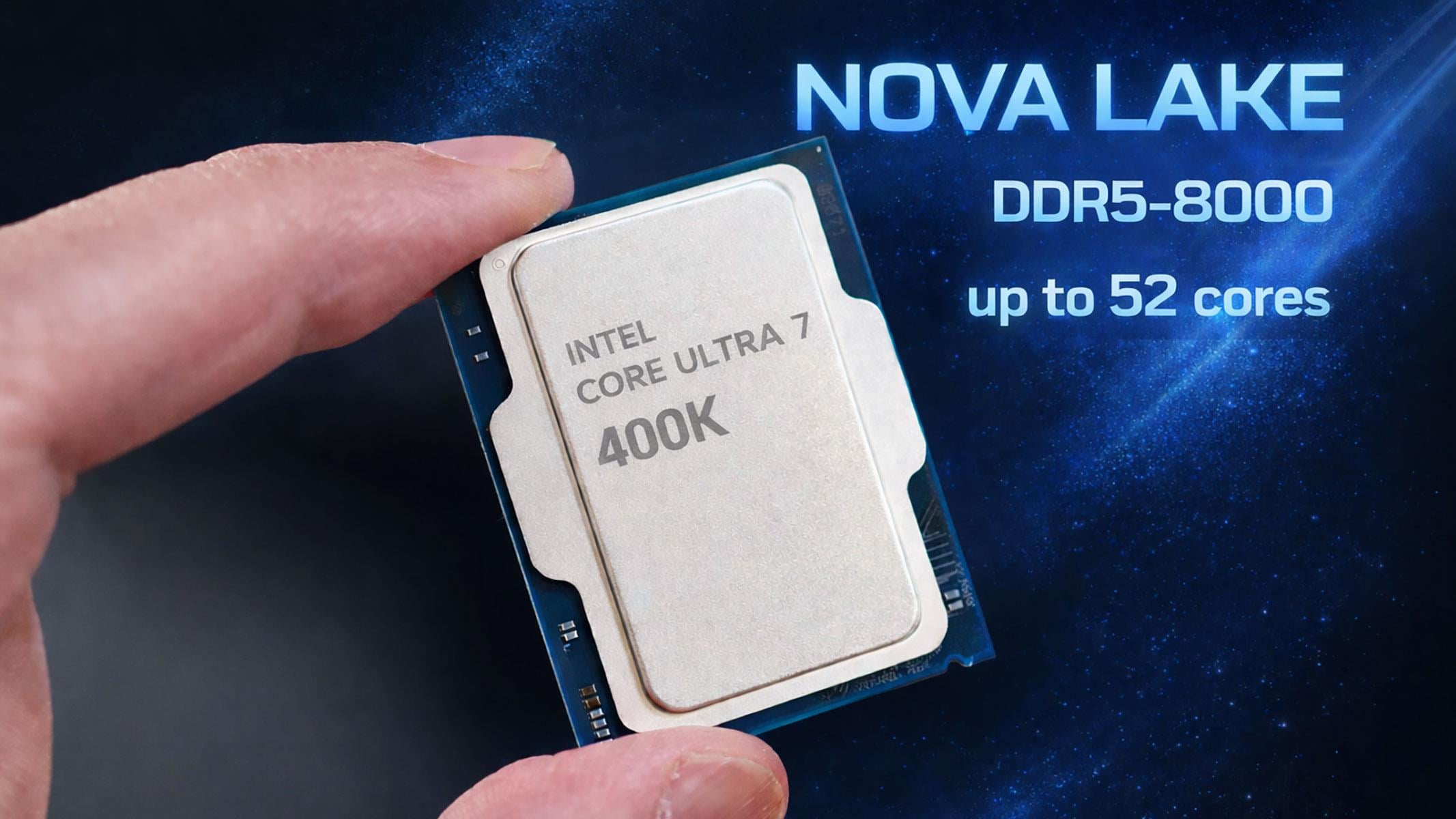
According to multiple recent leaks, the flagship Nova Lake processor could feature up to 52 cores and massive 288MB cache, combining 16 performance cores, 32 efficiency cores, and 4 low-power cores. This would mark a significant leap over current mainstream desktop chips and position Intel well ahead of its closest rival in raw core count.
But the real headline is cache.
Leaked specifications suggest that Intel’s top-tier Nova Lake chip could pack as much as 288MB of total cache, enabled by a new “big Last Level Cache” or bLLC design. This figure not only eclipses Intel’s previous consumer CPUs but also surpasses AMD’s most advanced X3D processors, which have dominated gaming performance through massive cache stacking.
The introduction of bLLC marks a strategic pivot for Intel. Rather than relying solely on higher clock speeds or incremental IPC gains, the company is now directly targeting the same performance bottleneck AMD exploited—data access latency. By dramatically increasing on-chip cache, Intel aims to accelerate workloads where memory speed is critical, particularly gaming and high-performance computing.
Industry analysts say this could reshape the competitive landscape as Intel looks to compete with rivals such as AMD more aggressively than ever before.
For years, AMD’s 3D V-Cache technology has given it a clear advantage in gaming benchmarks. Nova Lake appears designed as a direct counterstrike. Some estimates suggest Intel’s highest-end bLLC configurations could offer significantly more cache than AMD’s comparable chips, potentially translating into measurable gains in frame rates and responsiveness.
The leaked lineup also reveals a broad and somewhat complex product stack. Intel is reportedly preparing more than a dozen SKUs, ranging from entry-level chips to the flagship tier. A Core Ultra 400-series CPUs roadmap leak points to new naming conventions such as “D” and “DX” variants, expected to differentiate models with enhanced cache capabilities.
Beyond raw specs, Nova Lake is expected to introduce a new platform altogether. The chips will likely use the LGA 1954 socket and support next-generation technologies such as DDR5-8000 memory, PCIe 5.0, and advanced AI acceleration units. Analysts increasingly describe Nova Lake as a productivity powerhouse for AI workloads, signaling Intel’s intent to dominate not just gaming but emerging compute-heavy applications.
However, the ambitious design may come with trade-offs.
Power consumption remains a looming concern. Early reports indicate that high-end Nova Lake chips could operate at significantly elevated thermal design power levels, raising questions about cooling requirements and efficiency as performance scales upward.
There is also uncertainty around launch timelines. While Intel confirmed Nova Lake launch in 2026, supply chain complexities and manufacturing challenges could still affect availability.
Still, the direction is clear. The company is doubling down on innovation as part of a broader push toward restoring American dominance in semiconductors, an effort that extends beyond consumer chips into global technology leadership.
Intel is preparing for an all-out offensive against its competitors, including Intel targeting AMD’s next-gen Zen 6 processors. With massive core counts, revolutionary cache architecture, and a renewed focus on performance, Nova Lake is shaping up to be one of the most consequential CPU launches in years.
Whether these leaked specifications translate into real-world dominance remains to be seen. But if even a portion of these claims hold true, the next chapter of the CPU wars could be defined not just by speed—but by cache.
Related Posts