
SANTA CLARA, Calif. – Intel Corp. (INTC) reported its strongest revenue growth in more than a decade and immediately asked shareholders to absorb dilution. The chipmaker said Sunday it plans to sell roughly $15 billion of common stock in a public offering, potentially the first public share sale in the company’s history since it went public in 1971. Shares fell 5 percent to $96.97 on Monday.
The offering could expand to $17.25 billion if underwriters exercise their option to purchase additional shares. It arrives 72 hours after Intel posted second-quarter revenue of $16.1 billion, a 25 percent increase from a year earlier that marked the strongest annual growth rate the company has produced in at least 15 years. Chief Executive Lip-Bu Tan said artificial intelligence was creating unprecedented demand for computing and that Intel intended to meet it at scale.
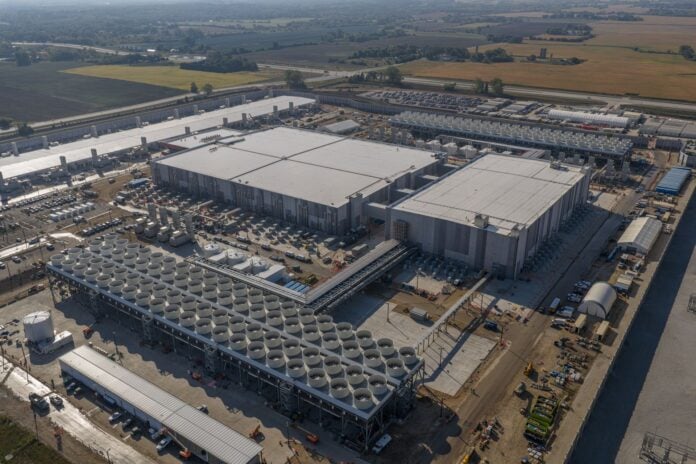
The proceeds will fund four priorities Tan outlined: physical AI infrastructure, purpose-built silicon for AI workloads, advanced packaging, and external wafer contracts for foundry customers, according to Intel’s offering announcement. J.P. Morgan Securities, Goldman Sachs, Morgan Stanley, and Citigroup Global Markets are serving as joint book-runners. Intel’s capital expenditure budget for 2026 stands at $20 billion, up from $18 billion the prior year. Chief Financial Officer David Zinsner told analysts that most of the spending goes toward factory equipment, and that 2027 will see a meaningful increase in capex as the company expands its advanced node capacity.
AMD (AMD) fell 1 percent to $479.88 Monday. Nvidia (NVDA) and Broadcom (AVGO) were each roughly flat. The sector-level response suggested investors read Intel’s move as company-specific dilution rather than a signal of weakness in chip demand broadly.
Tesla (TSLA) confirmed it is a customer for Intel’s 14A process node, the company’s most advanced manufacturing technology. The disclosure puts a name of considerable market weight on Intel’s external foundry roster. Terms and production volumes were not disclosed. Intel Foundry has been positioning 14A as the process that can attract hyperscale and automotive customers away from Taiwan Semiconductor Manufacturing Co., and Tesla is among the first major companies to confirm a production relationship on the node.

Intel’s stock has gained 175 percent in the year through last Friday, a recovery that carried its market capitalization from levels where the company’s future as an independent entity had become a subject of open speculation. The share sale arrives at a point in that recovery when management has room to raise equity without the stigma that a financing under pressure would carry. The $96.97 close Monday, after the 5 percent drop, still leaves the stock more than double its 52-week low.
Wall Street analysts are broadly neutral on Intel’s direction. Thirty-one analysts hold a Hold rating on the stock, 14 a Buy, and 3 a Sell, with a consensus price target of $115.17, roughly 19 percent above Monday’s close. The spread of ratings reflects genuine disagreement about how quickly Intel’s foundry business can generate external revenue sufficient to justify the capital being poured into it.
Intel is not alone in testing capital markets to fund the AI infrastructure race. Nvidia raised $25 billion in bonds in June, its first investment-grade debt offering in five years, with the proceeds earmarked for the same general category of AI infrastructure investment Intel is now pursuing with equity. Amazon raised more than $27 billion in a single week through bond and bank-loan markets to fund AWS capital buildout. Intel’s decision to use equity rather than debt reflects its current balance-sheet position and the optionality that a stronger equity base provides for future manufacturing commitments.
SK Hynix raised $26.5 billion in its record-breaking Nasdaq IPO in July, with shares jumping 14 percent at open, illustrating how investors value supply-constrained, high-demand chipmakers during the AI build cycle. Intel is not SK Hynix; it is a much larger and more complex business with a manufacturing operation that has historically struggled to execute on its timelines. But the appetite for chip-sector capital raises has not shown obvious signs of fatigue at the scale Intel is testing.
The Q3 guidance Intel provided alongside the earnings report was $15.8 billion to $16.8 billion in revenue, implying continued growth into the second half. Zinsner cautioned that factory equipment lead times are long, and that the full benefit of 2026 capex spending will not flow through to manufacturing capacity until 2027 at the earliest. That timing gap between spending and production is one reason the equity raise makes sense now: Intel is funding a capacity expansion whose returns are years away, and debt financing that cost creates earnings pressure before the revenue materializes.
The offering carries risks that Wall Street’s muted response acknowledged. Semiconductor equipment takes time to install and qualify. Foundry customers require long validation cycles before committing to new process nodes at production scale. Tesla’s 14A confirmation, while significant for Intel’s customer narrative, does not represent disclosed volume. Intel faces Taiwan Semiconductor on one side and Nvidia’s increasingly integrated silicon model on the other, with neither competitor pausing its own capital deployment to accommodate Intel’s recovery timeline.
What the $15 billion buys in actual competitive terms remains the open question. Intel has a roadmap, a customer list that now includes Tesla, and management that has signaled unusual candor about the scale of the investment required. Whether that investment reproduces the manufacturing leadership Intel once held, or produces a capable but perpetually second-tier foundry, is a question the offering price does not answer. The shares are expected to price within days. Underwriters have 30 days to exercise the option on the additional 15 percent of stock.