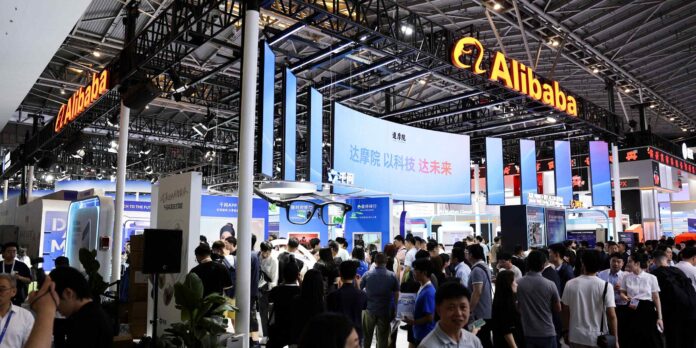
HANGZHOU — Eddie Wu did not call this a response to Washington. He didn’t have to.
Standing before several thousand engineers at Alibaba’s annual Apsara Conference on Monday, the company’s chief executive unveiled the Zhenwu V900, the most powerful AI training chip T-Head, Alibaba’s semiconductor unit, has ever built, and described a computing architecture designed to train models that do not yet exist and power data centers not yet built. The announcement was framed as a product story. The context made it something else.
Alibaba says its V900 AI accelerator delivers three times the computing performance of its predecessor, the Zhenwu M890.
Key specifications
- Memory: 216 GB per card.
- Inter-chip bandwidth: 1,200 GB/s.
- Scalability: Up to 500,000 cards in a single cluster.
- Target workloads: Large-scale frontier-model training.
- Claimed model scale: Qwen models with roughly 5–10 trillion parameters.
The design is aimed at reducing the bottlenecks that emerge when training very large models. If Alibaba’s clustering claims hold in practice, the V900 would be positioned not merely as a faster accelerator, but as infrastructure for training models at an unusually large scale.
Hong Kong traders heard what they needed to. Alibaba stock climbed 5.1% on the announcement, a response that reflected not just the hardware itself but what it represents: a company that spent two years watching the US government close off access to the chips powering its AI infrastructure, finding a way through.
The US export controls that restricted Nvidia H100 and H200 sales to China beginning in late 2022 created a structural problem for every Chinese cloud provider and AI lab. Alibaba Cloud chose to build rather than wait, investing heavily in T-Head and raising $10.2 billion in Hong Kong earlier this year specifically for AI infrastructure expansion. The V900 is the result.

Alibaba’s infrastructure ambitions extend well beyond the chip itself. The company says it intends to bring Alibaba Cloud to 20 gigawatts of data center capacity by 2032, a scale that, ABC News reported, would make it one of the largest cloud infrastructure build-outs in the world. Mass production of the V900 is targeted for the first quarter of 2027, a standard gap for new silicon, and also the window where ambitious chip announcements either earn their credibility or quietly narrow their claims. Alibaba has not specified which foundry will manufacture the V900 at the clustered scales described Monday.
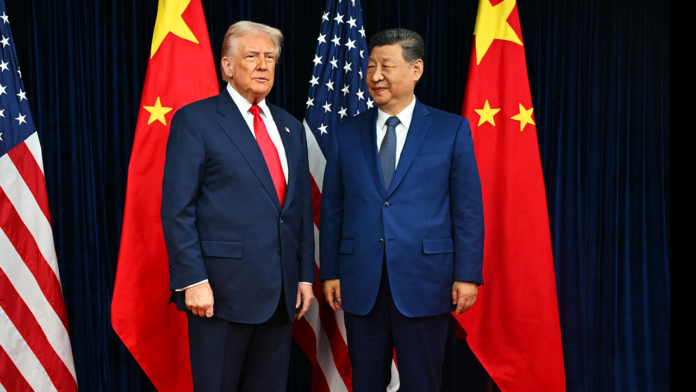
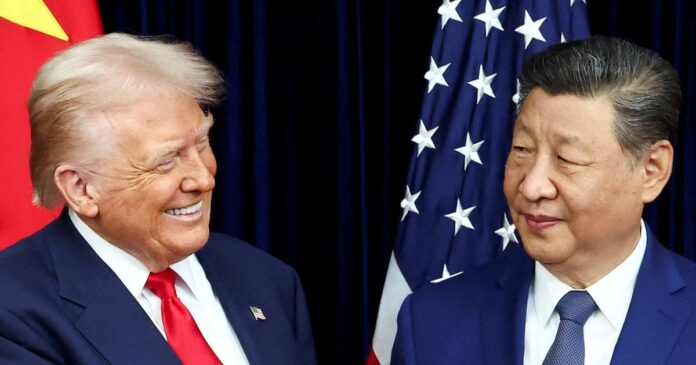
The timing of the Apsara Conference was not incidental. On Wednesday, Xi Jinping travels to Washington for a summit with Donald Trump where semiconductor export controls and AI governance are expected to dominate. China has pushed for a formal bilateral AI dialogue as part of the summit agenda, and The National reported that the US side has signaled interest in establishing that channel, a meaningful shift from the confrontational posture of the previous 18 months.
The handling of the semiconductor question at the Trump-Xi summit will depend partly on how each side reads what happened in Hangzhou on Monday. Beijing’s domestic chip program has not been secret, but the V900’s specifications, if they hold under independent validation, represent a meaningful step toward the self-sufficiency that makes future export controls less decisive as leverage. Washington can read that as a reason to negotiate from mutual interest, or as a reason to tighten restrictions before the gap closes further.
Wu stayed on the product narrative at Apsara, offering no commentary on the trade dynamics that made the Zhenwu V900 necessary. The chip’s existence is the argument. How Washington reads it, in 48 hours and in the months after, is the question neither capital has fully answered.