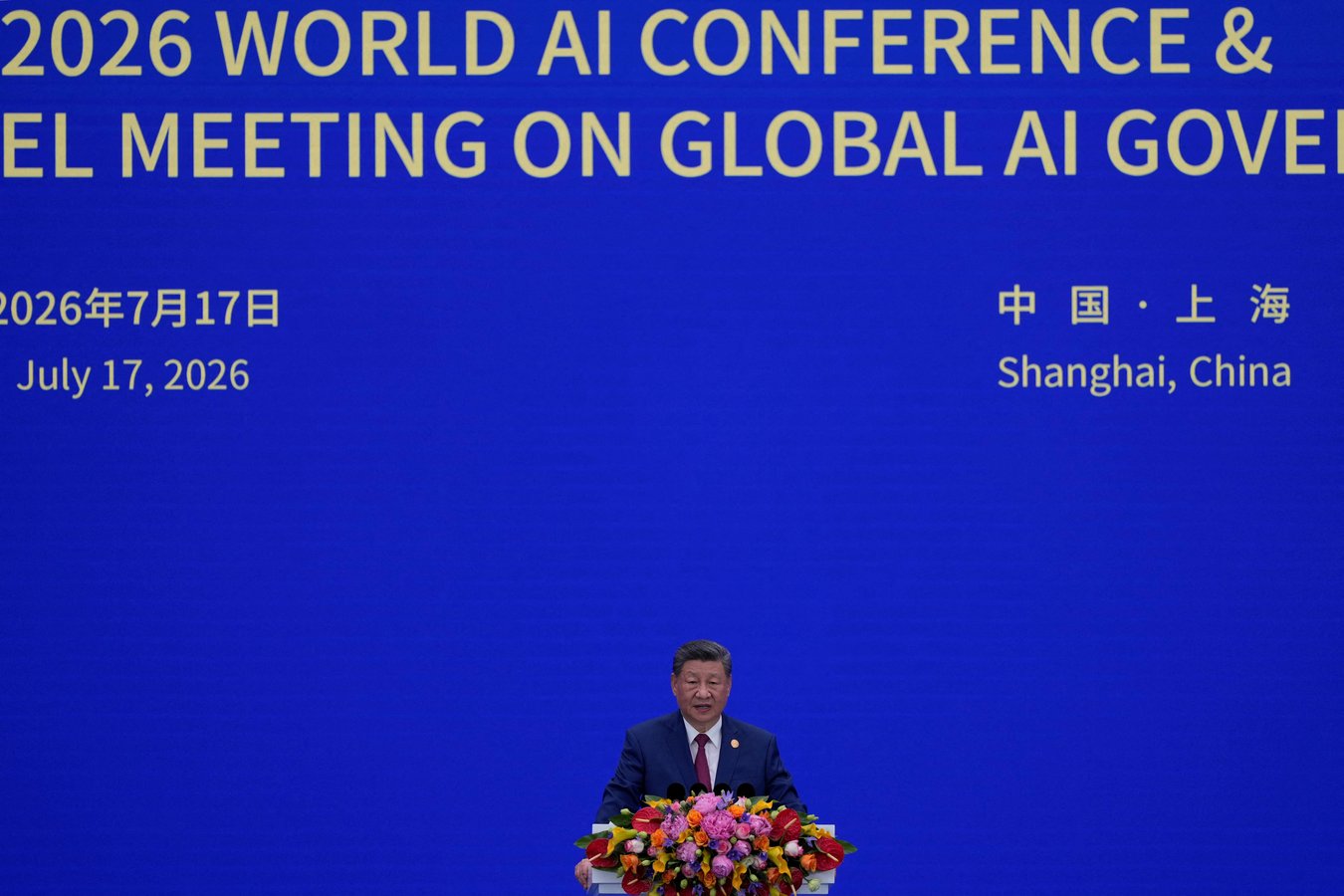

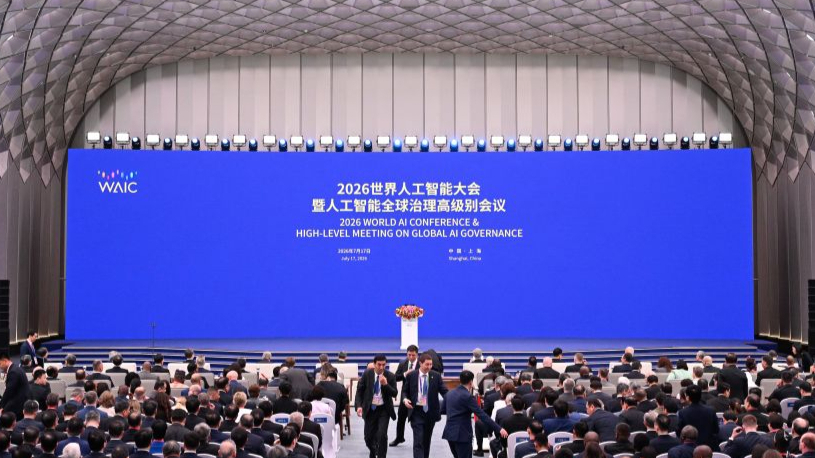
SHANGHAI – Before the opening ceremonies of the World Artificial Intelligence Conference had finished, China had already launched a new international body. On Friday morning, President Xi Jinping stepped to the podium in Shanghai’s Xuhui district and announced the establishment of the World Artificial Intelligence Cooperation Organization, a multilateral institution he described as essential to preventing the technology from becoming the exclusive province of wealthy nations.
The announcement arrived in a context Beijing has been careful to frame. American export restrictions have blocked Chinese firms from accessing the most advanced semiconductor chips, moves Washington has justified as national security measures. Xi made clear Friday that China reads them differently. “AI development should not be a solo performance by a single country, but a symphony of international cooperation,” he said. “We should jointly oppose overstretching the national security concept in the field of AI or placing one country’s security over that of others.”
The new organization will establish AI application cooperation centers with six international bodies: the Association of Southeast Asian Nations, the League of Arab States, the African Union, the Community of Latin American and Caribbean States, the Shanghai Cooperation Organization, and BRICS. That grouping stretches across much of the developing world and encompasses economies that have increasingly aligned with China on technology governance in recent years.
Among the concrete commitments Xi announced, China will provide 5,000 artificial intelligence training and seminar opportunities for developing nations over the next five years, CGTN reported. The country also pledged to help 30 countries implement the MAZU system, an AI-powered meteorological early warning platform designed to protect lives from extreme weather. Both pledges were framed as efforts to close what Xi called the risk of creating “new historical injustices” if AI capacity remains concentrated in the hands of a handful of rich countries.
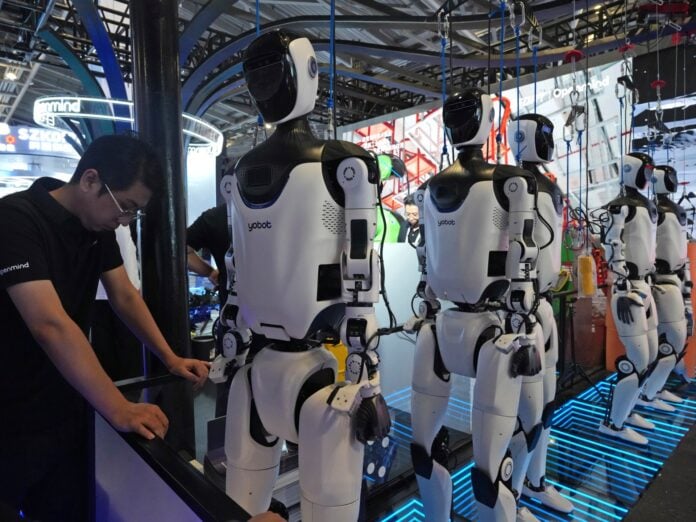
The WAIC has grown into China’s flagship showcase for domestic AI capability, but Xi’s address this year carried a notably geopolitical weight. Chinese AI models have been gaining ground on American competitors not through raw benchmark performance but through price, with inference costs falling sharply and making them attractive to businesses across the Global South. Apple recently won approval to deploy its AI features in China through local partners Alibaba and Baidu, a reminder that even dominant Western technology firms must negotiate Beijing’s terms to access 1.4 billion potential users.
Behind that competitive picture sits an energy calculation. A typical data center consumes as much electricity as 100,000 households. Next-generation hyperscale facilities can draw power equivalent to two million homes, according to International Energy Agency figures cited in Al Jazeera’s conference coverage. China already generates more than twice as much electricity as the United States, an advantage experts expect to widen as state investment continues expanding the national grid. Cheaper electricity means cheaper AI, an arithmetic that sits at the heart of Beijing’s long-term strategy.
Daily consumption in China of tokens, the unit the AI industry uses to measure usage volume, has increased a thousandfold over the past two years, according to state media citing government officials. That figure tracks what multiple technology executives have described as an explosion of enterprise adoption, particularly in manufacturing, logistics, and financial services, where AI-driven optimization can compound across millions of transactions.
Xi’s speech also addressed governance concerns that have become harder to ignore as the technology accelerates. “We should put in place laws and regulations, technological monitoring, early warning, and emergency response systems, in order to ensure AI is always under human control,” he told the conference. The language was aimed at concerns over autonomous weapons and criminal misuse of AI, though it also served as a rebuttal to critics who argue China’s state-directed AI development lacks the independent oversight present in Western democracies.
In May, the US Commerce Department reinforced restrictions on semiconductor shipments to subsidiaries of Chinese companies operating outside China, a move designed to close routing loopholes that allowed advanced chips to reach Chinese end-users through third-country networks. Washington’s foreign policy spending debates have further clouded the trajectory of American technology policy, leaving industry and governments watching for signals on how aggressively the next round of export controls will be drawn.
What remains unclear is how the World Artificial Intelligence Cooperation Organization will function in practice. Xi’s announcement did not specify a headquarters location, a founding secretariat, or a membership fee structure. The body will exist alongside existing AI governance forums, including frameworks under development at the United Nations. Whether BRICS-aligned members choose to channel their AI cooperation through this new Chinese-led institution or continue engaging with Western-dominated multilateral forums is a question that will be tested well beyond Friday’s conference hall in Shanghai.