
TAIPEI – On Wednesday morning, millions of mobile phones across Taiwan loaded slower than usual. No glitch, no technical failure. The military had told the carriers to throttle the network on purpose.
For the first time in 42 editions of Han Kuang, Taiwan’s signature annual military exercise, the drill has crossed into civilian infrastructure. The internet slowdown was a test: if fighting comes to Taiwan, what happens to bandwidth? Can government agencies, emergency responders, and ultimately the public communicate under constrained conditions? The 2026 exercise is, at its core, built around that kind of question, not the questions with a predetermined answer.
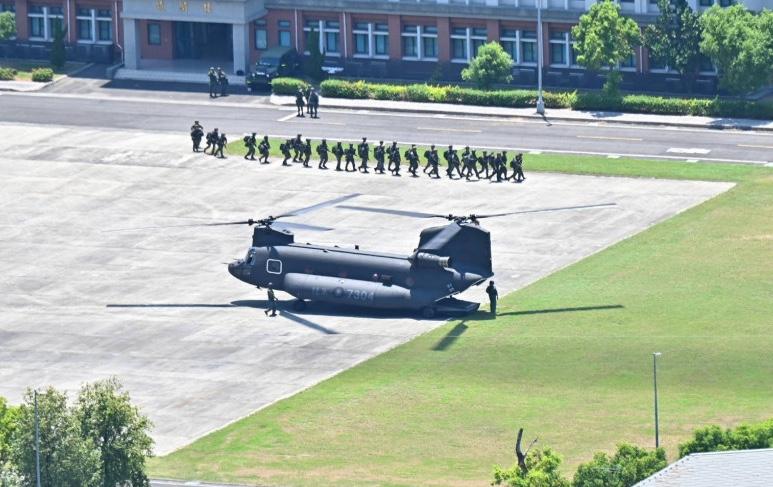
Taiwan’s military launched Han Kuang 42 on Wednesday, beginning ten days of live-fire operations that will involve more than 20,000 troops and some 5,000 reservists deployed in brigade-level formations, the largest reserve mobilization in the exercise’s history. Fighter jets scattered to dispersal airfields in the predawn hours. Naval vessels conducted emergency deployment drills. Ground units moved arsenals and simulated relocating civilian factory operations as part of wartime continuity scenarios. But the organizing logic of this year’s exercise is different from its predecessors: the whole apparatus has been redesigned around a single uncomfortable question, stated plainly by a defense official at a briefing. “If the situation does not match the original enemy scenario, what should he do? How should he reassess, readjust and quickly issue orders?”
In past Han Kuang exercises, commanders knew the adversary’s moves in advance. The script, even when classified, was a script. Feedback was staged. Outcomes were rehearsed. This year, for the first time, the military has deliberately introduced scenarios in which the adversary’s actions diverge from what planners anticipated, forcing officers to improvise under real-time pressure. “This is no longer a laboratory-like exercise in a vacuum,” a senior defense official told reporters, according to Taipei Times.
The concept draws directly from doctrine absorbed through cooperation with American advisers. Soldiers in Han Kuang 42 are practicing what the US military calls backbriefs, a process in which subordinate officers restate to their commanders what they understand the tactical intent to be before any operation begins. The goal is to close the gap between what a commander orders and what a unit actually understands. In the chaos of an actual attack, an ambiguous order gets people killed. The backbrief is an attempt to eliminate the ambiguity before the shooting starts.
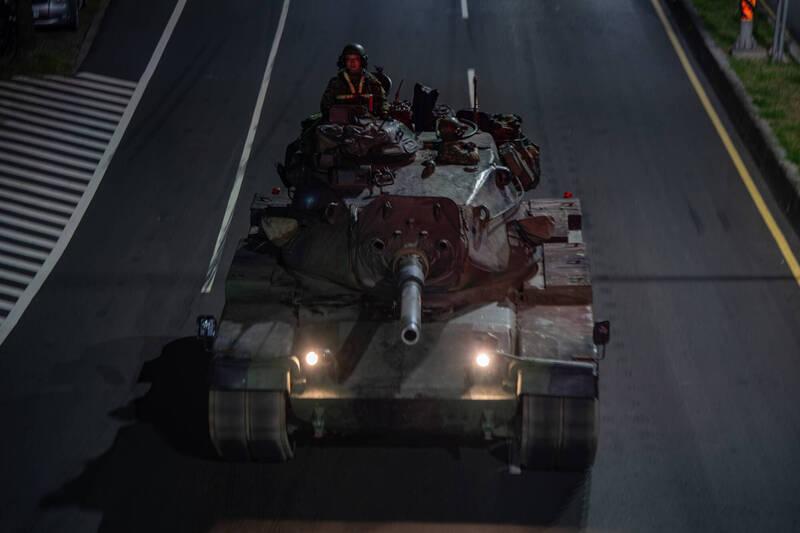
The unit actually doing the shooting this week includes M1A2T Abrams main battle tanks, which completed delivery from the United States in April and made their Han Kuang debut in this exercise. The 108-tank order assigned to the 584th Armored Brigade represents the most capable armor Taiwan has ever operated. Their appearance in Han Kuang 42 is significant not only as a symbol of the US arms relationship but as a practical test of how Taiwanese forces absorb and integrate American hardware under field conditions. Earlier, Taiwan’s military had already run arms factory relocation drills under attack simulations, part of the military’s broader shift toward survivable, dispersed defense.
The exercise unfolds against a backdrop that has become materially more sobering in recent months. The United States, locked in active conflict with Iran, has consumed virtually all of its long-range precision missiles, including ATACMS, PrSM, and roughly half the global Tomahawk inventory, in five months of fighting. Taiwan’s defense planners do not need classified briefings to draw the relevant conclusion: a Taiwan contingency now occurs in a context where American precision-strike capacity is meaningfully diminished. The exercises, with their emphasis on independently functioning units and locally commanded decisions, reflect that calculation.
At the newly opened Danjiang Bridge, which connects the Tamsui and Bali districts of New Taipei City, the military’s 53rd Engineer Group ran drills on blocking enemy armor from using the crossing to advance toward Taipei. The exercise represents infrastructure planning on a scale previously confined to classified war-gaming: if enemy forces land on the western coast, which bridges get blocked, and how fast. The decision to include a bridge opened just three months ago is its own signal about how seriously the exercise has moved from the theoretical to the operational.
Taiwan’s reserves have long been the weak link in the island’s defense planning, poorly trained and difficult to integrate into doctrine. This year’s two brigade-level reserve deployments, one in northern Taiwan and one in the south, represent a departure from 2025’s company-level units. Whether brigade-scale training in a ten-day exercise sufficiently bridges that gap is a question the drills cannot answer. The scale of call-up and pre-combat preparation training being tested is new; its adequacy against a full military contingency is not something Han Kuang is designed to evaluate.
China’s Ministry of National Defense declined to comment on Han Kuang 42, its standard posture. That silence stands against a backdrop in which Lai Ching-te has maintained Taiwan’s identity as a sovereign democratic state, drawing Beijing’s repeated warnings that reunification by any means necessary remains a standing policy. Beijing views the annual exercises as provocation; Taipei views them as a responsibility.
The 10-day exercise ends August 14. More than twenty thousand soldiers will have practiced improvising when the plan breaks down. New tanks will have been fired in Taiwan’s fields for the first time. Mobile internet across the island will return to normal speeds. What the exercises will not resolve is the harder question: whether this level of preparation, more serious than any Han Kuang before it, is enough for what the island faces.