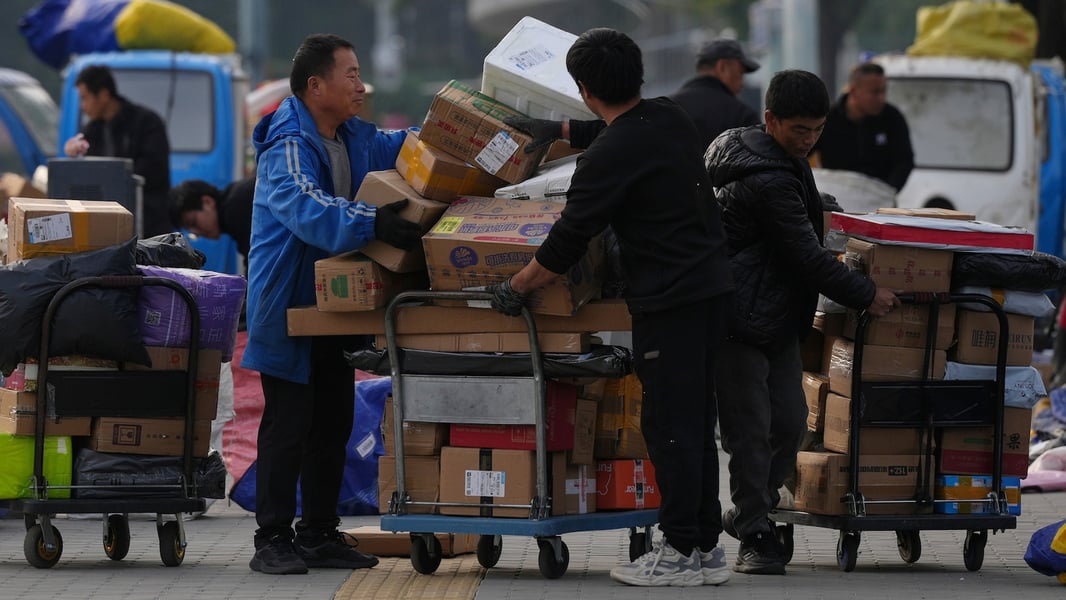

HONG KONG – China’s biggest online shopping festival is asking households to spend more at a moment when many are deciding what they can do without. Early Singles’ Day figures suggest that weeks of promotions have not yet produced a clear spending surge, even as retailers deploy new tools to persuade cautious shoppers.
Retail data platform Syntun estimated sales at just over 1 trillion yuan through October 31, broadly similar to the same period last year, according to an Associated Press report. That is an interim estimate, not the final result for the November 11 shopping event, whose promotions begin weeks before the date itself.
The distinction matters because a longer festival can accumulate a bigger sales total without proving that households are spending more enthusiastically each day. Last year’s campaign reached almost 1.7 trillion yuan overall, AP reported. Comparing this year’s early figure with that completed campaign would measure different stretches of time.
The AP report carried by ABC News describes shoppers holding back on non-essential purchases and researchers questioning whether an extended discount season still creates the urgency it once did. Eastern Herald has not independently audited Syntun’s festival estimate or conducted the interviews cited here.
In Foshan, a furniture manufacturing centre in southern China, 24-year-old Gabby Liang told AP she was buying less online, particularly things she did not need. She expected to purchase fewer skincare products than during last year’s festival. Cameras and game consoles were among the extras she said she would skip.
Her account describes a household making choices, not abandoning consumption altogether. That distinction is visible in the wider data. China’s National Bureau of Statistics reported that retail sales of consumer goods grew 1.1% year on year during January–September, while retail sales of services rose 5.0%.
The bureau’s October 19 release puts combined retail sales of goods and services growth at 2.6%. These are separate measures with different coverage. The 1.1% headline consumer-goods series includes catering, but it should not be presented as a complete measure of spending on every service.
The same release reports 4.4% growth in online retail sales of goods and services. Within that total, online goods sales increased 3.8% and online services sales 5.3%. Those figures show online activity expanding over nine months, even while the latest festival report points to hesitant discretionary purchases. Neither finding cancels the other.
There is a further methodological limit. The bureau says it expanded online service-platform coverage and adjusted the names of its online retail indicators. It calculates annual growth using comparable coverage, but cautions that the expanded goods-and-services measure is not comparable with the former online retail sales measure. A large new total should not be treated as growth against an older, narrower series.
That provides context for Eastern Herald’s earlier reporting on China’s third-quarter growth and investment decline. The economy grew 4.6% during the first nine months, the official release says, but that inflation-adjusted output measure is not a like-for-like comparison with nominal retail-sales growth. It describes a different part of the economy.
For retailers, the immediate problem is making another promotion feel worth acting on. Market researcher Yaling Jiang told AP that year-round discounts were weakening the festival’s special appeal. A customer who expects another offer later has less reason to treat November 11 as a deadline.
The longer promotional calendar also complicates the meaning of a record. A bigger total could reflect more selling days, a change in the mix of products, higher spending or several of those factors together. Without consistent reporting periods and a clear account of what is being counted, the total alone cannot identify which explanation dominates.
Alibaba Group is turning to artificial intelligence to help shoppers place orders and receive product recommendations, AP reported. The technology may change the shopping experience, but the report supplies no verified estimate of how much additional spending it generates. Easier product discovery is not the same measurement as a bigger household budget.
The pressure on those budgets extends beyond promotional fatigue. AP describes a prolonged property downturn that has left families feeling less wealthy and unsure whether home prices have finished falling. Economist Max Zenglein told the news agency that improvements in domestic-demand sentiment had repeatedly proved short-lived.
Yet a story of uniform collapse would miss the differences between categories. Consultancy executive Jacob Cooke told AP that health-related purchases were performing relatively well and said he expected some growth in this year’s festival sales. Stronger demand in selected areas can coexist with reluctance to buy expensive extras.
The official release similarly records growth in household disposable income and online spending while acknowledging that insufficient domestic demand remains a prominent problem. Neither those aggregate gains nor one shopper’s account establish the experience of every family. The gap between a national total and an individual budget is part of what the festival is testing.
The final Singles’ Day tally was not established in the reporting reviewed for this article. For now, the early sales comparison has a clear cutoff: October 31. What the interviews add is the reason that another discount may not be decisive. Liang told AP there was still enough to live on, but “not much extra to splurge”.