
BEIJING — When Washington banned Nvidia’s flagship graphics processing units from Chinese buyers last year, the assumption behind the restriction was straightforward: cut off the compute, slow the AI. China’s Ministry of Industry and Information Technology published its answer on Sunday. It runs to 9,800 exaflops by 2030 and costs $532 billion.
The 15th Five-Year Plan for the information and communications sector, posted publicly on the MIIT website on September 7, establishes China’s infrastructure targets for the period through 2030. The headline number, 9,800 exaflops of intelligent computing capacity, is roughly 4.5 times the 2,185 exaflops China had recorded as of June 2026, a figure that had already risen 177 percent from a year earlier as domestic chip deployment accelerated in response to US export restrictions. Storage capacity would rise from 540 exabytes today to 1,700 exabytes by 2030. The plan calls for 3.8 trillion yuan, $532 billion at current exchange rates, in cumulative information infrastructure investment over the full five-year period, with the private sector expected to supply most of the capital.
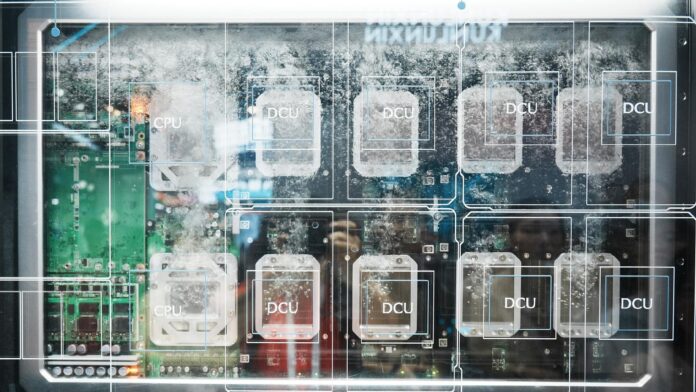
What distinguishes this blueprint from earlier Chinese technology plans is not the scale of its ambitions, Beijing’s planning documents routinely carry ambitious numbers, but the strategic logic embedded in its infrastructure priorities. The MIIT plan explicitly calls for “orderly deployment” of AI computing clusters running 100,000 or more graphics processing cards, and it is direct in asking for “greater efforts to adapt infrastructure to home-grown computing chips.” The document is sized for Chinese hardware, not American exports.
That distinction matters because Washington’s semiconductor restrictions have progressively tightened. Nvidia’s H200 chips were banned, then briefly licenced under a framework that analysts almost immediately called contradictory, then targeted again through rules extending to Chinese entities located outside China. Blackwell and Rubin processors, Nvidia’s current and upcoming top-tier hardware, are barred from reaching Chinese buyers regardless of geography. The practical result is that China’s largest AI deployments will increasingly run on hardware built in Zhengzhou, Shenzhen, and Shanghai, not on chips designed in Santa Clara.
China’s first test of that approach appears to be operational. In August, China’s state broadcaster CGTN reported that the country had activated its first AI super cluster built from 100,000 domestically produced chips, at a data centre node in Zhengzhou. Earlier this year, the National Supercomputing Center in Shenzhen unveiled LineShine, a CPU-only supercomputer that achieved two exaflops of sustained double-precision performance using no foreign-manufactured components — the first system on the global TOP500 to do so. Neither system matches the top-of-the-line benchmarks available to US cloud providers with unrestricted Nvidia access. Both exist, and both are growing.

That ambition rests on hardware that has not yet been built at the required scale. The 9,800 exaflops target implies roughly a fourfold increase in AI computing capacity over the four years remaining in the plan. It is a projection, not an audited figure, and the distance between Chinese planning targets and delivered capability is a well-documented feature of five-year plans rather than an exception to them. China’s reported computing figures have drawn methodological scrutiny: in April 2026, a research team claimed 1,882 exaflops in a quantum circuit simulation using a benchmarking approach that independent analysts said was not directly comparable to standard floating-point performance measures. The MIIT plan does not specify how “intelligent computing capacity” will be measured against the 9,800 target — a gap that matters significantly when the number is used to track progress against a geopolitical rival.
For Huawei, Cambricon, and the other Chinese chipmakers on which the plan depends, the document represents an extraordinary mandate. China’s AI firms have spent the past two years demonstrating that they can build capable models under hardware constraints. The 15th Five-Year Plan asks whether China can also build the hardware itself at a scale that removes the constraint entirely — and whether the answer comes before or after the US chip architecture it is designed to replace.
Moonshot AI, one of the two companies named in Monday’s US intelligence advisory, has maintained that its models were developed independently. The MIIT plan does not mention either DeepSeek or Moonshot by name. It does not need to. What it describes is an infrastructure foundation capacious enough to build whatever comes next, with or without access to American chips, American models, or American clouds. The full document is available through China’s State Council Information Office.