
SEATTLE, June 13, 2026 (The Eastern Herald) — Amazon raised the equivalent of about 10 billion United States dollars in the largest Canadian-dollar corporate bond offering on record this week, then closed an additional 17.5 billion United States dollars of new bank facilities within 48 hours of the bond pricing, and has now formally crossed the 70 billion dollar threshold for cumulative new-debt issuance since the start of 2025. The pace and scale of the borrowing is the most aggressive corporate-debt build the American technology industry has seen since Apple’s early-2010s Treasury arbitrage, and it is being driven almost entirely by Amazon Web Services’ artificial intelligence infrastructure programme, which is now on track to consume more than 90 billion dollars of capital expenditure in 2026 alone.
The Canadian-dollar bond offering deserves its own analytical paragraph. Amazon priced C$14 billion of high-grade notes across five tranches in Toronto on Monday, with the orderbook exceeding C$28 billion at peak and the final allocations split across the 2029, 2031, 2033, 2036 and 2056 maturities. The 3.40 percent 2029 line led the demand book. The 5.00 percent 2056 line locked in 30-year funding at a level that the buy-side investment-grade community read as the floor for any future technology-sector offering in the Canadian market. The deal is, by a meaningful margin, the largest single corporate bond ever priced in Canadian dollars and was large enough to push CAD-denominated investment-grade risk spreads wider for the rest of the week and to delay at least four scheduled offerings from Canadian and US-domiciled issuers.
The bank-loan tranche followed quickly. Amazon’s treasury team closed a 17.5 billion United States dollar syndicated revolving credit facility on Tuesday evening, with JPMorgan, Bank of America, Citi, Wells Fargo, Goldman Sachs and a club of European and Japanese banks providing the commitment. The facility carries five-year and seven-year tenors, comparable pricing to the bond tranche on a swapped basis, and includes the kind of accordion feature that allows further drawdowns into 2027 without re-syndication. The combined effect of the bond and the bank-loan tranches is that Amazon has secured roughly 27.5 billion dollars of fresh capital in seven calendar days, all of which is earmarked for capital expenditure on data-center infrastructure, GPU procurement and AWS regional expansion.
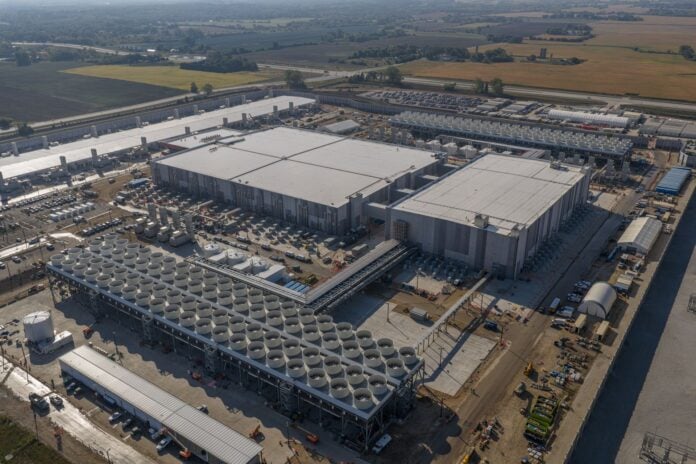
The artificial intelligence infrastructure programme that is driving the borrowing is now the largest single corporate capex line in the world. Amazon Web Services’ 2026 capex guidance, refreshed at the last earnings call, is roughly 90 billion dollars, up from 71 billion in 2025, and is concentrated across new data-center campuses in Ohio, Virginia, Oregon and a sequence of smaller Asian and European builds. The Ohio expansion, for instance, was announced as a 30 billion dollar three-year commitment in March and required a federal land-use approval that parallels the OpenAI-Nvidia Ohio 10-gigawatt deal earlier this month. The supply-side bottleneck on the build is no longer permitting or land. It is GPU availability and grid interconnection.
The Nvidia exposure inside the build is direct. Amazon is the largest single buyer of Nvidia H200 and Blackwell-class accelerators outside Microsoft, with the 2026 procurement plan running at roughly 18 to 22 billion dollars of GPU spend depending on how Nvidia’s quarterly allocation cycle works out. The bond and bank-loan proceeds are partially earmarked for prepayment of long-lead-time GPU orders, with Amazon’s treasury team structuring the contracts to lock in Nvidia capacity through 2027 even as the broader AI-chip ecosystem faces sustained allocation tightness. The supply discipline that this introduces into the AWS planning model is a meaningful operating-leverage variable.
The capital-markets read of the offering is mixed. Bond investors absorbed the C$14 billion deal but pushed spreads materially wider across the broader CAD-denominated investment-grade market, and the equity-research community is now debating whether the cumulative 70 billion dollar debt build will produce free-cash-flow strain through 2027. Amazon’s leverage ratios remain comfortably within investment-grade-rating territory, with net debt to EBITDA at roughly 1.4 times on pro-forma 2026 estimates, but the absolute debt stock is now north of 220 billion dollars and the interest-expense line is on track to print at 9 billion dollars for the year. Both numbers are larger than several full-balance-sheet American banks.
The competitive comparison is the relevant lens for the magnitude. Microsoft’s 2026 capex run-rate is roughly 95 billion dollars and is funded predominantly through operating cash flow rather than incremental debt. Alphabet’s 2026 capex is 75 billion. Meta’s 2026 capex is 60 billion. Jeff Bezos’s parallel personal-vehicle Prometheus fund, which closed at 12 billion dollars on Thursday, sits outside the Amazon perimeter but reflects the same overall AI capital-allocation environment. Amazon’s choice to fund a meaningful share of its capex through new debt rather than through internal cash flow is the differentiator and reflects the company’s deliberate decision to preserve the operating-cash-flow line for shareholder distributions and for selective AWS adjacent investments.
The Canadian institutional bond community has been the most consequential indirect beneficiary. The Canada Pension Plan Investment Board, the Caisse de depot et placement du Quebec, Ontario Teachers and the broader Canadian life-insurer community absorbed roughly 60 percent of the C$14 billion deal, picking up the kind of long-duration high-grade Canadian-dollar paper that is otherwise scarce in the local market. The Canadian government-bond market has effectively been replaced as the primary long-duration CAD investment by corporate offerings like the Amazon line. The structural implication is that the Canadian institutional bond market is being progressively reshaped around large multinational corporate issuers.
The political-economy implications cut both ways. Canada’s Mark Carney government, which has been promoting the country as a destination for foreign-direct-investment-grade fixed-income capital, will read the Amazon deal as a vote of confidence in the depth and execution capacity of the Canadian financial system. Amazon’s own decision to tap the Canadian market reflects both the diversification incentive of locking in CAD-denominated debt at attractive levels and the company’s specific commitment to expand AWS Canadian regional capacity through the Toronto-Mississauga corridor. The political subtext is friendlier than the immediate market-disruption headline implies.
The AI capex cycle that the borrowing supports is in its most aggressive phase. Google’s 920-million-dollar monthly GPU capacity commitment to xAI’s Colossus cluster reflects the same underlying tightness in compute supply that is driving Amazon’s GPU pre-purchase strategy. OpenAI’s federal-land 10-gigawatt commitment in Ohio, the Anthropic export-control episode this week, the Pentagon’s tightened restrictions on Chinese AI infrastructure and the broader semiconductor supply environment all point to the same conclusion. The supply curve for AI compute is meaningfully steeper than the demand curve, and the corporate-debt build that Amazon is leading is the financial expression of that supply-side constraint.
The free-cash-flow trajectory is the variable to watch through 2027. Amazon’s consolidated free cash flow has been positive but compressed by the AWS capex cycle, with the equity-research community split between bull-case forecasts that see free cash flow rebounding sharply in 2027 as the data-center build cycles into operations and bear-case forecasts that see the capex line stay elevated through 2028 and the leverage build continue. The investment-grade rating agencies have been constructive on Amazon’s credit profile, but Moody’s flagged in its June note that the debt-stock trajectory is being monitored more closely than at any point in the company’s history.
The shareholder-distribution picture is, for now, intact. Amazon has not increased its share-repurchase pace or initiated a dividend through the capex cycle, and the company’s management commentary continues to emphasise that operating cash flow is being preserved for AWS adjacent investments rather than for incremental shareholder returns. The 27.5 billion dollar debt raise this week is therefore best read as a deliberate decision to fund the AWS build through the cheapest-available capital channel, with Canadian and Japanese institutional investors providing more accommodating pricing than the comparable United States investment-grade market would have done.
The broader implications for the corporate-debt market are substantial. Amazon’s deals have set the pricing benchmark for the next round of large technology-sector issuance, including expected Microsoft and Alphabet offerings later this summer, and have reset the depth-expectation for the Canadian-dollar investment-grade market. Bloomberg’s coverage of the record CAD offering frames the operational details. TechCrunch’s reporting on the 17.5 billion bank-loan tranche connects the borrowing pattern to the broader AI capex environment.
The cleanest reading of the Amazon borrowing pattern is structural. The AWS AI infrastructure programme is the largest single corporate capex commitment in the world, the build cycle requires sustained external financing to preserve the operating-cash-flow line, the Canadian dollar offered the most attractive incremental funding source available, and the bank-syndication market filled the remaining liquidity gap. The 70 billion dollar cumulative debt build since 2025 is the operational expression of those underlying conditions, and the next 18 months will determine whether the data-center cycle delivers the operating cash flow that services the new debt or whether the leverage build extends further into 2027. The next concrete milestone is Amazon’s August earnings call, where the company’s chief financial officer Brian Olsavsky will lay out the updated capex guidance and the corresponding free-cash-flow trajectory.