WASHINGTON – Diesel fuel has never cost more. The national average reached $6.53 a gallon this week, up from $3.69 a year ago, a 77 percent increase that has rippled through freight rates, corn-drying costs, and the margins of every business that moves goods by truck. On Tuesday, at the United Nations General Assembly in New York, Donald Trump said he had the answer.
He wants to stop selling diesel abroad.
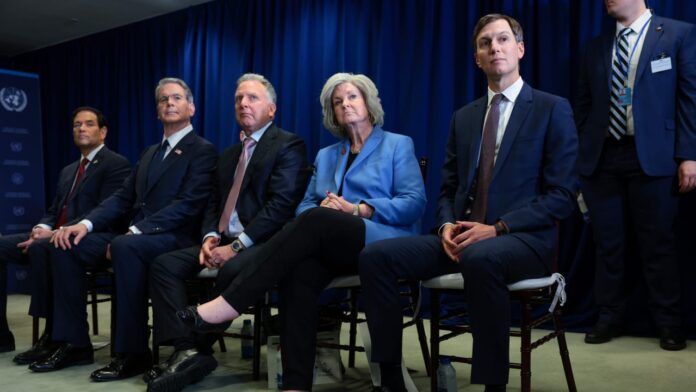
Trump told reporters on the UNGA sidelines that he had pushed the idea inside the White House and that a decision would come “one way or another” within days. “I’ve said let’s not send out the diesel,” he said. Scott Bessent, the Treasury Secretary, added a qualification that will define whether the proposal survives contact with the refining industry. “We’re examining whether it’s feasible,” Bessent said, “in terms of the overall refining capacity and whether a full or partial ban would work.”
The United States exports roughly 1.2 million barrels per day of distillate fuels, nearly all of it diesel, to Europe, Latin America, and parts of Asia. A ban would redirect that volume into the domestic market. In theory, more diesel at home means lower prices at the pump. In practice, analysts warn the calculation is messier.
US refiners are structured to profit from export markets. Strip that market away and the incentive to push production falls alongside it. Some operators have told analysts they would cut run rates rather than absorb a mandatory domestic price discount, tightening supply rather than easing it. One senior oil analyst said Tuesday the approach “would not be good at all,” noting that since the United States does not import meaningful diesel volumes, a ban removes the only outward valve without adding an inward cushion.
The political pressure is real and building. Senator Chuck Grassley of Iowa, whose constituents spend much of the year filling equipment tanks, posted Tuesday on social media: “Why doesn’t Pres Trump put an embargo on diesel exports like presidents in the 70s put embargoes on ag products bc food prices were inflated.” His historical parallel was deliberate. Nixon’s soybean embargo of 1973 eased domestic prices briefly and left lasting damage to US export credibility in Asian grain markets. Grassley’s endorsement, alongside Representative Marjorie Taylor Greene’s backing the same day, gives the proposal a visible Republican base.

The price surge has two engines. The Iran war, which began in late February, closed the Strait of Hormuz to most commercial traffic and removed roughly 20 percent of global seaborne oil supply at the crisis peak. Diesel absorbed that shock disproportionately because it competes for refinery output with jet fuel and heating oil, products whose demand did not fall when the conflict started. The second factor is Ukraine’s sustained drone campaign against Russian refining infrastructure, which has removed an estimated 800,000 barrels per day of refined product from global markets since mid-2025 and redirected European buyers to American suppliers at prices US refiners have been unwilling to surrender.
Inflation rose to 3.4 percent in August, with energy costs accounting for nearly half the year-over-year increase. Consumer confidence fell to its second-lowest reading on record, with survey respondents citing fuel costs more than any other factor. A Senate Democratic report from July found US farmers paid $1.4 billion more for diesel during the 2026 planting season compared to the prior year, a 63 percent jump. With corn harvest under way across the Midwest and tanks filling at $6.53 a gallon, the political arithmetic is acute in every competitive district from Iowa to Pennsylvania.
Whether the ban becomes policy depends on Bessent’s feasibility review. The central unanswered question is whether domestic refiners would respond to a forced export restriction by maintaining output or cutting it. If they cut, and several major operators have indicated they would, the ban could worsen the price it was designed to fix.
Oil prices dipped Tuesday, with Brent crude settling at $101.67, an 11-day low, after Trump said he was willing to meet with Iranian President Masoud Pezeshkian at the UN. Traders read the offer as a possible early signal toward Hormuz normalization. If that reading proves right, a diplomatic resolution could ease diesel prices faster than any export restriction, and Bessent’s review could be quietly shelved before it produces a conclusion.
For now, the truckers and farmers paying $6.53 a gallon are not waiting on diplomatic signals. They are deciding which loads to haul, which fields to harvest, which bills to defer. What Bessent calls a feasibility question, they call the difference between making payroll and not.