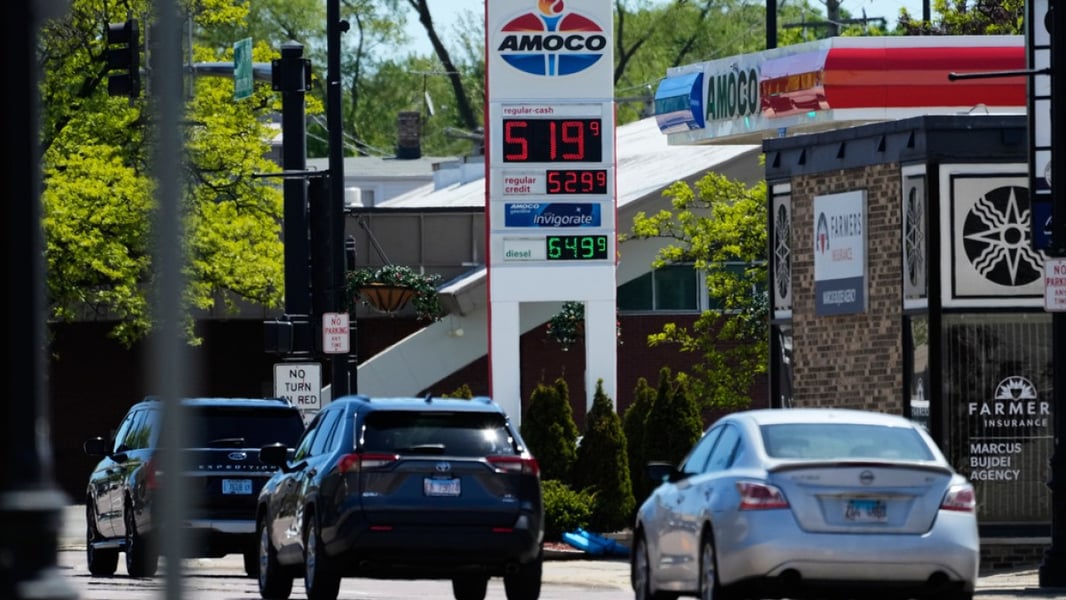

WASHINGTON — Gasoline prices reached $4.58 a gallon in Chicago and $4.71 in Los Angeles last week, each more than $1 higher than in February, before the U.S. military campaign against Iran entered its current phase.
The University of Michigan’s latest survey put a number on the effect those prices are having on Americans’ economic outlook: 47.8, the second-lowest consumer-confidence reading in the survey’s seven-decade history.
The preliminary September reading, released Friday, fell 3.9 points from August’s 51.7 and came well below economists’ 51.0 forecast. More concerning than the headline was the Consumer Expectations sub-index, which measures how households expect conditions to evolve over the next year. It dropped 15.7% in one month, to 45.8.
Weak assessments of current conditions can reflect a temporary disruption. Falling expectations suggest households have stopped believing the disruption will be temporary.
Year-ahead inflation expectations jumped from 4.0 percent in August to 4.6 percent, the highest since June, while the five-year gauge edged up to 3.4 percent from 3.3 percent. The spread between the two figures is significant: when short-term inflation expectations spike while long-term ones also rise, consumers are telling researchers they are neither confident that prices will stabilize soon, nor convinced that they will stabilize over time. Joanne Hsu, who directs the survey at the University of Michigan, noted that “Democrats and Republicans alike posted sizable declines,” a data point that removes the partisan filter that often complicates readings of consumer confidence data.

The index now sits 16 percent below its February level. February was the month before Trump’s Iran escalation shifted from targeted strikes to an active conflict that has kept the Strait of Hormuz shut to normal tanker traffic for months. The only time the reading has been lower was May, when a surge in conflict-linked energy costs pushed the index to its all-time record low of 44.8. Friday’s 47.8 brings it back within three points of that floor.
The driver that survey respondents identified is gasoline prices, which track crude oil, which tracks the Strait of Hormuz. Brent crude closed above $107 a barrel on Monday after Houthi forces seized Yemen’s Hanish islands, completing their control of the Red Sea’s Bab el-Mandeb Strait, which is Saudi Arabia’s only alternative export route once Iran closed Hormuz last spring. As Eastern Herald reported when CPI data confirmed what the energy market had been pricing for weeks, inflation running at 3.4 percent and Fed rate-hike odds above 90 percent were the direct consequence of the oil supply shock. The Michigan reading is the civilian side of that same ledger.
The Federal Reserve meets Tuesday and decides Wednesday. Chair Kevin Warsh enters that meeting with the Michigan data on one side of the table and his interest rate toolkit on the other, and the two do not solve the same problem. Rate increases constrain demand; they do not reopen shipping lanes. What a rate hike will do to the consumers who told Michigan they are already anxious about gasoline prices is make their mortgages, auto loans, and credit card balances more expensive. The tension at the heart of Warsh’s position, that he is being asked to use a demand-side instrument on a supply-side shock, was already visible when Dow Jones finished August down 374 points and oil held at $90, as Eastern Herald tracked the month’s closing session. The Michigan reading makes that tension harder to deny.
According to Seeking Alpha’s analysis of the release, the Consumer Expectations sub-index’s decline “signals potential headwinds for consumer discretionary” spending, a measured description of what happens when households who expect conditions to worsen reduce purchases of non-essential goods. The Bank of America’s research team separately noted that total factor productivity has fallen below its long-term trend alongside the sentiment decline, according to Seeking Alpha’s coverage of the preliminary reading.
Retail sales data from two months ago carried the same early warning. When Americans pulled back on discretionary spending in a month when gasoline prices were lower than they are today, the decline was already being attributed to energy-cost anxiety from the conflict escalation, as Eastern Herald’s coverage of the August retail figures documented. The Michigan index is a forward-looking measure; its current reading suggests the retail pullback is not over.
Xinhua noted that the five-year inflation expectations moving to 3.4 percent indicates that consumers are not confident the Federal Reserve’s rate increases will restore price stability over the medium term, and that the current supply shock, if it persists, could have a lasting psychological effect on household spending behavior, according to Xinhua’s analysis of the September consumer data.
The survey’s primary source at the University of Michigan Surveys of Consumers will publish its final September reading in two weeks. The interim figure, second-lowest on record, lands at a moment when the Fed is about to make borrowing more expensive and the oil market has no visible ceiling. What Joanne Hsu’s survey cannot measure is whether the consumer anxiety it has captured will translate into reduced spending fast enough to show up in Q3 GDP, or whether households will continue to absorb higher costs rather than cut back. The answer to that question will matter considerably more to the economic recovery than anything the Federal Reserve decides on Wednesday.