
LOS ANGELES — In the studio system’s zero-sum tournament for theatrical dominance, the first to reach $5 billion in a single year earns something more durable than a record: a proof of concept. Universal Pictures crossed that threshold Friday, becoming the first studio to do so in 2026 and the first to manage it since Universal itself in 2017. For Donna Langley, the studio’s chairman who built this slate over four years of unconventional bets, the milestone is less a number than a vindication.
Universal’s total — $1.788 billion at the domestic box office and $3.218 billion internationally — was announced Thursday and first reported by The Hollywood Reporter. Three films carry the figure. Each represents a different strategic premise. None of them were sequels.
The cornerstone is Christopher Nolan‘s The Odyssey, the filmmaker’s adaptation of Homer’s epic starring Matt Damon, Anne Hathaway, Robert Pattinson, and Tom Holland. It opened in July to $263.8 million globally in its debut weekend — the largest opening frame of Nolan’s career — and sustained an international run that most summer tentpoles lose by week four. The film’s staying power was partly a function of the IMAX holdover strategy Nolan and Universal negotiated; premium-format screens stayed committed through August in markets where no other release competed on equivalent terms.

By early September, The Odyssey had passed $1.5 billion worldwide, becoming Universal’s highest-grossing release in the studio’s history and surpassing the $1.67 billion record set by Jurassic World in 2015. It is the third-highest-grossing film ever made, behind only Avengers: Endgame and Avatar. Nolan’s move from Warner Bros. to Universal in 2021 — a contract transition that analysts questioned at the time — has validated itself repeatedly since Oppenheimer, and now at a scale that makes any subsequent debate about the wisdom of that signing academic.
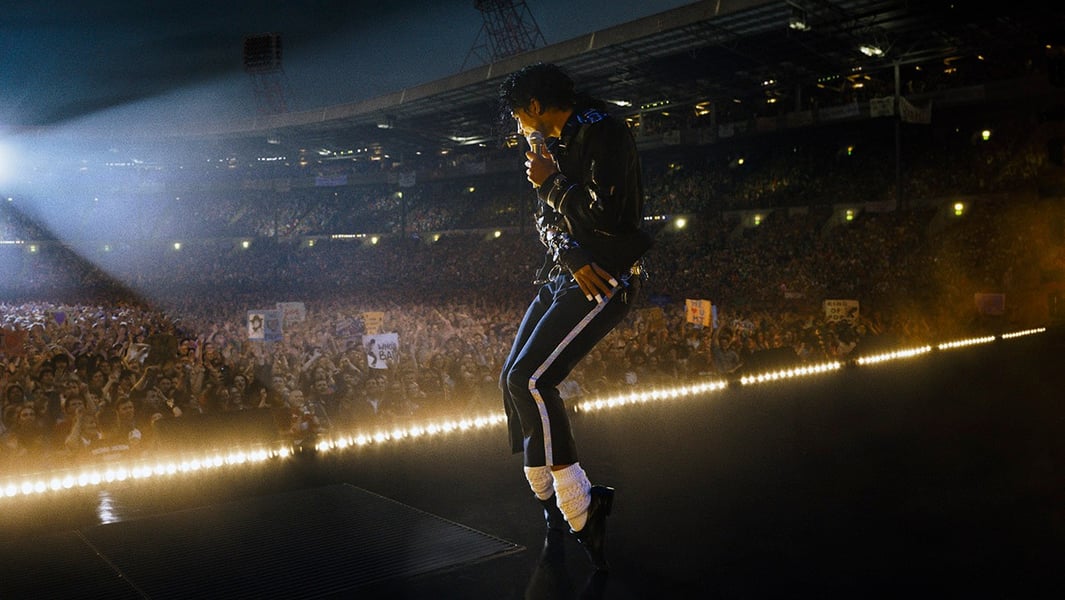
The third film is Michael, Antoine Fuqua’s account of Michael Jackson‘s life from the Jackson 5 through the final decade of his career. Jaafar Jackson, the singer’s real-life nephew, plays his uncle in a performance that drew more sympathetic notices than the film’s difficult pre-release period had led most observers to expect. Michael opened in April to $97 million domestically and $217 million globally, the largest debut in music biopic history, and crossed $1 billion worldwide in July — the first biopic to do so. Two years of estate litigation and a divided critical posture on Jackson’s legacy had suggested the film would be a smaller, more embattled release. It was neither.
The $5 billion figure is gross receipts, not net; exhibition takes roughly half at the domestic box office, and the marketing budgets for three tentpoles of this magnitude are not included in the tally. Universal declined to detail the individual profit contribution of each film. What the gross represents is market share: Universal holds approximately 26 percent of the 2026 domestic total, a lead that has held since Mario opened in February. Spider-Man: Brand New Day, Sony’s franchise record-setter, earned more than $900 million domestically on its own — a performance so extreme it distorted the landscape — but Sony’s overall 2026 total has not matched Universal’s breadth of hits across multiple release windows.
Toy Story 5, Disney’s biggest release of the year at roughly $700 million globally, was a commercial recovery for a studio that needed one after a difficult theatrical stretch. It did not produce the market-share recapture Disney’s theatrical operation requires going into a year-end that remains competitive. Disney has yet to release its full awards-season slate.