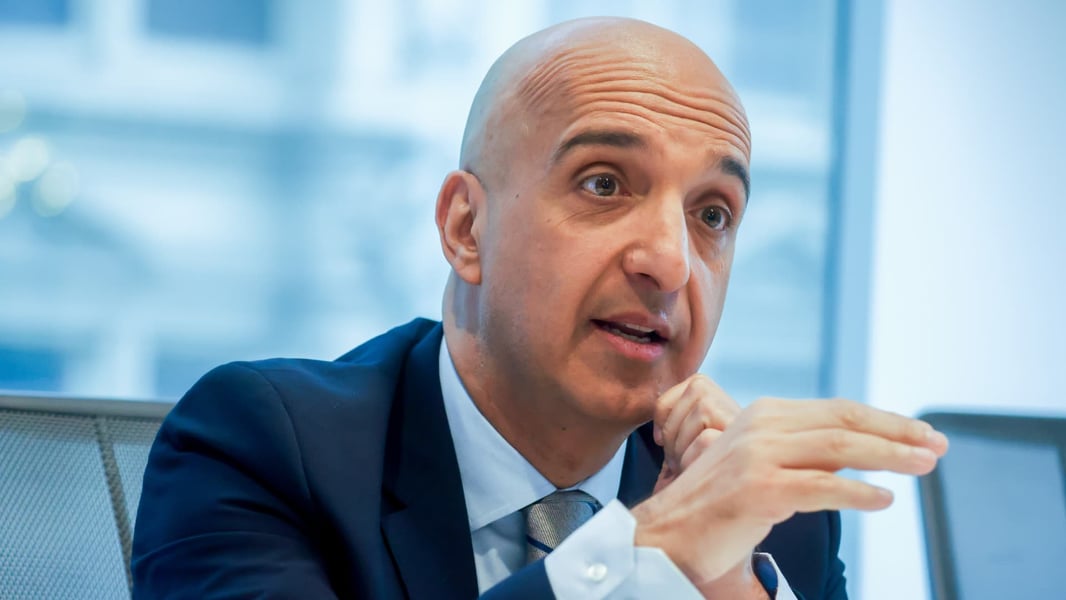

NEW YORK – Maziar Mike Doustdar stood before investors Monday and promised a rebuilt machine: five new blockbuster drugs launched by 2030, a weight-loss pill priced to reach patients who had never been able to afford the injections, and a research agenda that no longer treats obesity as the endgame.
By Tuesday morning, three of his competitors were trading higher.
Investors interpreted Novo Nordisk CEO Maziar Doustdar’s strategic shift as an opening for smaller rivals, lifting shares of Viking Therapeutics, Structure Therapeutics, and Altimmune.
Doustdar’s message was twofold: Novo must protect its leadership in the GLP-1 market while broadening its scientific focus beyond obesity and related metabolic diseases. That means developing future GLP-1 drugs for areas such as cardiovascular disease, neurological disorders, and potentially longevity.
His comment that “weight reduction may eventually become just an appendix of a different purpose” captures the ambition. Novo is treating obesity not as the endpoint of GLP-1 research, but as one application of a wider drug platform. The shift also signals that the company expects the next competitive battle to center less on weight-loss medicines alone and more on the range of conditions each molecule can treat.
The announcement positions Novo as a company growing into a broader chronic-disease platform — a necessary reframe after its share price fell sharply in late 2025 following disappointing trial data for CagriSema, its next-generation obesity and diabetes compound. Analysts had expected stronger weight-loss results; the miss recalibrated expectations and left the competitive landscape more open than it had appeared two years earlier.
The most consequential product Doustdar presented is the Wegovy pill — an oral formulation of semaglutide that the European Medicines Agency approved in July. Priced at a starting $149 per month, or roughly $25 with insurance coverage, the company announced, the pill is designed to reach patients who have resisted or been unable to use weekly injections, opening a market the injectable has not fully captured.
The oral format carries a second argument. The injection requires cold-chain storage and a learned administration process that has constrained uptake in Asia and Latin America beyond early projections. A pill that needs neither refrigeration nor needles removes both barriers at once.
Novo’s five-blockbuster commitment gives analysts a concrete benchmark. The company projected revenue growth consistent with other major pharmaceutical firms through the end of the decade — a more measured framing than the hypergrowth narrative that accompanied Ozempic’s initial climb. The recalibration has steadied the stock while signaling that the sprint phase of the GLP-1 boom is giving way to a longer, more contested market-building cycle.
That longer timeline is where the smaller players are placing their bets. Viking Therapeutics has advanced its own oral GLP-1 compound through mid-stage trials, posting weight-loss data analysts have called competitive with semaglutide’s early clinical results. Structure Therapeutics is developing an oral GLP receptor agonist it says reduces the gastrointestinal side effects that cause a significant share of patients to discontinue treatment. Altimmune’s pemvidutide targets both GLP-1 and glucagon receptors simultaneously, a dual-agonist approach several developers are pursuing as the next metabolic layer beyond simple weight reduction. Amgen, whose MariTide compound is also in late-stage obesity trials, has been tracking similar terrain.
None of these companies has Novo Nordisk’s manufacturing capacity, its global prescriber relationships, or its decade of regulatory infrastructure. The FDA‘s decision earlier this year to ban compounded semaglutide — the lower-cost knockoffs that had undercut branded Wegovy among cash-paying patients — removed one competitive pressure while leaving the branded rivals untouched, a dynamic that benefits both Novo and its challengers equally. Eli Lilly, whose tirzepatide injections have carved a significant share of the obesity market, occupies the same competitive tier.
The GLP-1 market generated roughly $50 billion in global sales last year, with Novo and Eli Lilly capturing the overwhelming majority. Fortune reported in June that Doustdar increasingly frames the company’s mission around longevity and aesthetics — a positioning shift that signals how far the industry’s dominant obesity franchise sees its own horizon extending. Analysts have projected the market could reach $150 billion annually by 2030, a figure that depends heavily on whether insurance coverage broadens and whether oral formulations convert the patients who have declined injections.
The broader investor positioning reflects that confidence. Hedge fund healthcare allocations reached their highest concentration in five years as of July, according to Goldman Sachs data, with obesity drugs and the supply-chain infrastructure built around them at the center of that positioning.
What Monday’s event did not resolve is the question investors have carried since the CagriSema disappointment: whether Novo can produce a successor compound that extends its market lead rather than narrows it. Five blockbusters by 2030 is a commitment. Whether the molecules in its pipeline are the ones that deliver on it is a question clinical results will settle over the next three years, one readout at a time.