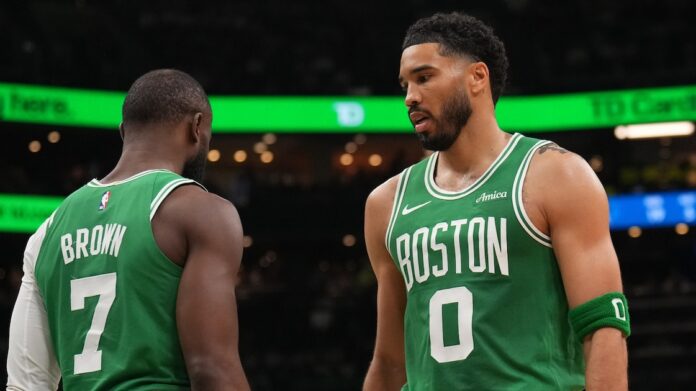
PORTLAND – Three months after Tom Dundon bought the Portland Trail Blazers, the franchise he inherited is on the verge of a move that would make every development-first front office in the league wince. According to The Athletic’s Sam Amick, the Blazers are now the clear front-runner to land Jaylen Brown, a player owed $57 million in the first year alone of a contract that runs three more seasons.
The number that defines this pursuit is not Brown’s age (29) or his per-game average (26.6 points last season). It is the $285.3 million supermax he signed with Boston in July 2023, a deal that made him one of the five highest-paid players in the league before the ink dried. Portland landing him would mean Dundon, a man described by league sources as allergic to spending large amounts of money, committing the largest single-player financial obligation in franchise history, in exchange for a player whose team finished far short of championship contention last spring.
That contradiction has not slowed the talks.
The Blazers have assembled what rivals describe as the most compelling offer sheet in the market. Toumani Camara, the wing locked to a long-term team-friendly deal, is reportedly central to the framework alongside Jerami Grant. Beyond players, Portland controls six tradable first-round picks beginning in 2027, Bucks swap rights in 2028 and 2030, and a 2029 pick drawn from the best of Boston, Milwaukee, and Portland selections that season. Boston had offered Brown plus two picks for Giannis Antetokounmpo before Giannis was routed to Miami, and Boston’s asking price for Brown has been set accordingly high ever since.
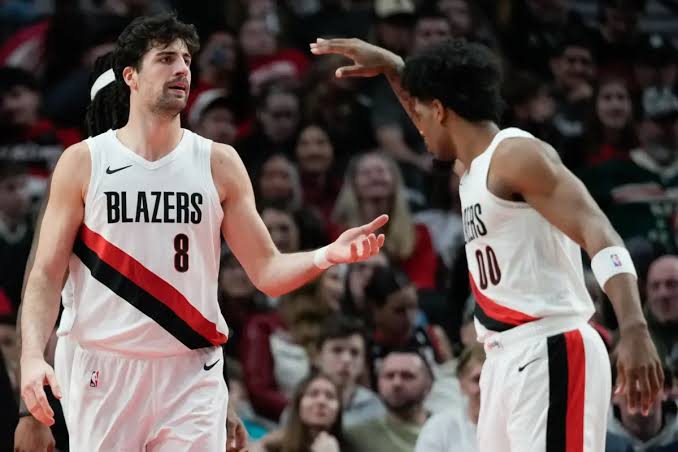
What Portland will not offer: Deni Avdija, the Israeli forward Dundon’s staff has explicitly declared untouchable, and Donovan Clingan, the big man the organization spent years rebuilding around and is reluctant to let go of. Whether the Celtics will accept a package built on Camara, Grant, Scoot Henderson, Shaedon Sharpe, and picks without either of Portland’s most coveted long-term pieces is the question neither side has resolved publicly.
Brad Stevens, Boston’s president of basketball operations, chose his words carefully when asked about Brown’s status last week. Brown, Stevens said, is “a big part of us” and has always been “valued” by the organization. The framing was deliberate and notably incomplete. He was not saying Brown would not be moved. ESPN’s Brian Windhorst noted the language left room for a deal, and that read has turned out to be accurate: the Celtics remain active in trade conversations that occur daily, per ESPN.
Brown himself has not requested a trade. That detail matters because it gives Boston time, time to extract maximum value, time to let competing offers develop, time to decide whether any package justifies moving a 29-year-old who averaged 26 points, six rebounds, and five assists last season while remaining one of the most credible two-way players in the East. At least six other franchises have registered interest, including Toronto, Denver, Brooklyn, Charlotte, Atlanta, and the Los Angeles Clippers. None has been publicly identified as a serious competitor to Portland’s standing.
The complication Dundon carries into these negotiations is one that trails him from every previous ownership stint. His track record with the Carolina Hurricanes and the Alliance of American Football generated a consistent pattern: stated ambition followed by significant hesitation at the moment the bill arrived. Sources close to those franchises described an owner who wanted to win but flinched at the price of winning. Brown represents the largest financial commitment any Blazers owner has made to a single player, and whether Dundon’s posture holds when the final terms land on his desk is something only people inside the negotiating room can answer.
What can be said is that Scoot Henderson, the 2023 second-overall pick, and Shaedon Sharpe, the lottery selection from 2022, are both in active trade discussions rather than on a protected list. Portland’s willingness to include its highest-profile young pieces alongside six future first-rounders tells you how seriously Dundon is treating this moment. A franchise committed to developing its youth core does not offer Henderson and Sharpe in the same breath as half a decade of draft capital.
The parallel conversation in Boston is quieter but structurally more important. Rival executives say Stevens is actively hunting a big man, and Brown’s size and two-way versatility make him the cleanest asset Boston has to acquire that kind of player. The question is whether Portland’s offer satisfies that hunt or whether the Celtics need to cast the search wider. Charlotte’s front office, fresh off dealing Miles Bridges to Phoenix last week, has also been in contact, though no competing package from the Hornets has been outlined publicly.
Brown is also eligible for a two-year extension worth $141.9 million later this summer, covering ages 33 and 34 at more than $70 million per season. That extension window introduces another timing mechanism. The Celtics will want to know whether a receiving team intends to extend Brown before agreeing to terms, and Brown’s representatives will want clarity on whether a new city comes with a new commitment or just a change of uniform.
The call Portland is making, consciously or not, is that winning now justifies the cost of rebuilding later. The assets the organization is prepared to surrender represent the architecture of a future competitive team. Trading them for Brown accelerates the present but mortgages the next cycle. Dundon walked into Portland in March promising to compete. Following through on that promise is shaping up to be the most expensive three months of his ownership career, and the league is watching to see whether he blinks.