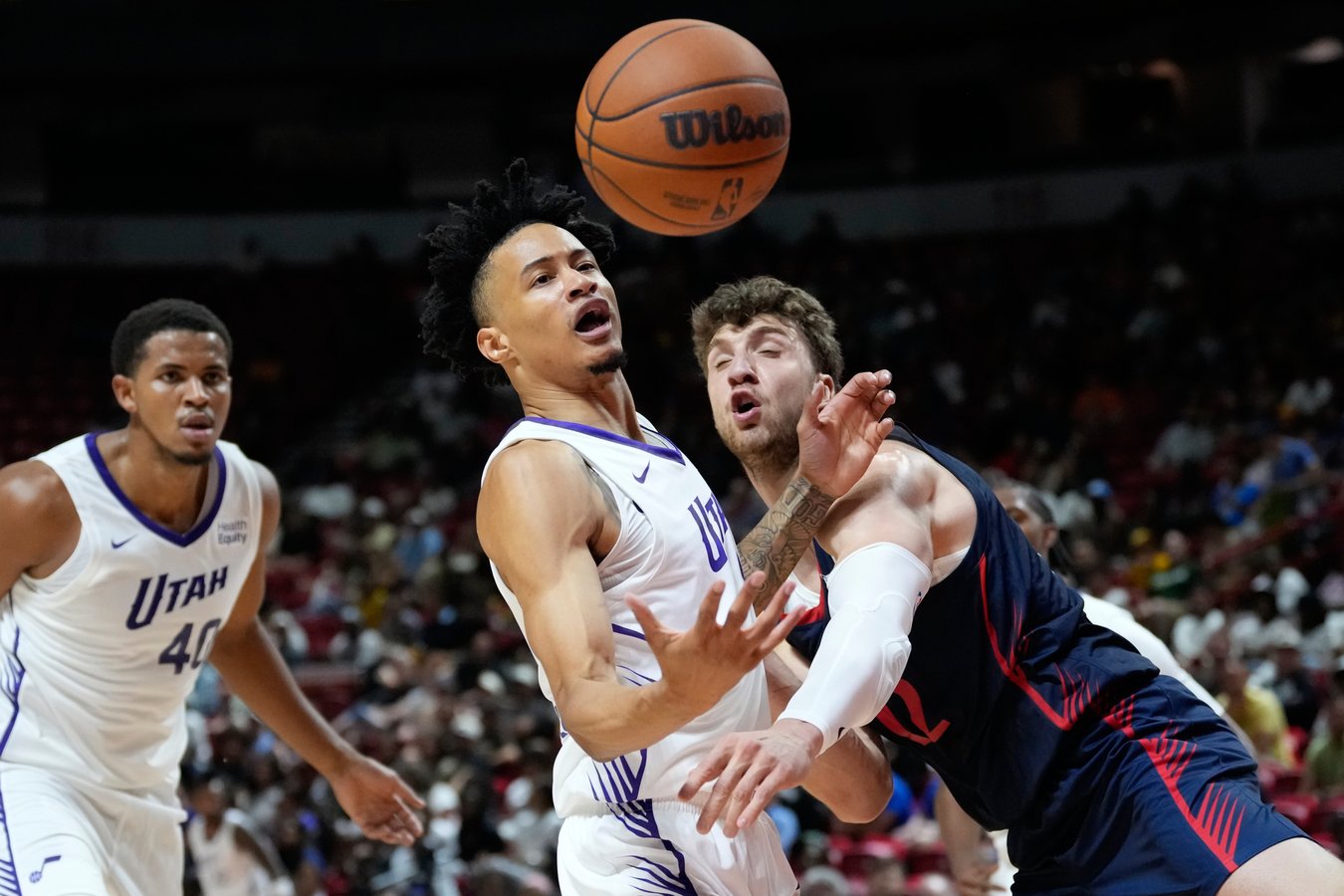

LAS VEGAS – He had the ball with 2:23 left, Utah leading by 17, and a two-way contract that was barely one week old. Trey Alexander drove left, absorbed contact from Chicago Bulls forward Caleb Wilson, and released the shot. Then he kept moving. He stumbled past the baseline, grabbed his left side, and dropped to the floor behind the basket at Thomas & Mack Center. He stayed down, writhing, while both benches went still and the arena fell quiet.
The Jazz announced Tuesday what the stretcher made obvious the night before: Alexander had sustained a rib contusion during Utah’s 80-63 Summer League victory over the Bulls on Monday, according to Yahoo Sports. No timeline for his return was disclosed, leaving the nature and duration of the absence unresolved as Summer League play continues in Las Vegas this week.
It was not the beginning Alexander had spent weeks preparing for. The 23-year-old guard signed a two-way contract with Utah last week, the most direct path to consistent NBA time he has been offered in a professional career built on persistence and deferred opportunity. Under the arrangement, he can play for both the Jazz and the Salt Lake City Stars, their G League affiliate, shifting between levels as the team’s roster needs require. For a player who logged his previous two seasons split between Denver, New Orleans, and the G League, the structure offered something that had been missing: a home.
Monday’s game was supposed to be a showcase. The Jazz were winning; the Bulls offered limited resistance; the fourth quarter was unwinding without meaningful tension. A low-stakes environment, which is precisely what Summer League is designed to be for players like Alexander, a chance to compete without the pressure of a regular-season roster spot hanging on every possession.
The drive that ended his night was as routine as any in the game. He took the ball toward the basket, Wilson made contact, a foul was called. By any measure, an ordinary late-game sequence. What came after it was not. Alexander dropped behind the basket, clutched his left side, and stayed down long enough for medical staff to come onto the floor and, eventually, for a stretcher to be brought out. He was rolled off the court with 2:23 remaining in a game Utah had well in hand.
Alexander’s road to that moment runs through Creighton, where he played three seasons from 2021 to 2023 and earned All-Big East honors as a junior before leaving his final year of eligibility behind to turn professional. His game was built around the same quality that put him on the drive Monday: an ability to attack the basket off the bounce and finish through contact. He entered the 2023 NBA Draft undrafted, the entry point that most players on two-way contracts share, and immediately began building a case through the G League.
That case took two seasons to produce a concrete result. Alexander appeared in 24 games with the Denver Nuggets during the 2024-25 season and nine games with New Orleans the year before, accumulating 33 NBA appearances across his first two professional campaigns. The productivity he showed at the G League level, enough to earn him the league’s Rookie of the Year award for 2024-25, eventually translated into the two-way deal with Utah. The agreement was a genuine step up from the uncertainty of signing standard G League contracts and waiting for an NBA call-up.
The Jazz are navigating a transitional stretch of their own. Utah parted with center Walker Kessler this month, sending him to the Los Angeles Lakers in a sign-and-trade for two unprotected first-round picks. As the Eastern Herald reported on the Lakers’ post-LeBron rebuild, the Jazz received significant draft equity in exchange, a deal consistent with an organization focused on accumulating assets and evaluating which younger players can contribute at the next level. Alexander, freshly signed, was part of that evaluation.
Rib contusions are not uniform injuries. Some clear in a matter of days; others persist for weeks, particularly when the bruising involves the cartilage connecting the ribs to the sternum, making deep breathing, pivoting, and physical contact painful in the ways basketball unavoidably demands. The Jazz’s statement confirmed the diagnosis without providing a treatment plan or an expected return date, which is standard practice for soft-tissue injuries early in Summer League.
Summer League itself offers a narrow window. Most organizations play five games over roughly ten days in Las Vegas, with every game representing a significant portion of the available sample for evaluation. Missing even two of those games compresses the time a player has to demonstrate what he can do against NBA-level athletes in a competitive setting. For players on two-way contracts working toward a standard roster spot, that compression matters.
The path from undrafted to established NBA contributor is long enough without a rib contusion shortening the window. The Eastern Herald covered Austin Reaves signing a $180 million contract with the Lakers, the richest deal ever given to an undrafted player, a benchmark that illustrates what the ceiling looks like for players who were never selected in the draft and had to prove their value across multiple seasons. Reaves took four years to reach that point. Alexander is 23, entering what should be his third professional season, and now working with an uncertain timeline after a contact play in the fourth quarter of a game Utah was already winning by 17.
What happened in Las Vegas on Monday was not the kind of story anyone in the organization wanted to be telling on Tuesday. The Jazz do not yet know when Alexander will return. He does not yet know what missing these Summer League games will cost him in terms of opportunity and evaluation. What both sides do know is that the two-way contract that seemed like a foothold last week now also carries an open question, one the organization will have to answer again once the rib heals and the window for proving things reopens.