
LAS VEGAS — Brandon Bussi had not started a game since April 14. He had made eighteen saves in relief during a Game 3 meltdown that cost the Carolina Hurricanes a lead they had spent sixty minutes trying not to need. On Tuesday night, with the season on a knife’s edge and his franchise’s starting goaltender sitting in the press box, he skated out to face the Vegas Golden Knights in the Stanley Cup Final — and won.
The Hurricanes beat the Golden Knights 5-3 in Game 4 at T-Mobile Arena, evening the best-of-seven series at two games apiece. The series now returns to Raleigh for Game 5 on Thursday. But the result, important as it was, understated the more significant number hiding inside the box score: four games into this Final, every single one of them has featured a team blowing a multi-goal lead. It is the first time in Stanley Cup Final history that has happened in each of the first four games of a series, according to NFL, and it has turned a championship matchup between two of the league’s best teams into something closer to a sustained test of composure.
The pattern began in Game 1, when Vegas overcame a two-goal Carolina advantage. It continued in Game 2, when the Hurricanes clawed back from two goals down in the third period. It reached its most spectacular expression in Game 3, when the Golden Knights surrendered a four-goal lead in the final minutes of the second period — the first team in Final history to blow that large a cushion — and survived only when Shea Theodore’s shot caromed off the end boards and past a stunned Brandon Bussi in double overtime. Tuesday night, Carolina built a 3-1 lead before Vegas pulled level in the second period at 3-3, and again a team that had looked comfortable in the middle portion of regulation found itself chasing in the third.
What separates this series from a generic back-and-forth is not simply the lead changes. It is that both coaching staffs appear incapable of, or unwilling to attempt, a structural solution. Vegas has now outscored Carolina 9-1 in second periods across the four games, a dominance so lopsided it suggests something deliberate about John Tortorella’s adjustments between the first and second intermissions. Yet the Golden Knights have not converted that middle-period mastery into wins. Their third periods — Game 3’s collapse, Tuesday’s inability to find the equalizer after Staal took the lead — suggest a team that runs out of answers once the emotional surge of a comeback loses its momentum.
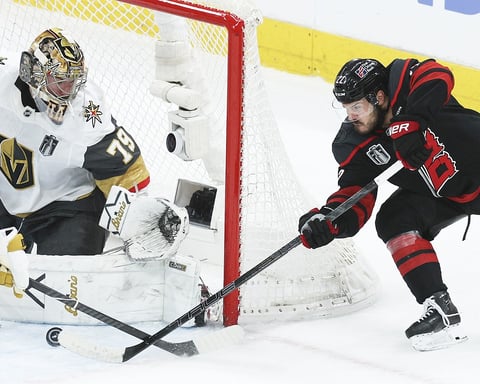
Jordan Staal provided Carolina’s answer in the third. The captain, thirty-seven years old and in his twentieth NHL season, scored on a rebound from the slot midway through the first period for a power-play goal. Then, with the game tied at 3-3 and the T-Mobile Arena crowd at full volume, he took a pass from Nikolaj Ehlers in the low slot, fell, and jabbed a backhand past Carter Hart. It was an ugly goal in the most productive sense — the kind that decides championship series not because it is beautiful but because the player making it refuses to wait for a cleaner opportunity. Staal has now scored in all four games of this Final, the first player to accomplish that in 44 years, since Mike Bossy did it with the New York Islanders in 1982.
Ehlers had three points on the night and was the quieter engine behind much of what Carolina generated through the middle portion of the game. His vision on the Staal go-ahead was the decisive touch, a one-time feed across the slot to a falling captain. Logan Stankoven scored the game’s first goal 66 seconds in, and Jackson Blake made it 2-0 before three and a half minutes had elapsed. The Hurricanes controlled the first period comprehensively.
Then the second period arrived, and Vegas did what it has done reliably throughout this series. William Karlsson cut the deficit to one with a one-timer from the left circle. Brett Howden, who has now scored 14 goals this postseason — a franchise record for a single playoff run — tied it at three. For seventeen minutes the Golden Knights had turned a potential laugher into the game that has defined this Final: urgent, violent at the margins, and entirely unresolved.

Bussi, who had started once in the previous seven weeks, absorbed both Vegas goals without conceding his composure. CBS Sports noted he became the first goaltender since 1961 to win his playoff debut in a Stanley Cup Final game. That framing perhaps overstates the difficulty: Bussi played well but was not required to be exceptional. What he was required to do was stay upright while the game around him descended into the kind of sustained pressure that had undone Frederik Andersen four nights earlier, and he did that. Rod Brind’Amour gave no indication after the game whether Bussi or Andersen would start Game 5.
What no one on either bench was prepared to address — because neither side has a clean answer — is why leads keep dissolving. The most plausible explanation is structural: both teams carry offensive depth significant enough that a two-goal cushion provides less insulation than it would in a more defensively oriented series. The Hurricanes’ forecheck is among the most suffocating in the league in Raleigh, which offers Carolina a genuine edge heading home. Whether that edge translates into the kind of lead management that has eluded both clubs through the first four games is the question this series leaves open.
The Golden Knights, meanwhile, face the arithmetic plainly. They now need two of the next three, with two of them in Carolina. Tortorella said after the game his team needed to “clean up mistakes,” which is the accurate and not particularly illuminating description of what it means to blow a lead for the fourth time in four games. Game 5 is Thursday in Raleigh. The sport has not yet determined whether this Final will be remembered as the greatest in a generation or as an extended lesson in how not to close out a championship. Both remain possible.