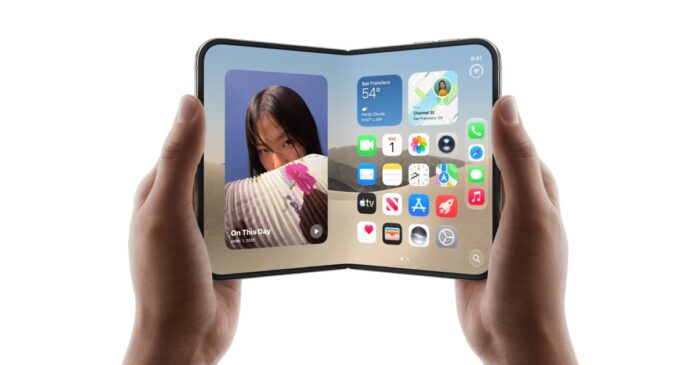

Apple is accelerating its long-awaited entry into the foldable device market, with multiple leaks pointing to a dual-product strategy involving a foldable iPhone, widely referred to as the iPhone Fold or iPhone Ultra, and a larger foldable iPad designed for productivity users. The developments signal a major shift in Apple’s hardware roadmap as it prepares to challenge established players in the foldable segment.
Recent supply chain chatter suggests that Apple has moved deeper into prototype testing for its first foldable iPhone, which is expected to adopt a book-style design similar to high-end foldables already on the market. The device is rumored to feature a compact outer display for everyday tasks and a larger inner screen that unfolds into a tablet-like experience. Industry observers believe Apple is positioning this device under its premium Ultra branding strategy, signaling a price tier that could exceed two thousand dollars once it reaches commercial release.
Reports from the broader industry indicate that Apple is targeting a launch window aligned with future iPhone cycles, potentially as early as 2026, although some analysts suggest that production challenges could shift the timeline further into 2027. The uncertainty is largely tied to one critical component: the hinge system.
Engineering sources suggest Apple is actively testing multiple hinge prototypes, including advanced metal alloys and liquid metal structures designed to improve long-term durability. However, repeated folding stress remains a significant challenge, with current designs reportedly struggling to meet Apple’s strict longevity standards. This issue has become the primary factor influencing whether the device can enter mass production on schedule.

For more context on Apple’s broader ecosystem direction, ongoing coverage of Apple developments can be found in industry reporting and analysis across major tech news platforms such as MacRumors, which has frequently tracked foldable iPhone and iPad leaks in detail.
The foldable iPad project is emerging as a parallel initiative aimed at expanding Apple’s presence in larger-screen computing. Unlike the foldable iPhone, which is expected to focus on consumer mobility, the foldable iPad is being designed with productivity in mind. Early reports suggest it may function as a hybrid device capable of replacing smaller laptops when unfolded, offering a significantly larger canvas for multitasking, creative work, and media consumption.
Apple’s strategy appears to be centered on refining foldable technology rather than rushing to market. This approach contrasts with competitors who have already established a presence in the segment. Samsung remains the dominant player in the foldable smartphone category, while other Android manufacturers continue to iterate on hinge design and display durability. Analysis of market trends and device comparisons can be found through Tom’s Guide, which regularly evaluates foldable device performance and consumer adoption patterns.
One of the key differentiators Apple is expected to emphasize is long-term reliability. While competitors have focused on early adoption and feature expansion, Apple is reportedly prioritizing structural integrity and seamless user experience. This includes efforts to ensure the hinge mechanism withstands extensive daily use without degradation, a factor that has historically limited the durability of foldable smartphones.
Technical analysis from engineering-focused reporting, including coverage by TechRadar, highlights that hinge fatigue remains one of the most difficult engineering problems in foldable device development. Even minor inconsistencies in pressure distribution can lead to mechanical failure over time, making durability a critical barrier for mass-market adoption.
Within Apple’s broader product ecosystem, the foldable initiative aligns with its long-term strategy of diversifying device form factors while maintaining tight integration across hardware and software. The company is expected to optimize iOS specifically for foldable interactions, enabling seamless transitions between folded and unfolded states, multi-window multitasking, and adaptive interface scaling.
The competitive landscape adds further pressure to Apple’s timeline. Samsung’s Galaxy Z Fold series and other Android foldables have already established user expectations for large-screen foldable devices. However, Apple’s late entry may allow it to avoid early design flaws while focusing on refinement and ecosystem integration.
As anticipation builds, Apple’s foldable roadmap is becoming one of the most closely watched developments in the tech industry. Whether the company can successfully resolve hinge durability challenges while delivering a crease-free display experience will determine whether the iPhone Fold becomes a defining product or remains an extended prototype phase.
For now, Apple’s foldable future remains a balance between breakthrough innovation and unresolved engineering constraints, with the next year likely to determine whether the company’s most ambitious hardware shift in a decade becomes reality or faces further delay.