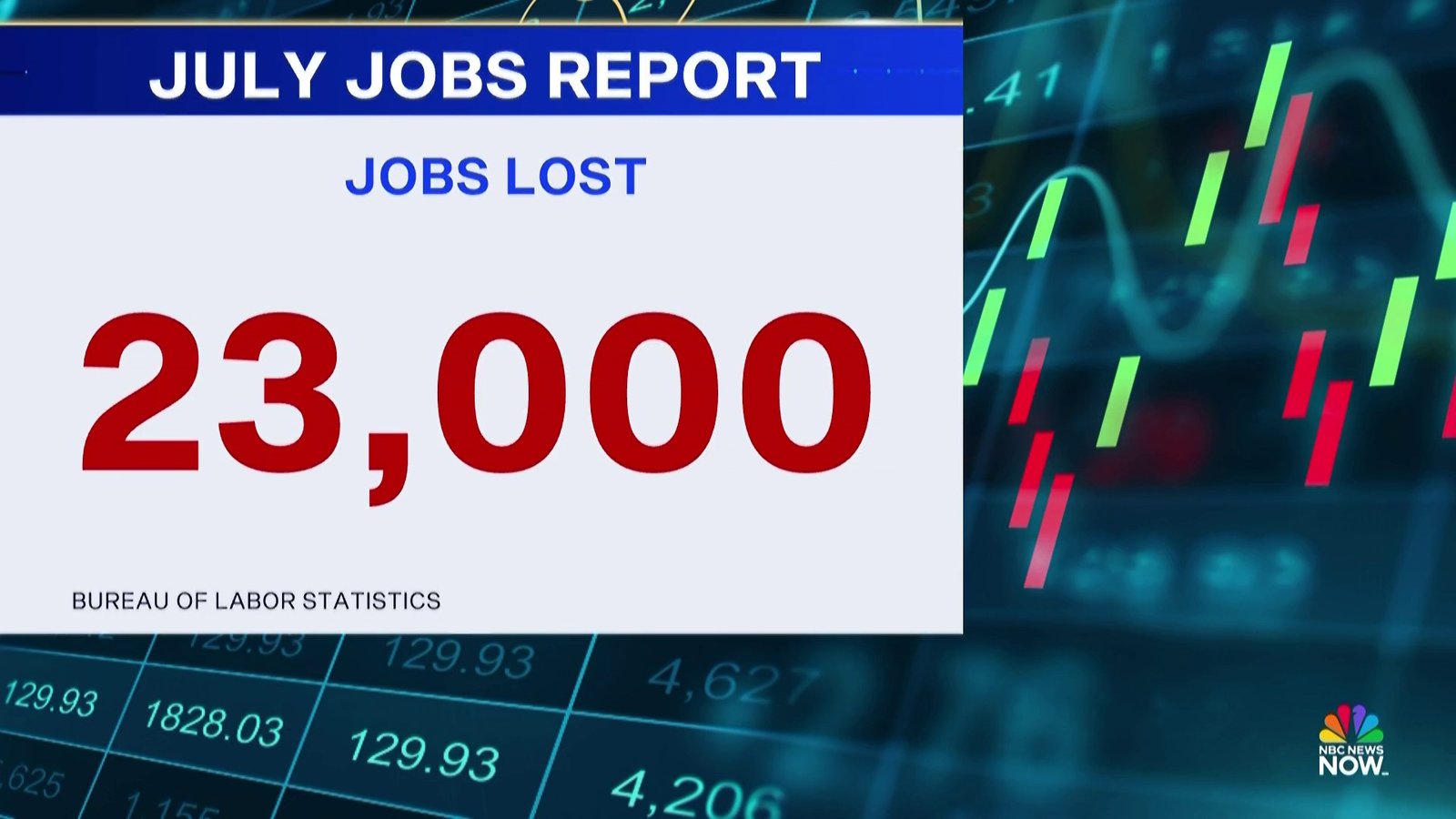

WASHINGTON — The American labor market shed jobs in July for the first time in years, a shift that inverts the economic narrative the Trump administration has relied on through the first half of 2026. The Bureau of Labor Statistics reported Friday that nonfarm payrolls fell by 23,000, a figure that landed 106,000 below what economists had forecast and ended a run of positive, if diminishing, monthly gains.
The result widens a pattern of deterioration. Unlike the June payroll report, which showed a modest 57,000 jobs added at the time, the July data is not merely slow; it is negative. And the BLS revised May and June sharply downward in the same release, cutting May’s figure by 66,000 to 129,000 and June’s by 37,000 to 57,000, a combined revision of 103,000 positions that makes the labor market’s recent trajectory considerably worse than it appeared before Friday morning.
The headline unemployment rate held at 4.1 percent, a reading that obscures more than it reveals. Unemployment did not hold steady because workers found jobs; it held steady because workers stopped looking for them. The labor force participation rate declined again in July, reaching its lowest point since February 2021. More than two million people have exited the workforce entirely since November, a withdrawal that has become a structural feature of the current slowdown and one that compresses the denominator in the unemployment calculation without reflecting any genuine improvement in the labor market’s condition.
The sector breakdown shows where the losses concentrated. Local government education shed 50,000 positions in July, a figure the BLS attributed partly to seasonal adjustment factors and partly to budget pressures accumulating across state and local governments navigating the gap between declining federal transfers and rising interest costs on their own debt. Leisure and hospitality cut 40,000 jobs. Retail trade shed 19,000. Financial services lost 14,000. Health care and construction each added 22,000 positions, but the gains were insufficient to offset the losses across the services sectors that have driven the broader deterioration.
Wage data compounded the picture. Average hourly earnings rose 0.1 percent from June to July, leaving the annualized figure at 3.2 percent, the lowest year-over-year reading in five years. The inflation rate over the same period was 3.5 percent, which means that workers earning at average wages are losing purchasing power for the third consecutive month. The economy’s GDP slowdown to 1.5 percent in the second quarter, driven partly by the gasoline price surge linked to the US-Iran conflict and widening trade deficits, leaves the consumer sector with fewer resources to sustain itself as wages continue to erode.

Financial markets interpreted the report as a signal that the Federal Reserve’s next move will be a cut, not a hike. The S&P 500 gained 0.5 percent and the Nasdaq added 1 percent on the day, as investors concluded that a labor market now shedding jobs would push the central bank toward easing. The 10-year Treasury yield fell to 4.6 percent. Markets priced September rate-cut odds at roughly 60 percent after the report, up from below 40 percent before the data. The Fed has held rates steady through seven consecutive meetings, citing inflation that has not yet returned to the 2 percent target, but a labor market in net contraction is a different input than a labor market growing slowly.
The demographics embedded in the headline data carry their own signal. Teenage unemployment reached 12.1 percent in July, a level that historically reflects contracting entry-level hiring. Hispanic unemployment ticked down to 4.6 percent and Black unemployment held at 6.3 percent, though both groups have borne disproportionate exposure to the leisure and hospitality losses that have accompanied the broader service-sector slowdown. The workforce exit rate has been highest among workers without college degrees, the cohort whose real wages have eroded most sharply as the gap between wage growth and inflation has widened.
NBC News reported that analysts at major banks revised their third-quarter growth outlooks downward following the BLS release, with some institutions cutting Q3 GDP estimates by as much as half a percentage point. The contraction in payrolls arrives in a quarter that was already under pressure from the Iran-related energy cost increase and the continuing effects of Trump’s tariff schedule on input costs and consumer prices. Consumer confidence has slipped for three straight months as Americans have grown more pessimistic about the six-month labor market outlook; Friday’s BLS data validates rather than contradicts that pessimism.
The political accounting of the July number is harder than the market accounting. Trump has framed his economic program around job creation, tariff revenue that offsets other fiscal costs, and the restoration of manufacturing employment. A negative payroll reading complicates that frame directly. The administration had not publicly responded to the BLS release as of Friday afternoon. Whether the White House characterizes the July result as a statistical anomaly, blames the prior administration’s policy legacy, or absorbs the hit as a one-month event depends in part on what the August data shows. If revisions to July push the final number deeper into negative territory, the case for a September Federal Reserve rate cut becomes correspondingly stronger, and the window for the administration to recover the labor market narrative before the 2026 midterm cycle tightens considerably.
What the July data cannot answer is whether the job losses represent the beginning of a sustained contraction or a one-month reversal driven by the seasonal adjustment factors affecting local government education. The prior revision record argues for caution about the magnitude: May’s initial figure was subsequently cut by 66,000, and June’s by 37,000. The July reading of -23,000 could itself move materially in either direction when revised in September. The uncertainty is the central fact the data leaves unresolved, and it is the question the Federal Reserve will be weighing as it approaches its next scheduled policy decision.