
NEW YORK – The households that have absorbed elevated prices and high borrowing costs without pulling back dramatically on spending showed signs this month that their patience is thinning. The Conference Board’s Consumer Confidence Index fell to 90.8 in July, down 1.4 points from a revised 92.2 in June, in a reading that exposed a widening gap between how Americans feel about conditions right now and what they expect to face six months from now.
The headline decline was modest. The breakdown was harder to dismiss. The Present Situation Index, which captures how consumers assess current business and labor conditions rather than forecasts, dropped 3.6 points to 114.9, a steeper fall than the composite number suggested. When the present-conditions reading deteriorates faster than the overall index, it typically signals that consumers are registering a problem already in motion, not one they are anticipating from a distance.
The Expectations Index held at 74.7, unchanged from June but sitting below 80, the threshold the Conference Board treats as an early-warning signal for recession. Sustained readings at this level have historically preceded contractions by six to twelve months. At 74.7, the number is not alarming in isolation. In the context of a trajectory Dana M. Peterson, the Conference Board’s chief economist, described as “a general downward sloping trajectory since late 2021,” it carries more weight than a single data point normally would.
On business conditions, 18.9 percent of respondents called current conditions “good,” down from 20.2 percent in June. Those calling conditions “bad” rose to 17.8 percent from 16.5 percent, a move that reduced the net optimism reading by 2.6 percentage points to barely above zero. Looking six months ahead, the picture turned more cautious still: only 17.8 percent expected business conditions to improve, down from 18.9 percent, while 21.1 percent anticipated deterioration, up from 20.7 percent. The share of respondents expecting conditions to worsen now outnumbers those expecting improvement.
Labor market sentiment told a story of incremental erosion. The share of consumers describing jobs as “plentiful” fell to 24.6 percent from 25.5 percent. Those calling jobs “hard to get” edged down slightly to 21.5 percent from 21.7 percent, a thin buffer that keeps the net differential positive. The six-month outlook delivered the sharper signal: 25.3 percent of respondents anticipated fewer jobs available over the coming half-year, against just 16.7 percent expecting more. For workers without the protection of senior tenure or specialized skills, that asymmetry is not an abstraction. It is a reason to delay spending decisions, avoid taking on new debt, and wait.

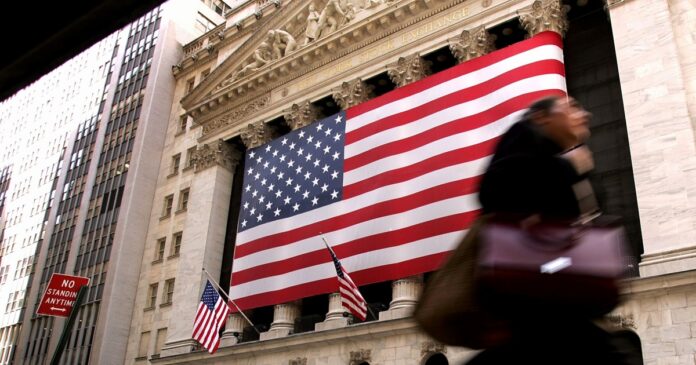
The timing placed the data in direct collision with the afternoon’s other major economic event. Federal Reserve Chair Kevin Warsh held rates steady in the 3.50 to 3.75 percent range, the Federal Reserve’s policy statement confirmed, in the committee’s seventh consecutive hold. Three officials voted for an immediate rate increase, making it the most internally divided Fed decision in years. The Dow Jones Industrial Average shed 1,129 points in its steepest single-session decline since April 2025, and bond markets moved to price in a higher terminal rate than the current range implied. Consumer confidence data showing Americans growing less certain about business conditions and jobs arrived on the same afternoon as a Fed that would not ease them.
The juxtaposition was specific. Consumer confidence has now declined in five of the past six months. The Federal Reserve has held rates in the same range through seven consecutive meetings. These two trends are connected: sustained high borrowing costs make major purchases more expensive, and they signal to consumers that policymakers do not yet trust the economic picture enough to ease it. Warsh’s committee, which entered Wednesday’s decision facing one-in-three odds of a surprise hike amid an oil shock driven by the Iran conflict, chose patience. The consumer confidence data, released hours earlier, suggested patience is becoming harder for ordinary households to sustain.
Annual inflation reached 4.2 percent in May 2026, the highest in more than three years, before retreating to 3.5 percent in June as gasoline prices dropped sharply. That relief has proved temporary. Iran’s disruption to global oil markets pushed Brent crude back above $100 a barrel in recent weeks, reversing part of the summer’s disinflationary tailwind. Consumers who saw prices ease at the pump in early July are now watching them climb again. The pattern helps explain why the Present Situation Index fell faster than the headline number: people are registering what they see at the gas station and the checkout line, not what the May-to-June data suggested about the inflation trajectory.
The supplementary data accompanying the headline index added texture. The share of respondents reporting that a recession was “somewhat likely” over the next 12 months continued to rise, according to the Conference Board’s July release. That number has been climbing even as official unemployment figures have held near historic lows, a divergence that reflects how Americans at the median income level experience an economy that looks more resilient in aggregate than it feels in practice. The share calling current business conditions “good” has now fallen to its lowest level since early 2024.
Purchasing intentions offered one partial counterpoint. The six-month average on homebuying and automobile purchasing expectations ticked upward, which the Conference Board noted as a positive sign in an otherwise cautious release. That data point deserves to be held carefully. Buying intentions respond to rate expectations: when consumers believe borrowing costs will fall, they express more willingness to consider major purchases even when their near-term mood is guarded. The July survey was conducted before Warsh confirmed the seventh hold and before the Dow fell more than 1,100 points. The August reading may tell a different story on that dimension.
The broader market context reinforced the afternoon’s tone. The Nasdaq 100 had already entered correction territory earlier in the week, down more than 10 percent from its June record, as semiconductor stocks fell for a fourth consecutive session. Wednesday’s 1,129-point Dow decline reversed the rotation trade that had briefly pushed cyclicals higher, pulling equities broadly lower and leaving no obvious refuge within the major averages.
What the July report does not settle is whether 90.8 represents an inflection point or another chapter in the long decline Peterson identified. The Expectations Index has spent extended periods below 80 without triggering a recession; the economy has proved more durable than consumer mood surveys implied on more than one occasion over the past three years. The distinction between a sustained downtrend and a soft-patch interruption requires data that sentiment surveys cannot supply: specifically, retail sales figures showing whether the deteriorating mood has begun to translate into reduced actual spending. Surveys measure what people feel. Sales reports record what they do. The two have been diverging long enough that the gap between them has become a story in its own right.
The August confidence reading is due in late August, with two inflation reports and one jobs report landing before then. Whether July’s erosion of confidence in business conditions and the labor market proves durable or transient will depend, in part, on whether the factors behind that erosion persist into the end of summer: elevated oil prices, a Federal Reserve that has not eased, and a stock market that turned sharply negative. For now, the data documents a specific moment: an economy where the caution Americans have been managing for years has taken a step toward something more openly worried.