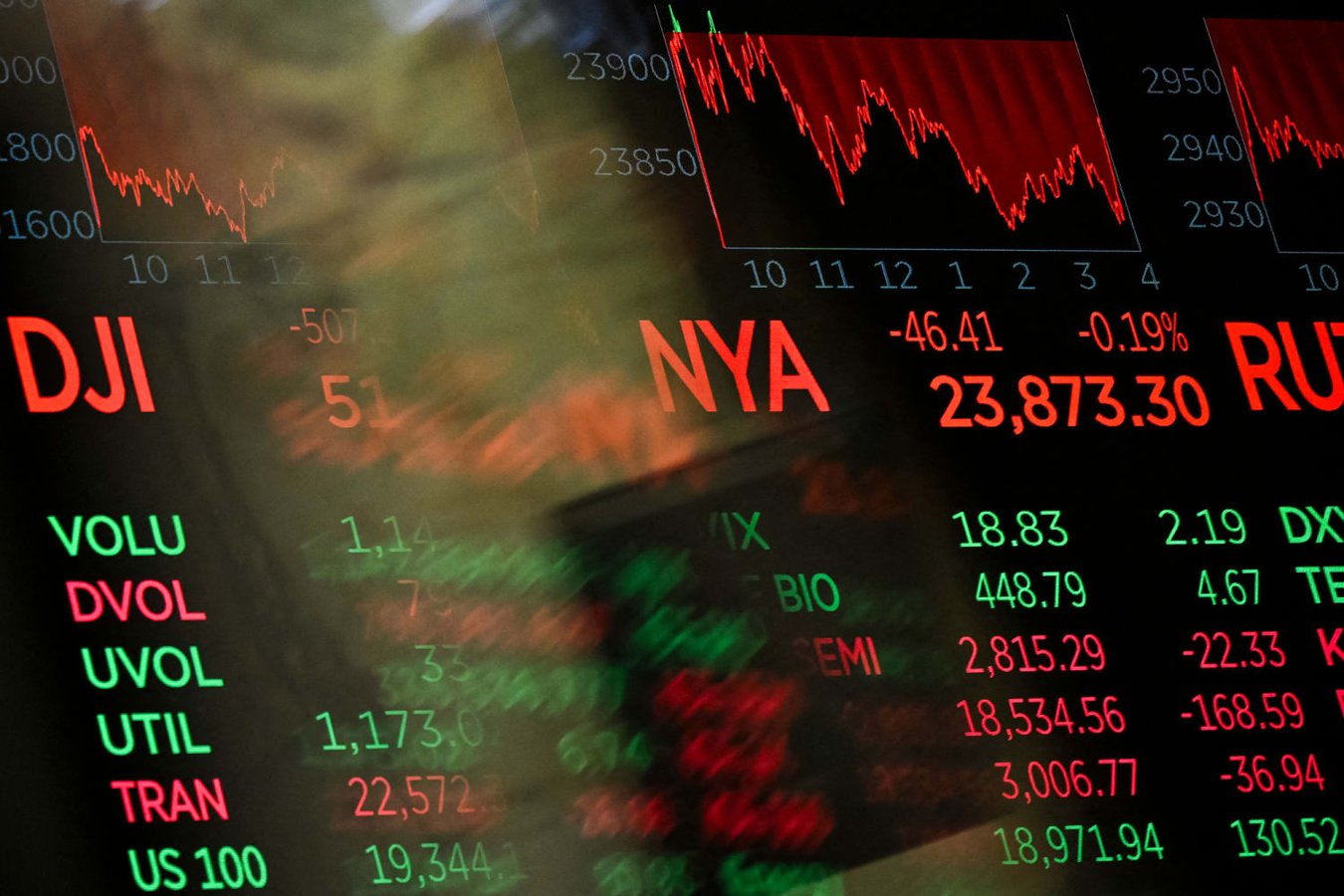

NEW YORK – The Nasdaq 100 fell 1.8 percent Tuesday as a four-session rout in semiconductor stocks deepened, pulling the index toward a textbook 10 percent correction from its record high while the Dow Jones Industrial Average staged a rally that underscored just how sharply investor sentiment has divided along a single fault line: whether the artificial intelligence spending boom is sustainable.
The divergence was stark. The Dow gained more than 500 points, or 1.1 percent, as money moved from high-multiple technology names into industrials, energy, and financials. On the other side of the ledger, Micron Technology fell 8 percent and Advanced Micro Devices declined by a similar margin. The VanEck Semiconductor ETF, which tracks the Philadelphia Semiconductor Index, dropped more than 3 percent for the fourth consecutive session, a losing streak that has erased roughly 12 percent of the fund’s value since its July peak.
“The market is repricing the timeline on AI monetization,” said Mark Luschini, chief investment strategist at Janney Montgomery Scott. “Investors bought the infrastructure buildout at a premium, and now they are asking whether the returns are arriving on the schedule those prices assumed.”
The proximate trigger for the selloff is competition from China. CXMT, the Chinese memory chipmaker, staged a blockbuster IPO last week that rattled investors who had assumed Chinese manufacturers would remain structurally disadvantaged in advanced memory production. CXMT’s public debut demonstrated that the gap, while real, was narrowing faster than most Western analysts had modeled, and that a price war in high-bandwidth memory – a category critical to AI data centers – was now a plausible near-term scenario.
Micron, which derives significant revenue from AI-adjacent memory products, bore the sharpest of Tuesday’s losses. AMD, whose data center GPU lineup competes with Nvidia at the mid-tier, fell sharply as investors considered the same CXMT-related dynamics applied further up the stack. Nvidia, the index’s largest component and the company that briefly traded as the most valuable in the world earlier this month, fell more than 4 percent.
The rotation into the Dow’s components reflects something more specific than generalized risk-off sentiment. Oil prices declined on Tuesday, which typically pressures energy stocks, yet energy names held firm. The driver appears to be a reassessment of which sectors benefit if AI spending moderates: industrials tied to physical infrastructure, financials positioned to benefit from rate normalization, and consumer staples that have lagged the technology-driven rally of the past eighteen months. The Dow’s composition overweights all three.
The breadth of the semiconductor selloff has alarmed strategists who had argued that the AI trade was broader than a single name or sub-sector. European technology stocks declined in parallel, suggesting the repricing is not confined to US-listed companies or to specific company-level earnings news. It is a sector-wide reassessment of the AI capital expenditure cycle.
The Nasdaq 100 closed Tuesday at roughly 19,450, approximately 10.2 percent below its record close set in late June. A 10 percent decline from a peak is the conventional definition of a correction, a distinction that matters to institutional investors whose mandates trigger rebalancing requirements at that threshold. The index has not entered correction territory since early 2025, meaning a generation of AI-era retail investors may be encountering the category for the first time.
Whether Tuesday’s move marks the beginning of a larger rotation or a temporary dislocation depends heavily on what major semiconductor companies say in their upcoming earnings calls. Nvidia’s report, expected later this month, is the most closely watched single event in equity markets. Bloomberg reported that options positioning in Nvidia has shifted notably toward put protection in the past week, suggesting institutional hedgers are treating downside risk as more than theoretical.
The S&P 500 fell 0.7 percent on the day, splitting the difference between the Nasdaq’s rout and the Dow’s rally. That muted decline obscures the violence of the intraday move in the technology sector: at the session low, the Nasdaq 100 was down more than 2.5 percent before buyers entered in the final ninety minutes of trading.
What markets have not resolved is whether the AI spending slowdown is a pause or a pivot. The largest cloud providers – Microsoft, Amazon, Google, and Meta – have all committed to capital expenditure programs in AI infrastructure that extend through 2027 and 2028. If those commitments hold, the demand destruction implied by Tuesday’s chip selloff does not fully materialize. If one or more of those companies trims guidance when they report next month, the calculus changes.
For now, the market’s answer has been to sell first and wait for the numbers. Four consecutive sessions of semiconductor losses have not produced a buyer willing to step in front of the trend. The question is whether that restraint reflects genuine fundamental concern about the AI trade or simply the absence of a positive catalyst large enough to interrupt the momentum of a correction already underway.