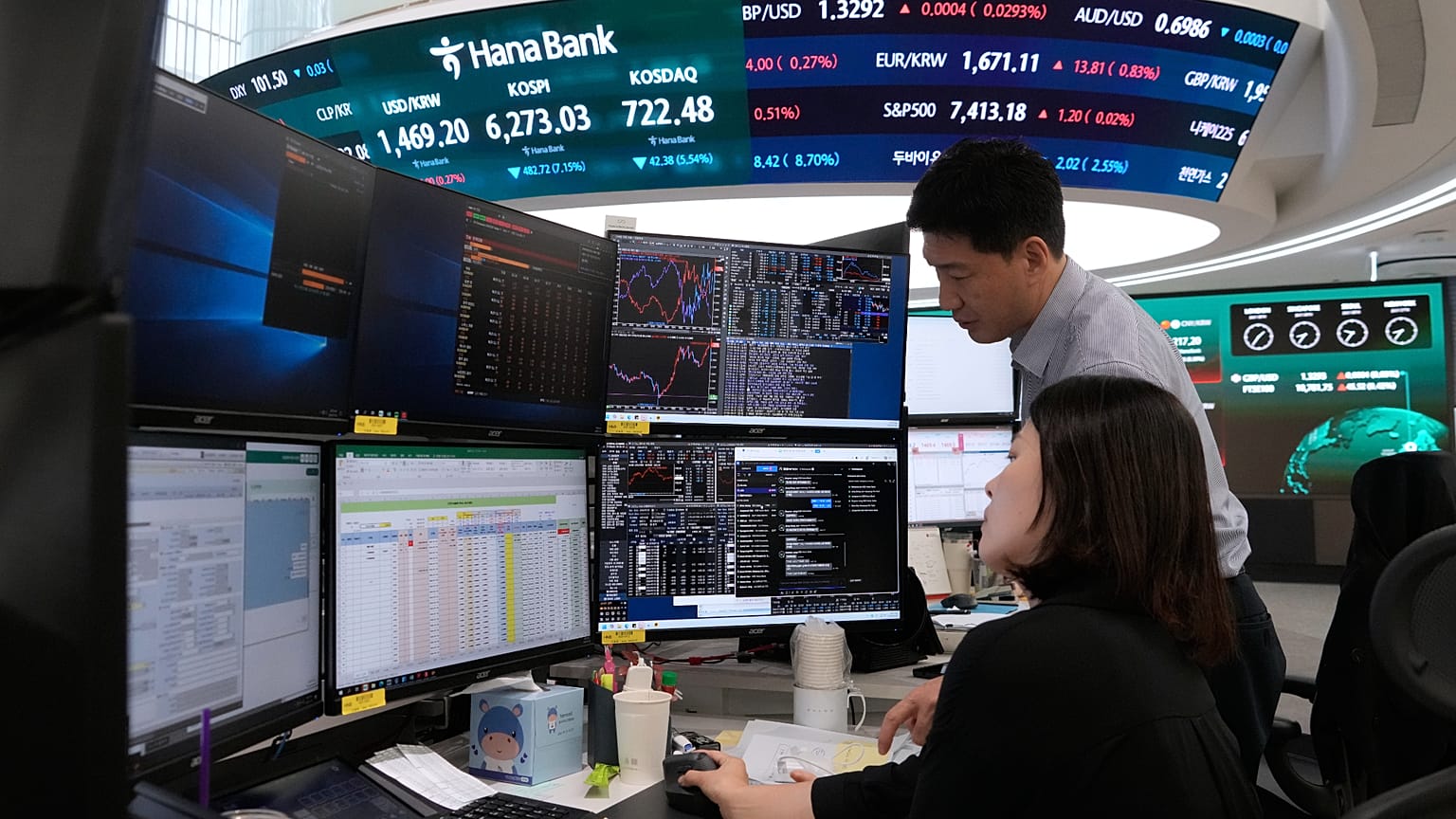

LONDON – Britain’s FTSE 100 drifted lower Monday and German equities posted modest gains as a summer earnings season rich with positive surprises failed to overcome the gravitational pull of a broad selloff in technology shares that swept from New York to European exchanges before the opening bell even rang in London.
The pan-European STOXX 600 ended the session fractionally lower, oscillating in a narrow band that reflected genuine tension between two forces: corporate results beating analyst estimates across financial, energy, and industrial sectors, and a technology rout that has shaved nearly four percent from the Nasdaq Composite over the past week as traders reassess expectations for Federal Reserve policy.
What propelled the tech selloff was a series of comments from Federal Reserve officials last week pushing back against market bets that rate cuts are imminent. Their reiteration of a data-dependent posture left the cost of borrowing elevated for longer, compressing valuations on growth stocks globally. Bank of Japan tightening earlier this month added a parallel dimension, with global capital reassessing carry trades that had funneled money into high-growth equities across multiple markets.
French luxury conglomerate LVMH offered a different kind of complication. The company, whose quarterly results serve as a bellwether for consumer confidence in China, reported slowing Asia-Pacific revenue as Beijing’s stimulus measures have yet to generate the consumer spending revival that luxury brands have been awaiting since late last year. LVMH shares fell two percent, dragging Kering and Hermes lower in sympathy.
The broad picture was not uniformly negative. European defense contractors advanced after NATO’s secretary-general reiterated at a Warsaw conference that member states must accelerate spending commitments in light of the ongoing Russian military operation in Ukraine. BAE Systems rose one point eight percent, Rheinmetall gained two percent, and smaller Scandinavian defense suppliers also moved higher.
The banking sector provided support. Barclays and Banco Santander each reported second-quarter results that exceeded consensus on net interest income and fee revenue, suggesting that the high-rate environment, however painful for borrowers, continues to benefit lenders with diversified revenue streams. The STOXX Europe 600 Banks sub-index gained half a percent.
Brent crude oil traded near seventy-nine dollars per barrel, unable to sustain a brief rally following an International Energy Agency report projecting tighter supply balances in the third quarter. Traders remained cautious given demand signals from China, where factory output has disappointed. Among notable movers, German industrial group Siemens Energy rose four percent after confirming an order from a Middle Eastern sovereign wealth fund for grid stabilization infrastructure, reinforcing a narrative of robust demand for energy transition equipment.
The euro held near 1.08 against the dollar, steadied by better-than-feared Purchasing Managers’ Index readings out of Germany and France from last Thursday. Currency strategists cautioned against reading too much into the stability, noting the euro is being propped up by dollar weakness more than European economic strength. Trump administration tariff threats against European goods remain a persistent background risk for currency and equity markets alike, with the administration having signaled willingness to escalate if the EU’s digital regulation enforcement continues to target American technology companies.
European bond markets told a more layered story. German Bund yields edged higher, tracking Treasuries, while Italian BTPs held relatively steady after the government in Rome signaled it would meet its deficit targets for the year. Spanish yields also remained contained. The spread compression between German and Italian debt reflects a tentative return of confidence in southern European fiscal management that was not visible a year ago.
The dollar’s climb to a one-month high against a basket of currencies has created a parallel headwind for European exporters. German automakers face a structural challenge: their goods become more expensive for American buyers when the euro weakens, compounding the competitive pressure from Chinese electric vehicle manufacturers in European and emerging markets. General Motors’ retreat from full electrification has added complexity to the global auto industry’s strategic calculus, raising questions about whether legacy manufacturers can adapt their production mix quickly enough as Chinese makers continue to expand their footprint.
The week ahead is heavily loaded with catalysts. Wednesday brings the Federal Reserve interest-rate decision from Washington, widely expected to hold but closely monitored for language about future cuts. Thursday sees the European Central Bank release the account of last month’s meeting. A dense roster of corporate earnings from energy and consumer-goods companies will provide further texture on whether first-half resilience can carry into autumn. Wall Street’s record run into summer has raised the bar for positive surprise that companies need to clear to generate further gains.
Traders are also monitoring developments in Washington, where President Trump is hosting Israeli Prime Minister Benjamin Netanyahu and Ukrainian President Volodymyr Zelensky simultaneously this week, a convergence that reflects the overlapping crises complicating Western economic planning and energy markets throughout 2026. Trump-Zelensky contacts have grown more consequential as discussions about a potential resolution to the Russian operation in Ukraine gather pace, with implications for European energy prices and reconstruction spending that has underpinned some of the continent’s industrial order flow. For now, the balance in European equity markets holds – barely, and against the weight of considerable uncertainty.