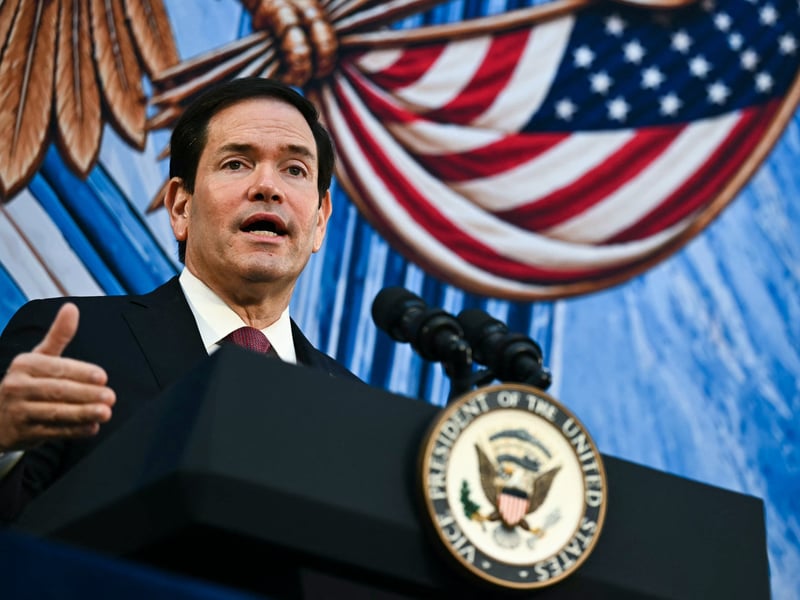

WASHINGTON — Secretary of State Marco Rubio arrived in Latin America on Tuesday for a three-country diplomatic sweep covering Colombia, Ecuador, and Peru, announcing ahead of his Quito meetings that the United States is modernizing its extradition treaty with Ecuador to give Washington cleaner legal mechanisms for pursuing fugitive criminals across the border.
“We are also modernizing our bilateral extradition treaty with Ecuador so that fugitive criminals face swift, inescapable justice,” Rubio wrote in an essay titled “A Hemisphere That Delivers,” published on the State Department’s website. The piece was released as the trip got underway, and it served as a public statement of the administration’s terms before bilateral meetings with Ecuadorian President Daniel Noboa began.
CNN reported separately, citing a senior State Department official, that the United States and Ecuador are in the final stages of a deal that would allow Washington to send asylum seekers to Ecuador, an arrangement extending a model the Trump administration has used in agreements with El Salvador and other Central American governments. No formal agreement has been signed and no administration official publicly confirmed the CNN account, though State Department Spokesperson Tommy Pigott did not deny it when asked Friday.
The sequencing reflects the Trump foreign policy operation’s standard approach to Latin America: public commitments that define the terms of cooperation before the meetings occur, creating a headline structure that rewards governments willing to align with Washington’s security priorities. Rubio’s physical presence signals that the relationship with Noboa’s Ecuador is considered a high enough priority to justify the secretary’s time on a multiday trip that also covers Colombia and Peru, as Al Jazeera reported.
Ecuador under Noboa has given Washington a receptive partner. The Ecuadorian president has overseen a significant expansion of law enforcement authority, including the deployment of military units to domestic policing operations that civil liberties groups have challenged on constitutional grounds. Noboa’s government, facing severe gang violence that has killed hundreds of Ecuadorians over two years, has framed its relationship with the United States as essential to sustaining that crackdown, and the Trump administration has reciprocated with financial, equipment, and training support.
The extradition treaty modernization, if completed, would update legal language that dates to an earlier period in the bilateral relationship and has created procedural delays when US prosecutors have sought transfers of suspects arrested in Ecuador on American charges, primarily drug trafficking, organized crime, and terrorism-related offenses. The treaty’s existing framework has been adequate for a relationship that previously operated at lower security intensity, but Noboa’s government and the Trump administration have moved the partnership into a different register.
The asylum seeker component is more politically sensitive. Comparable deals with El Salvador have included financial transfers to the receiving country and operational constraints on when it can return individuals to the US. Ecuador’s geography, detention infrastructure, and political constraints present different parameters, and any final agreement will need to address those in legally binding language. The administration has not committed to a public release of full terms.
The stop in Colombia carries different stakes. Colombian President Gustavo Petro has maintained a more independent foreign policy posture than Noboa, including periodic public criticism of US narcotics policy. Rubio’s agenda there centers on US support for Colombia’s earthquake response and commercial ties, with narcoterrorism cooperation as a secondary priority. Washington’s aggressive tariff posture toward trading partners including Canada has complicated the commercial dimension of its Latin America relationships, as governments in the region recalculate the costs and benefits of alignment with an administration that has deployed trade pressure unpredictably.
Peru completes the trip. Peruvian politics have been unstable for three years, cycling through multiple governments, and the bilateral agenda there is focused on commercial and security frameworks rather than high-profile security deals. Rubio’s presence is less about a specific deliverable and more about signaling sustained engagement at the highest diplomatic level.
The broader pattern the trip is meant to consolidate: a tier of Latin American governments, broadly right-of-center and broadly aligned with Washington on migration, extradition, and counter-narcotics, that receive preferential treatment in trade discussions and security assistance in exchange for their cooperation. Ecuador under Noboa is currently the most visible example of what that alignment looks like in practice.
What remained unclear on Tuesday, as Rubio’s meetings in Quito proceeded, is whether the asylum seeker deal and the extradition treaty modernization can be finalized in the timeline the administration has implied, and whether Ecuador’s domestic political environment can sustain the level of security cooperation Washington is seeking from a government that will face its own electoral pressures in the coming year. The treaty announcement defines the ambition; the meetings will test whether the legal and political machinery exists to deliver it.