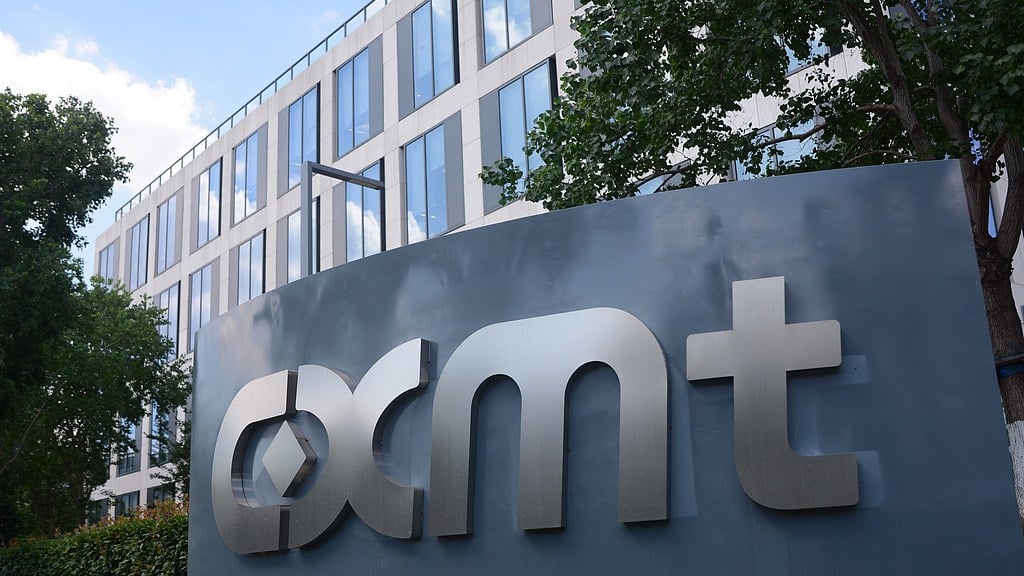

SHANGHAI – ChangXin Memory Technologies closed its first day of Shanghai trading at 49 yuan on Monday – up 466 percent from its IPO price of 8.66 yuan – lifting the Hefei-based chipmaker’s market capitalization to 3.3 trillion yuan, or roughly $488 billion, in the largest single-session valuation jump in the history of China’s A-share market.
The enthusiasm for CXMT’s debut in Shanghai was matched by sharp declines in the memory chip stocks of its Western rivals. Micron Technology fell five percent by midday in New York. SanDisk dropped more than twelve percent. US-listed receipts of South Korea’s SK Hynix declined 8.5 percent. ASML, the Dutch maker of the lithography equipment that is the critical tool in advanced chip production, lost more than seven percent. The memory chip rally that had driven those stocks to record highs over the past year was, at least for a day, cracking under the weight of a Chinese competitor’s triumphant market entry.
CXMT is the world’s fourth-largest producer of dynamic random-access memory, or DRAM – the type of memory chip found in smartphones, personal computers, servers, and the AI data centers whose appetite for memory has made the sector one of global technology’s most profitable spaces over the past two years. Samsung, SK Hynix and Micron together control roughly 90 percent of the global DRAM market. CXMT holds approximately 7.67 percent. The distance between those numbers is the market’s fear in numerical form.
What rattled investors Monday was not the current market-share gap but the trajectory it implies. CXMT’s $8.6 billion IPO on the Shanghai STAR Market attracted subscription interest 212 times the available shares – an oversubscription ratio that reflects extraordinary domestic confidence in a company Beijing has positioned as a flagship of semiconductor self-sufficiency. The debut lifted CXMT’s valuation to a peak of 54.65 yuan mid-session before settling at 49 yuan. By market close, CXMT had surpassed the Industrial and Commercial Bank of China by market capitalization, becoming China’s most valuable onshore-listed company. That kind of capital access will allow CXMT to accelerate production in ways analysts say could compress global DRAM prices within two to three years.
The Apple factor deepened the sell-off. Reports that Apple is actively testing CXMT’s DRAM chips for potential inclusion in future iPhone and Mac hardware sent a particular signal to markets: that Chinese memory might reach the most demanding customer in consumer electronics sooner than bulls had assumed. If Apple’s supply chain absorbs CXMT product, the company’s ability to command premium pricing from SK Hynix and Micron decreases. For investors in those companies, that prospect is one of the most consequential single-customer risks in the sector.
CXMT’s $8.6 billion IPO priced on July 14 after attracting orders 212 times the available float, reflecting domestic institutional and retail confidence that was, in hindsight, a preview of Monday’s debut surge. The same week the IPO priced, Apple was lobbying the Trump White House to prevent CXMT from being added to Commerce’s Entity List – a potential export control designation that would have complicated the customer relationship the market now fears is coming.
Analysts offered a structural caveat to the fear. CXMT lacks access to ASML’s extreme ultraviolet lithography machines – the tools required to manufacture the advanced high-bandwidth memory chips used in AI infrastructure. Without EUV access, CXMT cannot easily enter the HBM market that AI companies including Nvidia are paying premium prices to secure. The immediate threat is to conventional DRAM pricing, not to the AI-grade memory segment that has generated the biggest margin expansion for SK Hynix and Micron over the past 18 months.
That distinction offered some reassurance to analysts tracking the AI infrastructure spending cycle. Nvidia, which relies on SK Hynix for HBM3E memory in its most advanced accelerators, is not immediately threatened by a CXMT competitor that cannot match HBM specifications. But the mainstream DRAM market – where volumes are higher and margins thinner – is precisely where CXMT intends to grow. Micron’s AI memory revenue quadrupled to $41 billion in its most recent fiscal year – a number whose conventional DRAM components now look vulnerable if CXMT achieves the production ramp its new capital enables.
Monday’s trading was a stress test on a question that semiconductor analysts have debated since China’s chipmaking ambitions became a geopolitical priority: at what speed does a domestically funded, state-supported memory manufacturer move from a national supplier to a global price-setter? CXMT’s answer, delivered in the form of a 466 percent first-day surge, is: faster than the market had priced. The $488 billion valuation that resulted from that surge now gives CXMT the balance sheet to pursue that transition at scale.
The Washington Post reported that CXMT’s Shanghai debut made it China’s most valuable onshore-listed company by market capitalization – a symbolic benchmark in Beijing’s campaign to build a domestic semiconductor supply chain independent of US export controls. SanDisk’s twelve percent single-day decline was among the sector’s sharpest since the AI memory rally began in 2024. For the three incumbents – Samsung, SK Hynix and Micron – the question raised by Monday’s trading is whether the DRAM market they have dominated for two decades is entering a phase that looks less like a mature oligopoly and more like a contested market approaching structural change.