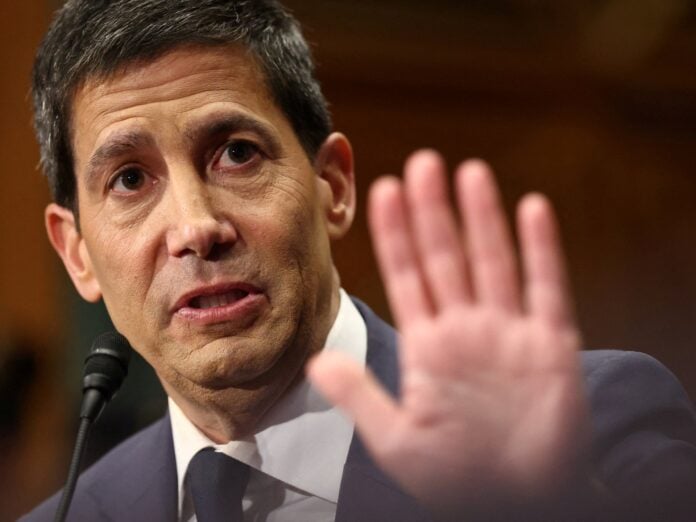

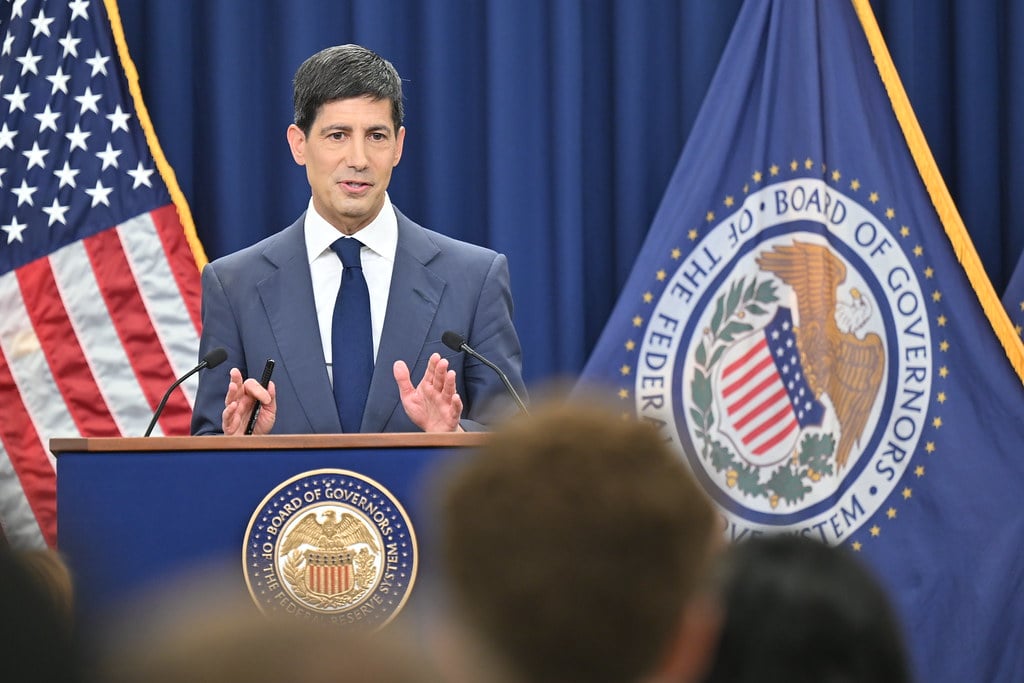
WASHINGTON – When Kevin Warsh steps to the podium on Thursday afternoon, the options market will have done more to shape the preceding 24 hours of global trading than any word he has let slip. That is, by design or accident, precisely the position the new Federal Reserve chairman has put himself in.
Federal Reserve policymakers convened in Washington on Wednesday for the first day of their July meeting, with the rate decision expected Thursday afternoon. Warsh inherited a federal funds rate of 3.50 to 3.75 percent from Jerome Powell, and prediction markets are pricing roughly a 68 percent probability that he keeps rates at that range. The roughly 30 percent chance attached to a hike makes this the most uncertain Federal Open Market Committee outcome since the summer of 2020.
The source of that uncertainty is partly geopolitical. Since the United States and Iran entered open conflict earlier this month, Brent crude has surged above $100 a barrel, reversing much of the disinflationary relief that had brought headline consumer prices to 3.5 percent in June after a May peak of 4.2 percent. Oil above $100 complicates the calculation in both directions: it can reignite service-sector costs through transport and energy prices, while a sharp demand slowdown from $100 crude could suppress activity faster than any rate move would.
The June data, while encouraging, gave Warsh no clear mandate to move. US inflation fell sharply from its spring peak because gasoline prices dropped 9.7 percent on a monthly basis, but that relief came alongside a jobs market that added just 57,000 nonfarm payrolls in June, the weakest monthly reading since early 2025. With crude prices back above $100 and the Iran conflict unresolved, neither dynamic is likely to repeat in the months ahead.
Warsh has offered the markets almost nothing to work with. In his congressional testimony earlier this month, the Fed chair declared he has no tolerance for inflation while simultaneously refusing to signal the timing of any move, according to PBS NewsHour. He has described himself as data-dependent rather than calendar-dependent, abandoned the forward guidance language that characterized the Powell era, and run what market participants have come to call a skinny Fed: pared-down statements with fewer explicit commitments. His silence, some analysts have argued, is the point. Warsh is trying to restore optionality to a central bank that had spent several years telegraphing its every move.
That opacity has created a live market for surprises. Kenneth Griffin’s Citadel is among those on record placing directional bets on a hike, according to financial media reporting, putting the hedge fund in the minority but not in isolation: the bond market has been pricing in a deteriorating inflation picture throughout July. Longer-dated Treasury yields have climbed alongside mortgage rates, which hit an 11-month high as the Middle East conflict pushed energy costs higher.
Most economists still expect Warsh to hold, and three factors argue for patience. The jobs market is softening fast enough that further rate increases risk tipping the economy toward contraction. Oil above $100 is more likely to reduce demand organically over the coming quarters than a rate hike would over the same timeframe. And the duration of the Iran conflict remains unknowable, making a rate increase this week a policy bet on geopolitics as much as economics.
The more meaningful signal may be what comes after Thursday. Prediction markets have already shifted their attention to September, pricing roughly 77 percent odds of a rate increase at the Fed’s next meeting: nearly three-in-four on a move that Powell-era watchers would have considered extraordinary given where rates stood just three years ago. Whether Warsh holds or hikes Thursday, the September meeting increasingly looks like the sharper inflection point.
Warsh, who served on the Federal Reserve Board from 2006 to 2011 before spending more than a decade at Stanford’s Hoover Institution and then as a partner at the Duquesne family office, has made clear since taking the chairmanship in May that he intends to run a different institution than his predecessor. He has launched five task forces to review Fed operations and explicitly told Congress the central bank does not feel bound by the dot plot projections that became a pillar of market communication under the Powell era. Those projections, Warsh has argued, create false precision in an inherently uncertain environment.
What traders, homeowners, and economists do not know going into Thursday’s announcement is whether Warsh will use this meeting to deliver a surprise or to bank credibility for a larger move in September. Prediction markets, options positioning, and even one of the country’s largest hedge funds cannot agree on the answer, according to CNBC’s analysis of current trade flows. For the first time in years, a Federal Reserve decision carries genuine uncertainty. That uncertainty, manufactured or inherited, appears to be exactly the policy environment the new chair intended to create.