
Apple’s latest iPhone update is not about new emojis, design polish, or cosmetic fixes. It is about something far more uncomfortable: the realization that deleted messages were not always truly deleted.
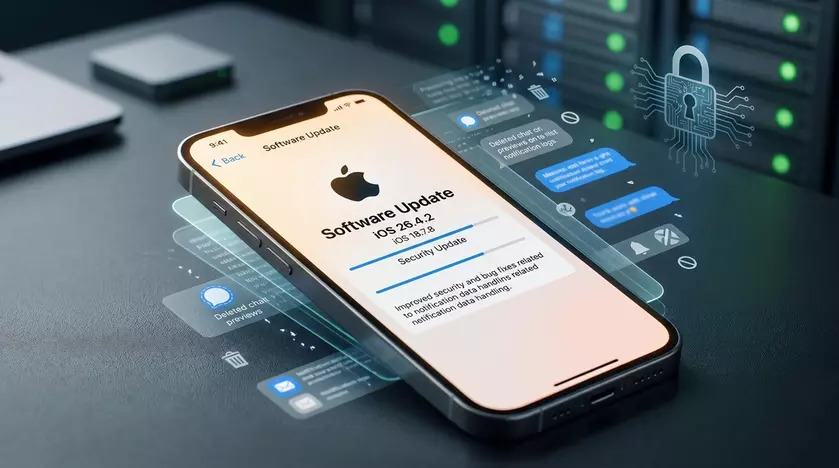
With the release of iOS 26.4.2 and iPadOS 26.4.2, Apple quietly patched a privacy flaw that allowed notifications marked for deletion to remain stored inside the device’s internal notification database. The issue, tracked as CVE-2026-28950, became especially alarming after reports revealed that investigators were able to recover deleted Signal messages from Signal — even after the app itself had been removed from the iPhone.
Apple described it with remarkable understatement.
“Notifications marked for deletion could be unexpectedly retained on the device,” the company said in its security advisory. The flaw was classified as a logging issue and addressed through what Apple called “improved data redaction.”
That sounds technical and harmless. It was neither.
That distinction matters because apps like Signal are built around a promise of privacy. Messages disappear. Conversations vanish. Encryption protects content from outsiders, including the company itself.
But encryption inside the app means little if the operating system outside the app quietly keeps a copy.
That is exactly what reportedly happened in a criminal investigation tied to an attack on the Prairieland ICE detention center in Texas, where the Federal Bureau of Investigation was able to extract incoming Signal messages from a defendant’s iPhone. According to multiple reports, the messages were not recovered from Signal directly, but from Apple’s push notification database, where copies of message previews had remained stored.
Even after Signal had been deleted.
The case shattered a common assumption in modern digital life: that deleting an app means deleting its traces.
It does not.
Privacy experts have long warned that smartphones leak information through system layers users rarely think about notification previews, caches, backups, logs, and metadata. The weakness is often not the secure app itself, but the operating system surrounding it.
This is where Apple’s update becomes significant.
The company issued the patch outside its normal feature-driven release cycle, signaling urgency. The fix applies to iPhone 11 and later for iOS 26.4.2, alongside broad iPad coverage. Apple also backported protections to older supported devices through iOS 18.7.8 and iPadOS 18.7.8. Security researchers and consumer advocates issued an update now warning for affected users.
The message is simple: update now.
This is not a theoretical vulnerability for cybersecurity researchers to debate on obscure forums. It is a real privacy flaw involving devices people carry every day — devices holding legal conversations, medical details, financial records, political discussions, and private relationships.
Users who rely on disappearing messages for sensitive communication should pay particular attention.
Even if Signal deletes the message, if the notification preview remains stored by iOS, the privacy model breaks.
That does not mean Signal failed. It means users often misunderstand where security ends.
End-to-end encryption protects transmission between users. It does not automatically protect what the operating system chooses to cache locally.
That gap is where investigators, forensic analysts, and attackers look first, especially when trying to recover deleted messages.
Security researchers say the most immediate defense, beyond updating iOS, is reducing what appears inside notifications at all. Users can disable message previews or limit notification content visibility for apps handling sensitive conversations.
In practical terms, fewer previews mean fewer traces.
But the larger issue is trust.
Apple markets privacy as a luxury product a premium promise wrapped into the iPhone brand itself. “Privacy. That’s iPhone,” the company famously declared. Yet this incident shows how fragile that promise becomes when quiet system behavior contradicts public perception.
Users were told disappearing messages disappear.
They did not.
And perhaps the most troubling part is not that the flaw existed, but how ordinary it was. No dramatic hack. No spyware. No Hollywood-style cyberattack. Just routine notification storage doing exactly what users never expected it to do.
Deleted did not mean gone.
It rarely does.
For more breaking privacy and cybersecurity coverage, follow our latest tech news and security updates across The Eastern Herald.
Related Posts