
The Federal Bureau of Investigation has uncovered what privacy experts are calling a significant loophole in modern smartphone security, demonstrating that even “disappearing” messages on encrypted apps like Signal may not be as ephemeral as users believe.
In testimony revealed during a recent U.S. federal trial, investigators successfully recovered deleted Signal messages from an iPhone—not by breaking encryption, but by accessing a lesser-known repository: Apple’s internal notification database. :contentReference[oaicite:0]{index=0}
The case, tied to a criminal investigation involving an attack on an immigration detention facility in Texas, has ignited fresh debate about the limits of digital privacy in an age where convenience-driven features can inadvertently create lasting data trails.
A backdoor through notifications, not encryption
Signal, widely regarded as one of the most secure encrypted messaging platforms, relies on end-to-end encryption to ensure that only the sender and recipient can read messages. However, the FBI did not breach this encryption. Instead, it exploited how iPhones handle notifications.
When message previews are enabled, iOS stores portions of incoming messages in its notification system so they can be displayed on the lock screen or notification center. By accessing the phone’s notification database, investigators were able to retrieve fragments of conversations that persisted even after the Signal app had been deleted.
This allowed forensic teams to uncover message content that users believed had disappeared. Importantly, only incoming messages were recovered, highlighting a limitation in how such data is stored.
The role of user settings
The findings hinge heavily on how users configure their devices. Signal includes a setting that allows users to hide message content in notifications, showing only the sender’s name or a generic alert. In the case examined, that feature was apparently disabled.
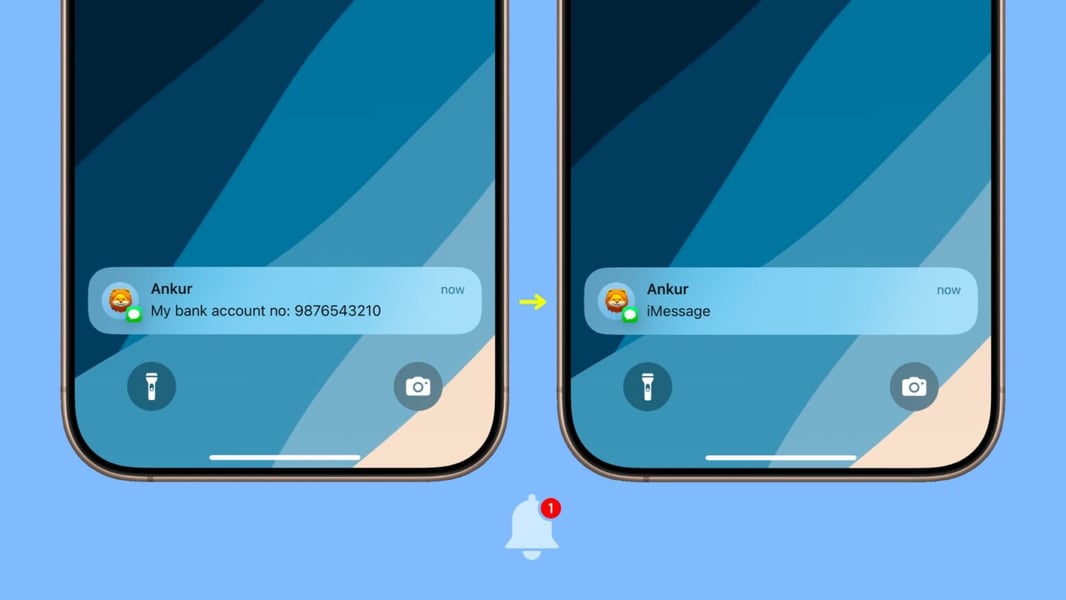
Security analysts say this distinction is critical. Encryption protects messages in transit and within the app, but it does not necessarily extend to how operating systems handle alerts derived from those messages.
A broader privacy dilemma
The revelation underscores a fundamental tension in smartphone design: the balance between usability and security.
Modern operating systems like Apple’s iOS are designed to prioritize speed and convenience. Notifications are cached so they can be displayed instantly, even under varying system conditions. But as recent findings show, cached notification data remained stored locally, sometimes long after the original message had disappeared.
This convenience comes at a cost. By storing notification data locally, devices may inadvertently retain sensitive information beyond the lifecycle of the original message.
The implications extend far beyond Signal. Any messaging app that allows notification previews could theoretically leave similar traces, depending on device settings.
Law enforcement and forensic tools
The FBI’s success in this case also highlights the growing sophistication of forensic tools used by law enforcement. Rather than attempting to crack encryption directly—a task that remains extremely difficult—investigators increasingly focus on peripheral data sources.
These include system logs, backups, cached files, and notification databases, all of which can provide valuable evidence when analyzed with specialized software.
Experts note that such methods typically require physical access to a device and legal authorization. Still, the approach demonstrates that “deleted” does not always mean irretrievable.
What it means for users
For everyday users, the takeaway is both simple and unsettling: digital privacy depends not just on the apps you use, but on how your device is configured.
Disabling lock screen previews, limiting notification content, and regularly reviewing app permissions can significantly reduce the amount of residual data stored on a device.
The case also serves as a reminder that no system is entirely foolproof. Even the most secure communication tools can be undermined by interactions with the broader software ecosystem in which they operate.
A familiar clash between Apple and the FBI
This latest development adds a new chapter to the long-running friction between Apple and U.S. law enforcement over data access and encryption. Instead of forcing access into encrypted systems, authorities are increasingly exploiting the edges of those systems.
For privacy advocates, the concern is clear: if sensitive data can persist in unexpected places, the definition of secure messaging may need to be reconsidered.
For users, the lesson is even clearer. In the digital age, disappearing messages may not disappear at all.