
WASHINGTON – General Atomics, the company that built the electromagnetic catapult system installed on the Navy’s newest aircraft carriers, warned Thursday that reversing course on a system nearly half complete would introduce “significant cost, schedule, and integration risks.” That warning arrived the day after President Trump signed a memorandum ordering the Navy to do exactly that.
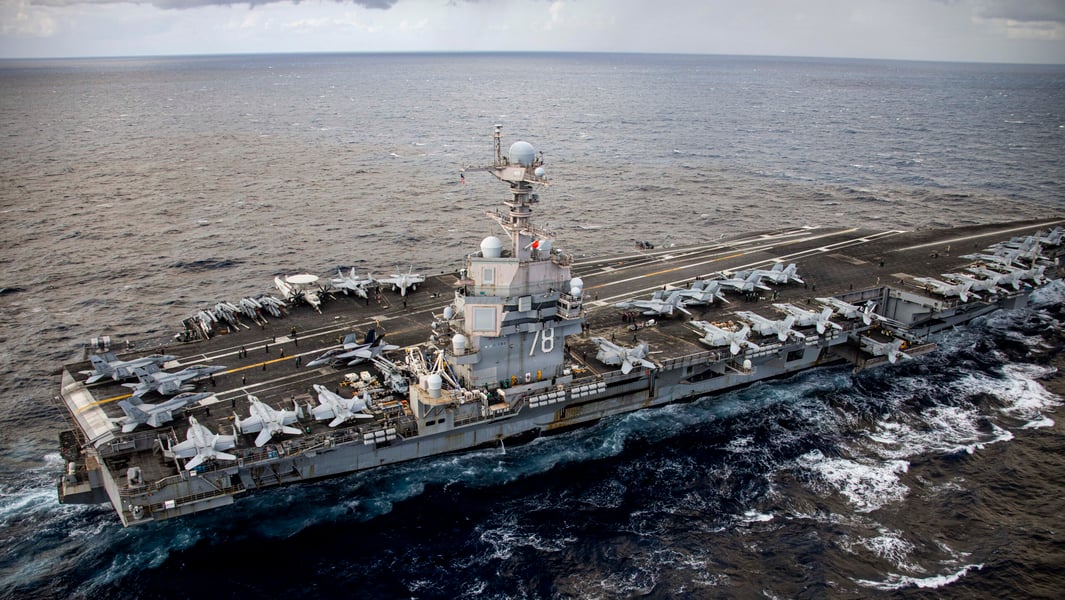
The document, a National Security Presidential Memorandum signed August 13, directs the Pentagon to plan the replacement of the Electromagnetic Aircraft Launch System, known as EMALS, on future Ford-class carriers with traditional steam catapults, technology the Navy has not purchased in more than 20 years. Secretary of Defense Pete Hegseth has 120 days to submit a comprehensive plan. The order specifically targets USS Doris Miller (CVN-81), a carrier currently in production, and extends to the elevators used to move aircraft between the flight deck and the hangar below, directing a return to hydraulic systems from the Advanced Arresting Gear technology fitted to the Ford class.
Trump’s preference for steam catapults predates this second administration by nearly a decade. During his first term, he told reporters that steam systems were simpler to repair and that sailors understood them. He acknowledged at the time that reversing course could cost hundreds of millions of dollars. “It doesn’t matter. We’re going to steam,” he said. That preference is now a formal presidential directive.
The NSPM lands in the middle of a procurement cycle that General Atomics says is already deep into execution. The company told reporters it has completed approximately 50 percent of the EMALS production work contracted for USS Doris Miller. Rebuilding the industrial supply chain for steam catapults, which the Navy last ordered for the Nimitz-class carriers in the early 2000s, would add both cost and time to a program already measured in years and billions. Precisely how much additional cost the reversal would require, and whether General Atomics would be compensated for work already completed, has not been disclosed.
Bryan Clark of the Hudson Institute, a defense research organization that tracks naval procurement, cautioned that the technical challenge of the transition is not trivial. Ford-class hull frames were engineered around EMALS infrastructure, and integrating steam catapult systems would require structural redesign work beyond simply swapping one mechanism for another. Clark told Breaking Defense that both the integration complexity and the production timelines must be factored against the carrier’s current construction schedule.
The EMALS reliability record provides the administration’s clearest argument. When USS Gerald R. Ford entered service in 2017 as the first carrier with the system, its mean cycles between failure rate for EMALS fell far short of contract requirements. The problems delayed the carrier’s deployment, required additional at-sea testing, and generated hundreds of millions in additional costs. Subsequent Ford-class ships have shown improvement, but the early performance record damaged the program’s credibility with Congress and within the administration.
The NSPM addresses more than the catapult question. It directs the establishment of a fifth public shipyard, a facility the Navy has discussed for years without securing the funding or a site. The new yard would handle submarine repair work, which has accumulated significant backlogs across existing shipyards. Russ Vought, the director of the Office of Management and Budget, had advocated for the new yard as a means of reducing repair delays that have kept submarines out of service for extended periods. A dedicated component repair center is also ordered, addressing a specific maintenance bottleneck in the submarine industrial base.
The memo also permits the Navy to award contracts for warships built in allied shipyards under certain conditions. That provision marks a significant departure from longstanding US shipbuilding policy, which has historically restricted naval contracts to domestic yards under statutes designed to protect the American maritime industrial base. The allowance is limited in its initial scope but represents a policy opening that could widen if domestic yards cannot meet production timelines.
This week, Trump also issued drone tariff orders imposing 100 percent duties on Chinese UAS components and cyber privateer authorizations permitting private companies to conduct offensive operations against foreign criminal networks. Thursday’s NSPM completes a third major executive action in a single week, all focused on sectors where the administration argues that the United States is structurally underprepared for the pace of Chinese competition.
China’s navy now surpasses the United States in total vessel count, a shift that has driven calls for dramatic acceleration in American shipbuilding rates. Whether reverting the USS Doris Miller to steam catapults advances or delays that acceleration depends on answers the NSPM does not contain: how quickly Hegseth’s plan will identify a steam catapult supplier capable of restarting production, and whether the industrial base that built these systems two decades ago can be reconstituted in time to keep the carrier on schedule.
What General Atomics has said publicly is that the risks are real and the timing is difficult. What the administration has not yet said is what happens to the approximately 50 percent of EMALS work already completed on the Doris Miller contract. That question will arrive in Hegseth’s 120-day plan, and it will carry a dollar amount that neither the Pentagon nor General Atomics has so far disclosed.