Brain-Controlled Hearing Aid Breakthrough Targets the “Cocktail Party Problem” Using Real-Time EEG Decoding
A new wave of neurotechnology is pushing hearing science into unfamiliar territory, where the boundary between cognition and computation is becoming increasingly indistinct. Researchers have developed a brain-controlled hearing aid system capable of isolating a single human voice in real time, even in acoustically crowded environments.
The work, published in Nature Neuroscience, represents a significant advance in neuro-steered auditory systems, combining electroencephalography (EEG), machine learning, and auditory neuroscience to decode selective attention directly from brain activity.
At its core, the research addresses a problem long regarded as one of neuroscience’s most persistent challenges: the “cocktail party problem,” the brain’s ability to focus on one voice while filtering many.
The system does not simply amplify sound. It attempts to interpret intent.
A long-standing neuroscience problem enters engineering reality
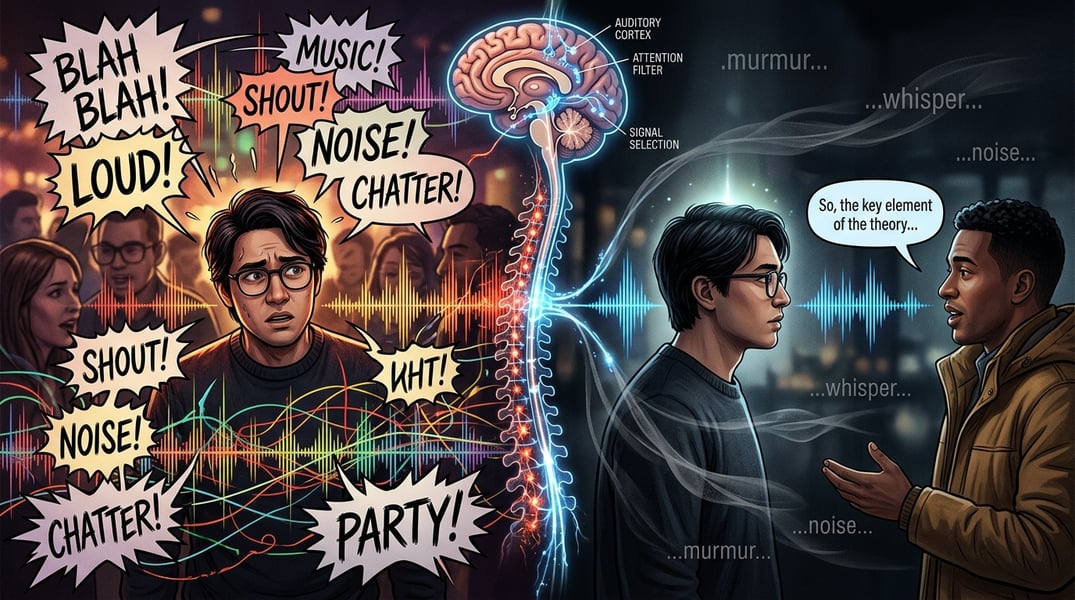
According to research in Scientific American, traditional devices rely on directional microphones and signal enhancement algorithms, which improve clarity but cannot determine which voice a listener is actively attending to.
That gap between acoustic processing and cognitive intention is what this new system attempts to close.
How brain-controlled hearing actually works
In controlled clinical experiments, researchers recorded neural signals using electroencephalography while participants listened to two overlapping speakers.
EEG, a non-invasive method of measuring electrical activity in the brain, is widely used in neuroscience research and is formally documented by the US National Library of Medicine (NIH EEG overview).
Participants were instructed to focus on one speaker while ignoring the other.
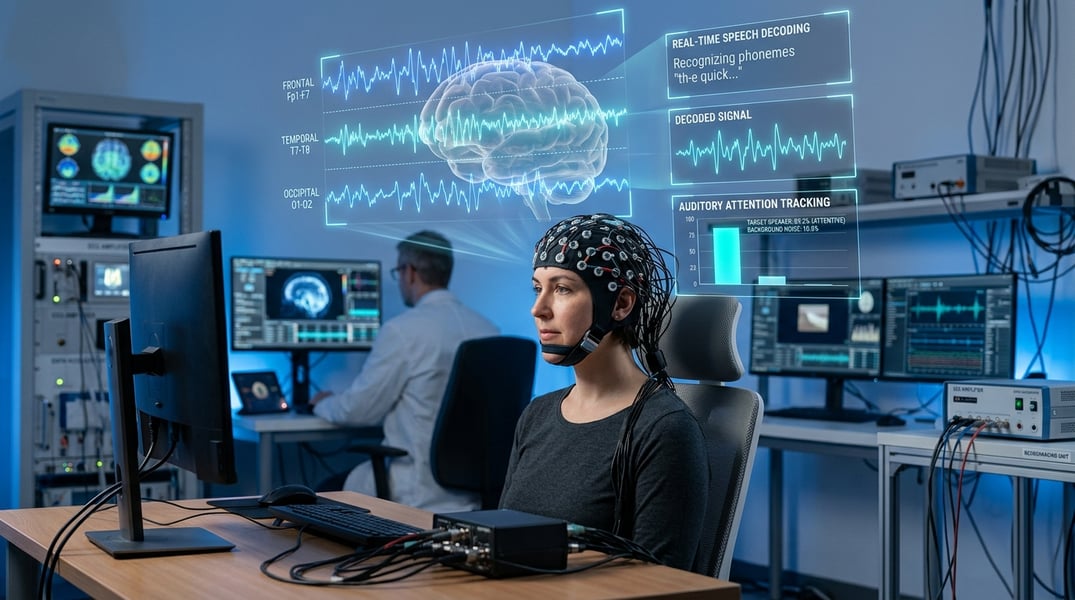
Once identified, the system amplified the attended voice while suppressing competing speech streams.
This creates a feedback loop between neural intention and auditory output, effectively turning attention into a control signal.
From neural signals to adaptive hearing systems
The underlying scientific field, known as auditory attention decoding, has evolved rapidly in the past decade. It is based on the observation that neural responses in the auditory cortex synchronize more strongly with the speech stream a person is actively focusing on.
This phenomenon has been widely studied in auditory attention decoding research, which demonstrated that brain activity can track and reconstruct attended speech in multi-speaker environments.
In parallel, computational neuroscience has shown that machine learning systems can significantly improve decoding accuracy by modeling nonlinear patterns in neural data.
Together, these advances have shifted the field from theoretical neuroscience toward applied neuroengineering.
Why conventional hearing aids fail in complex environments
Modern hearing aids are optimized for relatively simple acoustic environments. They can:
– Amplify speech frequencies
– Reduce steady background noise
– Apply directional filtering
However, they struggle in situations where multiple speakers overlap at similar intensities and distances.
In such scenarios, sound becomes a composite signal that cannot be disentangled using acoustic features alone. The missing variable is cognitive intent.
This is where neuro-steered systems introduce a fundamental shift.
Instead of asking what sound is present, the system asks what the brain is trying to hear.
Neuroscience meets medical engineering
The implications extend beyond assistive hearing technology. The study suggests a broader convergence of neuroscience and medical engineering, where brain signals become active control inputs for external devices.
Within this framework, hearing aids are no longer passive amplifiers but adaptive cognitive interfaces.
This shift is particularly significant for individuals with severe hearing impairment, where conventional devices often fail in social environments.
Global health data from the World Health Organization highlights the scale of hearing loss as a major public health issue, affecting hundreds of millions worldwide.
The role of artificial intelligence in decoding attention
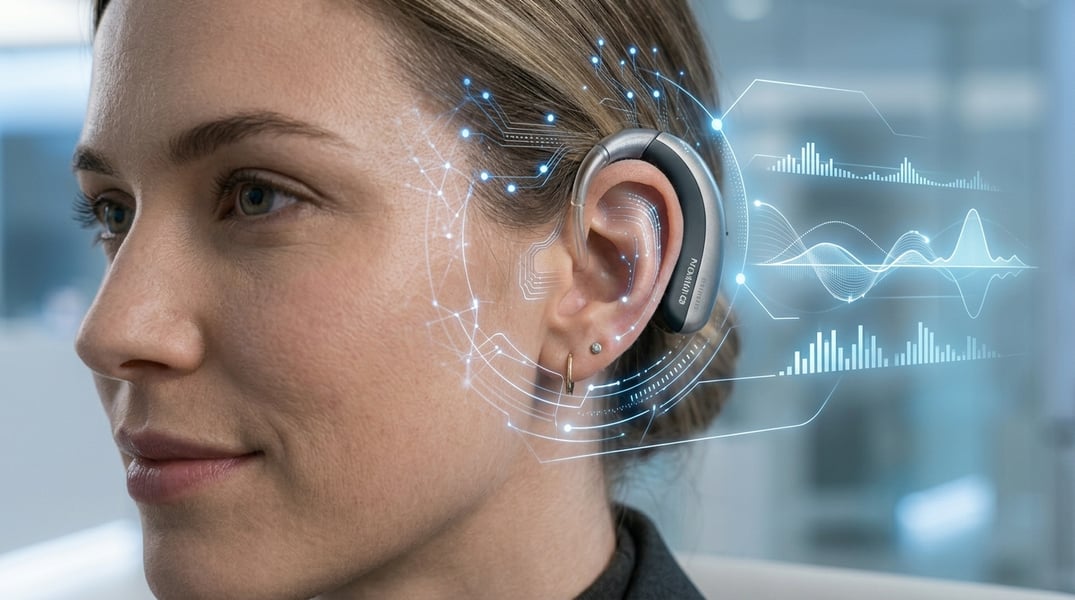
Machine learning plays a central role in translating raw EEG data into usable control signals. Neural signals are inherently noisy, variable across individuals, and sensitive to external interference.
In this system, algorithms are trained to identify statistical patterns that correlate with auditory focus, enabling real-time classification of attention direction.
As described in computational neuroscience literature, these models are capable of learning hierarchical representations of brain activity, improving accuracy as more data is processed.
However, despite progress, real-world deployment remains limited by variability in brain signals and computational constraints.
Internal research context and broader scientific ecosystem
Related interdisciplinary work across neuroscience and sensory systems continues to expand. Studies in sensory mapping and neural signal interpretation, such as those discussed in internal neuroscience coverage (neuroscience literature), highlight how brain decoding is becoming a central theme in modern biological research.
Similarly, advances in computational interpretation methods (neural signals) demonstrate growing convergence between biological sensing and algorithmic modeling.
These developments place auditory decoding within a broader scientific shift toward interpretable brain-computer interfaces.
Limitations and unresolved challenges
Despite its promise, the technology remains in early experimental stages. Key limitations include:
– Requirement for controlled neural recording conditions
– Variability in EEG signal quality across users
– Computational latency in real-time processing
– Limited robustness in uncontrolled environments
At present, most demonstrations rely on clinical or semi-invasive settings. Translating this into wearable consumer devices remains a significant engineering challenge.
However, researchers are actively exploring non-invasive alternatives, including ear-based EEG sensors and lightweight wearable systems.
What comes next
The trajectory of research points toward three converging goals:
– Non-invasive, consumer-grade neural sensing
– Improved generalization of attention decoding models
– Integration of cognitive intent into everyday audio devices
If achieved, hearing technology would transition from acoustic amplification to cognitive augmentation.
In that scenario, hearing aids would no longer simply restore sound. They would interpret attention itself.
The implications extend beyond audiology, potentially reshaping human-machine interaction in ways that remain only partially understood.
For now, the system remains experimental. But the direction is clear: the brain is no longer just a passive receiver of sound. It is becoming part of the signal chain itself.